WengYang Industrial Zone Yueqing Wenzhou 325000
Work Hours
Monday to Friday: 7AM - 7PM
Weekend: 10AM - 5PM
WengYang Industrial Zone Yueqing Wenzhou 325000
Work Hours
Monday to Friday: 7AM - 7PM
Weekend: 10AM - 5PM


If you are not familiar with the selection of different types of RCCBs Type b variants,As engineers at cnkuanya, we are proud to stand at the forefront of electrical safety. The evolution of modern electrical environments, driven by non-linear loads like variable frequency drives (VFDs), photovoltaic (PV) systems, and electric vehicle (EV) chargers, has introduced a new class of electrical fault: the smooth DC residual current. This invisible threat can render traditional residual current devices (RCDs) ineffective, creating significant safety gaps in installations.
This comprehensive guide is written for our professional peers—the engineers, installers, and system designers who build and maintain the electrical infrastructure of our world. Here, we will explore the technical necessity of DC fault protection, explain the superiority of Type B technology, and provide a detailed breakdown of our flagship VKL11B series, a complete portfolio designed to ensure absolute safety in any application.

At its core, a standard RCD (Type AC or Type A) operates on a simple, elegant principle: it uses a differential current transformer to measure the balance of current between the line and neutral conductors. In a healthy circuit, these currents are equal and opposite, summing to zero. A fault to earth causes an imbalance, which induces a current in the transformer’s sense coil and trips the device.
However, Type AC RCDs are designed only for sinusoidal AC currents, while Type A RCDs add protection for pulsating DC currents. Neither is designed to detect smooth DC residual currents. This is a critical vulnerability. Power conversion electronics, common in modern systems, can produce smooth DC leakage that saturates the magnetic core of a Type A RCD. This phenomenon, known as “blinding,” effectively turns the safety device into a useless piece of plastic, unaware of any subsequent AC or pulsating DC faults.
This is where Type B RCCBs become essential. Compliant with the rigorous IEC 62423 standard, Type B devices incorporate advanced electronics and secondary sensing mechanisms specifically designed to detect the full spectrum of fault currents: pure sinusoidal AC, pulsating DC, high-frequency AC, and, most importantly, smooth DC.
At cnkuanya, our design philosophy is inspired by the uncompromising quality and reliability of world-leading German manufacturers like Doepke. We believe that safety devices must be prepared for the worst-case scenario. The VKL11B series is the result of this philosophy—a range of Type B RCCBs that provide robust, reliable protection without compromise, ensuring that your circuits are protected against all foreseeable residual current faults.
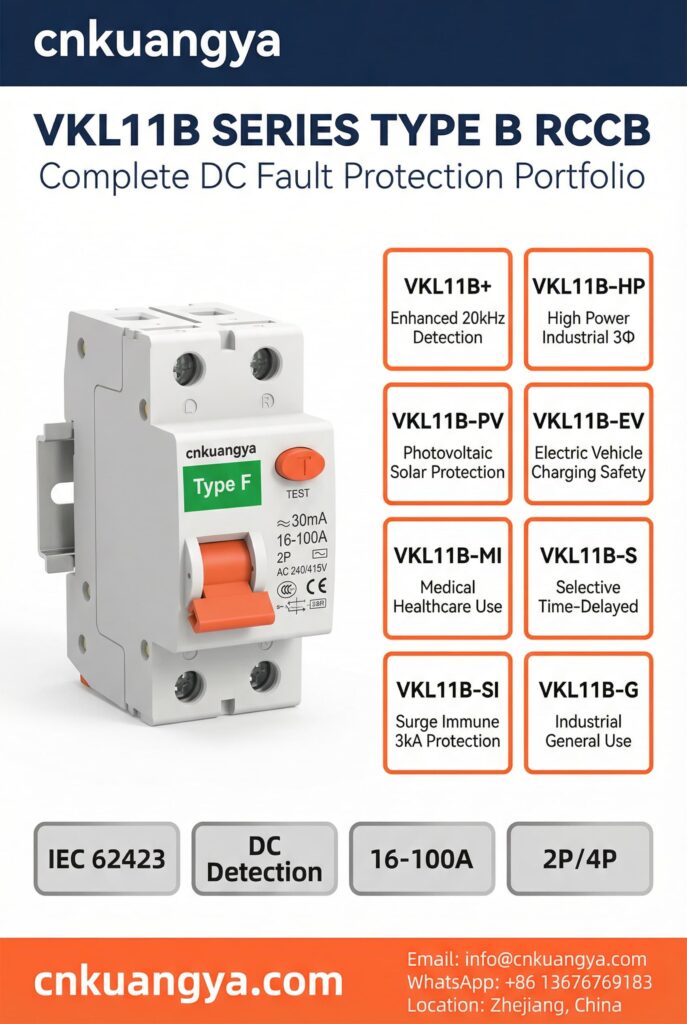
The VRL22BVKL11B series is not a single product, but a complete family of solutions tailored for specific, demanding applications. Each variant shares the same core Type B technology but is optimized to address unique challenges.
The VKL11B+ enhanced type B RCD represents the next step in all-current sensitivity. While standard Type B RCCBs are tested up to 1kHz, the B+ variant extends its certified detection range for high-frequency leakage currents up to 20kHz, with tripping values defined below 420mA. This makes it the ideal future-proof solution for environments with a high density of cutting-edge electronics, ensuring protection against not only today’s fault currents but tomorrow’s as well.
Industrial environments are dominated by powerful machinery, much of which relies on three-phase VFDs and converters. The VKL11B HP high power application variant is engineered for this exact purpose. It provides reliable Type B protection for high-power motors, pumps, HVAC systems, and manufacturing equipment, where the potential for large DC and high-frequency leakage currents is significant. Its robust construction ensures stability and performance under demanding industrial conditions.
The green energy revolution is powered by solar technology, but it comes with unique electrical safety challenges. Transformerless PV inverters are a common source of smooth DC leakage currents. The VKL11B PV solar system RCCB is specifically designed to provide essential protection for these systems. It ensures that a fault on the DC side of a solar installation does not compromise the safety of the entire AC system, safeguarding both personnel and equipment.
The rapid growth of electric mobility requires a corresponding evolution in safety infrastructure. The VKL11B EV electric vehicle charging protection is a critical component for any residential or commercial EV charging station. An EV charger is a direct bridge between the AC mains and a large DC battery pack. In the event of an insulation failure, significant smooth DC current can leak into the protective earth. The VKL11B-EV guarantees disconnection under these conditions, preventing the upstream blinding of other RCDs and ensuring the highest level of safety for users. Per IEC 60364-7-722, any AC charging point must be protected by a Type B RCD or a Type A RCD in conjunction with a device that ensures disconnection on DC faults exceeding 6mA. The VKL11B-EV is the all-in-one, compliant solution.
In medical settings, equipment reliability is a matter of life and death. Devices such as MRI machines, CT scanners, and X-ray equipment utilize sophisticated power electronics that can generate complex leakage currents. The VKL11B MI medical isolation RCD is designed for these sensitive applications. It provides high-immunity Type B protection that prevents nuisance tripping from operational leakage while guaranteeing disconnection in the event of a genuine, hazardous fault.
In complex, tiered electrical distribution systems, fault discrimination is essential. A fault in a final circuit should not cause a trip in the main distribution board, leading to a widespread outage. The VKL11B-S is a “Selective” or time-delayed Type B RCCB. It is designed to be installed upstream of other instantaneous RCDs. Its intentional time delay ensures that the RCD closest to the fault trips first, isolating the problem locally and maintaining power to the rest of the installation.
Environments with heavy switching loads or high lightning exposure are prone to transient voltage surges. These surges can cause nuisance tripping in standard RCDs, leading to unnecessary downtime. The VKL11B SI surge immune RCCB is constructed with a higher immunity to transient currents (up to 3kA 8/20µs). It is designed to differentiate between a dangerous residual current and a harmless transient surge, making it the perfect choice for installations where continuity of service is paramount.
The VKL11B-G is a variant that features a short time-delay, often referred to as a “G-Type” (General use, time-delayed). It is designed to be more robust than an instantaneous RCD but faster than a fully selective S-Type. This characteristic provides a degree of immunity against transient surges without sacrificing protection speed entirely, making VKL11B G industrial grounding protection a balanced choice for many industrial and commercial applications where equipment may have higher inrush or operational leakage currents.
Choosing the correct RCCB is a critical design decision. The following tables and guide are designed to simplify this process.
| RCD Type | Sinusoidal AC | Pulsating DC | Smooth DC | High-Frequency AC |
|---|---|---|---|---|
| Type AC | ✅ | ❌ | ❌ | ❌ |
| Type A | ✅ | ✅ | ❌ | ❌ |
| Type B | ✅ | ✅ | ✅ | ✅ (up to 1kHz) |
| Type B+ | ✅ | ✅ | ✅ | ✅ (up to 20kHz) |
| Variant | Primary Application | Key Feature |
|---|---|---|
| VKL11B+ | Future-proof commercial/data centers | Extended frequency detection (20kHz) |
| VKL11B-HP | High-power industrial machinery | Optimized for three-phase VFDs |
| VKL11B-PV | Solar PV installations | Protects against inverter DC faults |
| VKL11B-EV | EV charging stations | Prevents RCD blinding from DC leakage |
| VKL11B-MI | Medical imaging equipment | High immunity for critical systems |
| VKL11B-S | Main distribution boards | Time-delayed for selectivity |
| VKL11B-SI | Environments with transient surges | High surge immunity (3kA) |
| VKL11B-G | General industrial circuits | Short time-delay for robustness |
| Variant | Primary Application | Key Feature |
|---|---|---|
| VKL11B+ | Future-proof commercial/data centers | Extended frequency detection (20kHz) |
| VKL11B-HP | High-power industrial machinery | Optimized for three-phase VFDs |
| VKL11B-PV | Solar PV installations | Protects against inverter DC faults |
| VKL11B-EV | EV charging stations | Prevents RCD blinding from DC leakage |
| VKL11B-MI | Medical imaging equipment | High immunity for critical systems |
| VKL11B-S | Main distribution boards | Time-delayed for selectivity |
| VKL11B-SI | Environments with transient surges | High surge immunity (3kA) |
| VKL11B-G | General industrial circuits | Short time-delay for robustness |
Follow these questions to find the right model for your project:
Correct installation is just as critical as correct product selection.
The shift towards a more complex, electronically driven world demands a parallel shift in our approach to electrical safety. Type A and AC RCDs, while still useful in simpler circuits, are no longer sufficient for installations containing modern power conversion technology. The potential for blinding by smooth DC currents constitutes a clear and present danger that can only be mitigated by correctly specified residual current protection.
The cnkuanya VKL11B series offers a complete, technically superior portfolio of Type B RCCBs. From the specialized protection required for an EV charger to the robust selectivity needed in a large industrial plant, our products provide the highest level of safety and reliability. By understanding the technology, selecting the appropriate variant, and following installation best practices, you can design and build electrical systems that are not only compliant but truly safe.
For detailed specifications or consultation on your next project, we invite you to consult with cnkuanya’s engineering experts.