WengYang Industrial Zone Yueqing Wenzhou 325000
Work Hours
Monday to Friday: 7AM - 7PM
Weekend: 10AM - 5PM
WengYang Industrial Zone Yueqing Wenzhou 325000
Work Hours
Monday to Friday: 7AM - 7PM
Weekend: 10AM - 5PM

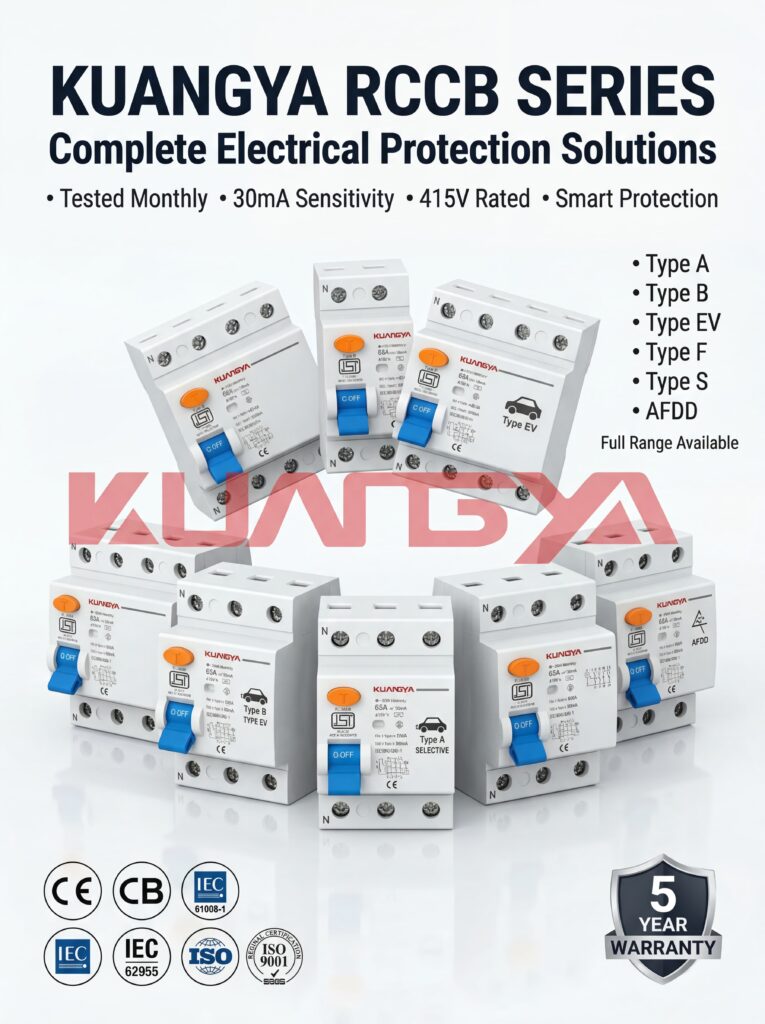
Quick answer: The most useful RCCB trend for electrical designers is application-specific residual-current selection. A circuit with a charger, inverter or variable-speed drive may create fault-current waveforms that a basic Type AC device is not designed to detect. Choose the RCD type from the equipment instructions and local installation rules, then verify current rating, residual operating current, poles, short-circuit coordination and upstream selectivity.
Electronic loads have made residual-current waveform analysis more important. An RCCB detects a difference between currents in the live conductors and disconnects when its specified residual-current conditions are met. It does not provide overload or short-circuit protection by itself. A designer must therefore coordinate it with a suitable fuse or circuit breaker, or specify an RCBO where combined functions are needed.
The practical question is not which RCD type is newest. It is which residual-current waveforms the connected equipment can produce, and which protective arrangement its manufacturer and the applicable wiring rules require.
IEC 62423 specifies additional requirements and tests for Type F and Type B RCDs. It describes Type B protection for smooth DC residual currents; it does not define Type B as detecting smooth DC only “up to 6 mA.” The 6 mA figure is commonly encountered in EV-charging DC residual-current detection and must not be confused with the general capability or rated residual operating current of every Type B RCCB. Our Type B RCCB guide explains the selection questions in more detail.
An EV charging circuit can require protection against DC residual current. A Type B RCD is one possible arrangement. Depending on the charging equipment and applicable rules, another arrangement may use a suitable upstream Type A or F RCD together with a 6 mA residual direct-current detecting device (RDC-DD). IEC 62955:2018 addresses RDC-DDs for permanently connected AC mode 3 charging stations; it is not a general product standard for a supposed universal “Type EV RCCB.”
Read the exact charger installation manual. Confirm whether DC detection is built in, what external RCD it requires, and whether an upstream RCD could be exposed to a smooth DC current. Avoid choosing a device from a marketing label alone.
PV inverters and variable-speed drives contain power electronics, but their residual-current behavior and protective requirements vary by design. Do not assume every PV system needs Type B, or that Type F is suitable for every drive. Check the equipment manual for the required RCD type, permissible sensitivity and any integrated residual-current monitoring. Also review the earthing system and where the RCD sits relative to other devices.
Where a downstream circuit can pass smooth DC residual current, evaluate any upstream RCD for possible loss of sensitivity. A change to one final circuit can affect protection elsewhere in the installation.
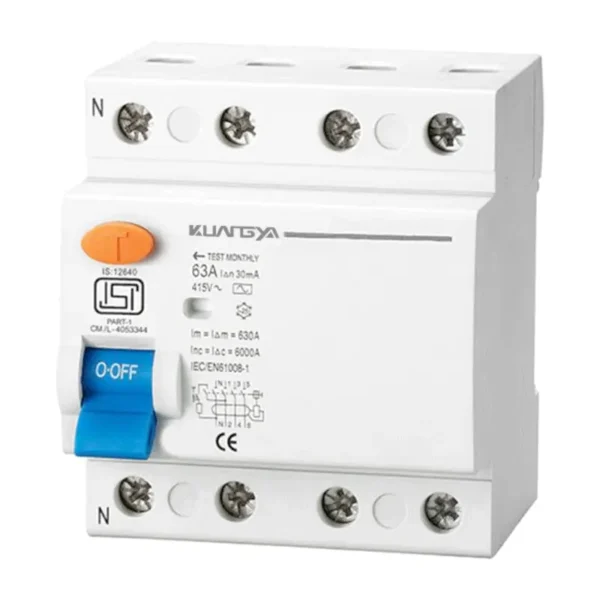
For a product example, KUANGYA’s VFL002 RCCB page lists AC, A and ASi options. That page does not make the VFL002 a Type B device. Request the current datasheet and approval documents for the exact variant before specifying it.
No. A standalone RCCB provides residual-current protection. It needs appropriate overload and short-circuit protection elsewhere in the circuit. An RCBO combines residual-current and overcurrent functions.
No universal rule follows from the equipment category alone. The answer depends on the equipment design, its built-in DC detection, the installation and the applicable local rules. Use the exact manufacturer’s instructions.
No. Remote monitoring may help maintenance teams see alarms or trends, but it does not by itself establish the protective performance of an RCCB. Follow the manufacturer’s test instructions and the applicable inspection requirements.
RCCB selection is becoming more specific to the connected load. Start with the residual-current waveform and equipment manual, then verify the full protective arrangement. Clear, model-specific documentation is more useful than unsupported market forecasts or claims that one RCCB type is suitable for every installation.

