WengYang Industrial Zone Yueqing Wenzhou 325000
Work Hours
Monday to Friday: 7AM - 7PM
Weekend: 10AM - 5PM
WengYang Industrial Zone Yueqing Wenzhou 325000
Work Hours
Monday to Friday: 7AM - 7PM
Weekend: 10AM - 5PM

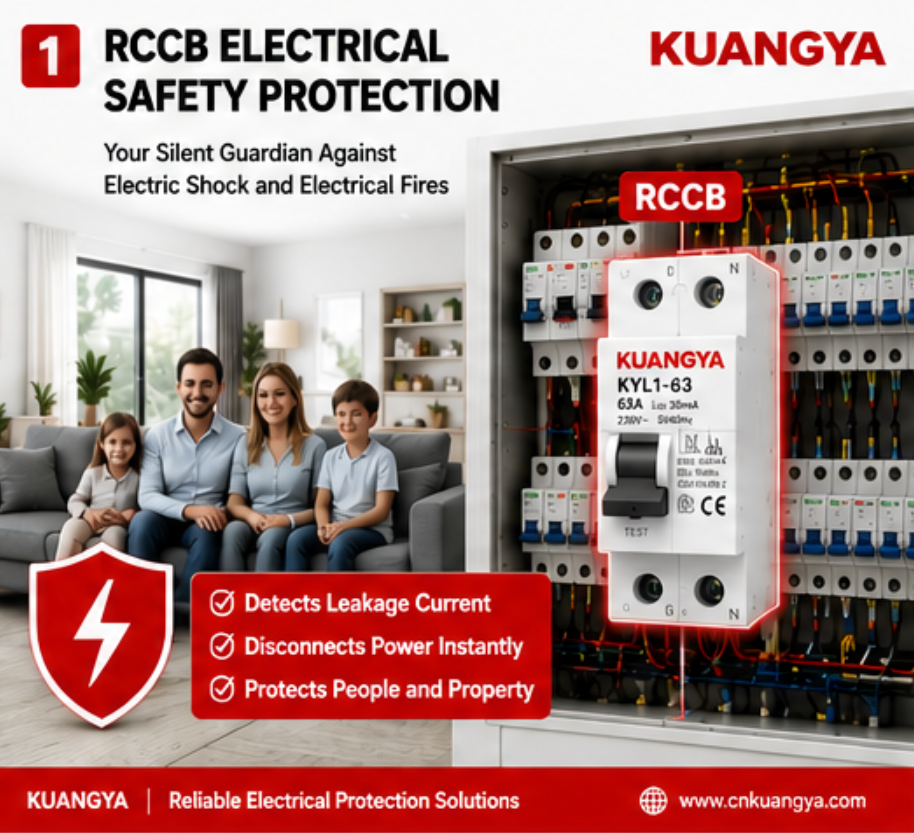
RCCB – DC Circuit Breaker Manufacturer | Solar Protection Device Supplier – Kuangya
Electrical accidents remain one of the leading causes of residential and industrial fires worldwide. Every year, thousands of injuries and property losses occur because of electrical leakage that goes undetected.
This is where an RCCB becomes one of the most important protective devices in any electrical installation.
An RCCB is designed to detect leakage current and disconnect power before serious harm occurs. Unlike ordinary circuit breakers, it focuses specifically on protecting human lives from electric shock and reducing fire risks caused by insulation failures.
According to the International Electrotechnical Commission (IEC), residual current protection has become a critical requirement in modern electrical systems.
For more electrical safety information, visit:
RCCB stands for Residual Current Circuit Breaker.
The primary purpose of an RCCB is to monitor the balance between the phase conductor and the neutral conductor.
Under normal operating conditions, the current flowing through the live wire should equal the current returning through the neutral wire.
If an imbalance occurs, the RCCB detects leakage current and trips immediately.
This action helps prevent:
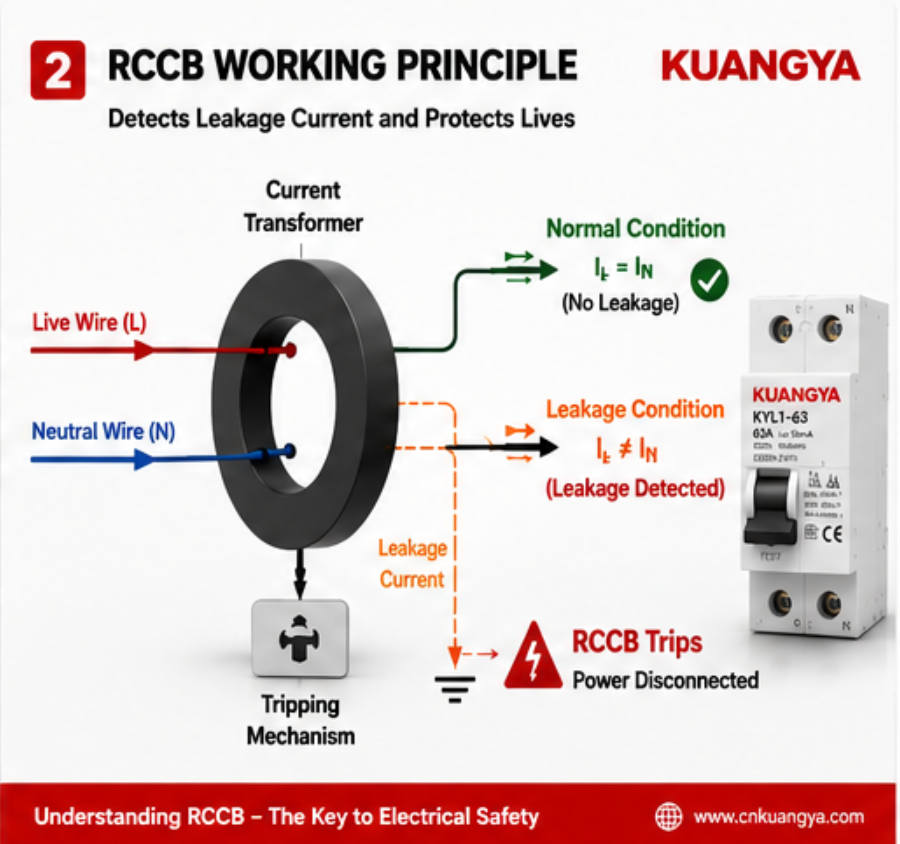
Inside every RCCB is a sensitive current transformer.
The transformer continuously compares incoming and outgoing current.
When the difference exceeds the preset trip value, the device disconnects the circuit.
The operating principle can be summarized as follows:
| Condition | Incoming Current | Returning Current | RCCB Action |
|---|---|---|---|
| Normal Operation | Equal | Equal | No Trip |
| Leakage Current | Different | Different | Trip |
| Human Contact | Different | Different | Trip |
| Insulation Failure | Different | Different | Trip |
Imagine a washing machine with damaged insulation.
The metal body becomes energized due to leakage current.
When a person touches the machine, electricity may flow through the body.
Without an RCCB, severe electric shock could occur.
With an RCCB installed, power is disconnected within milliseconds.
This rapid response significantly reduces injury risk.
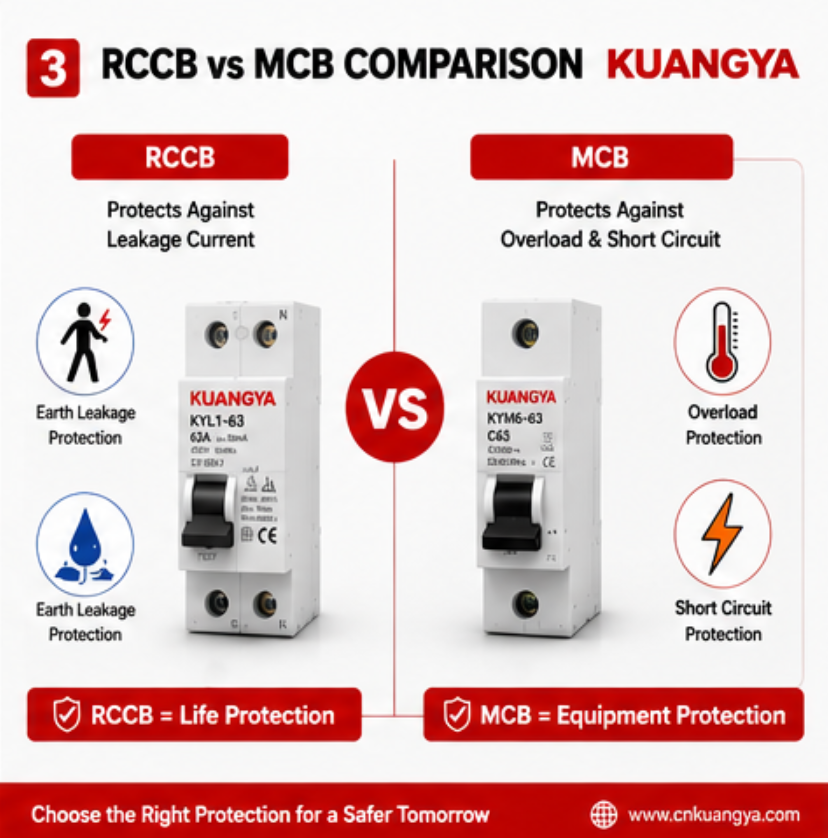
Many homeowners confuse RCCB devices with MCB devices.
Although both are protective devices, their functions are completely different.
| Feature | RCCB | MCB |
|---|---|---|
| Protects Against Leakage | Yes | No |
| Protects Against Overload | No | Yes |
| Protects Against Short Circuit | No | Yes |
| Protects Human Life | Yes | Limited |
| Detects Earth Faults | Yes | No |
The ideal electrical installation uses both devices together.
You can learn more about circuit protection solutions through https://www.cnkuangya.com/.
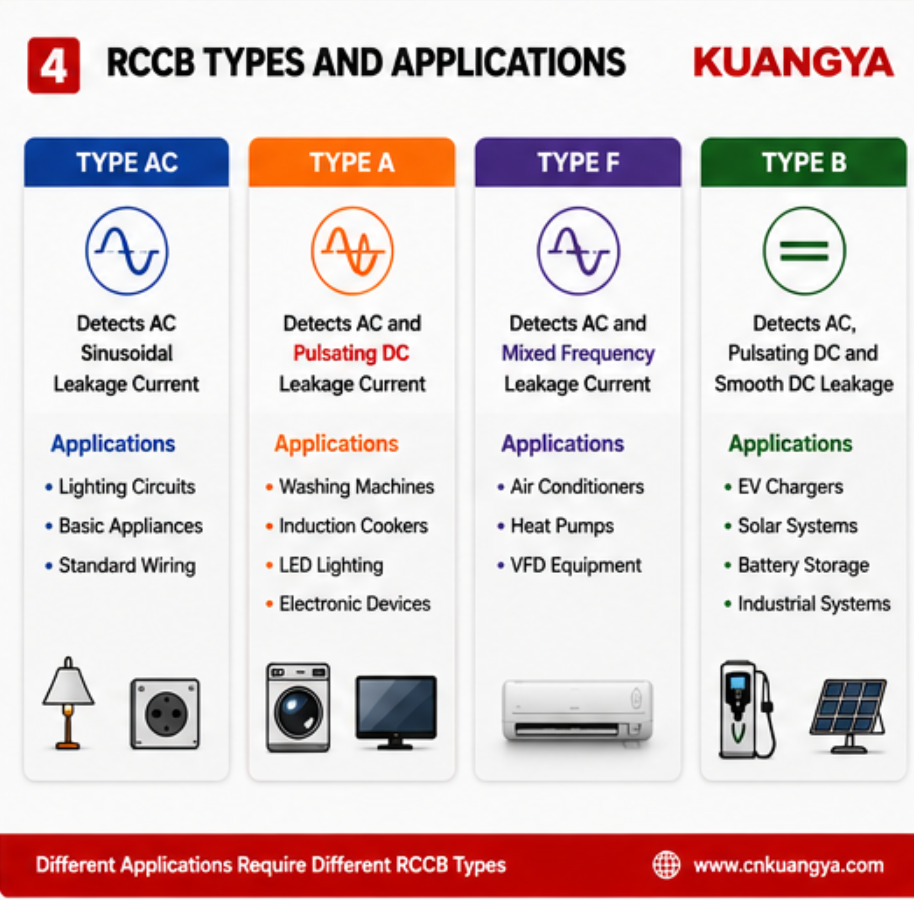

Type AC RCCB devices detect alternating sinusoidal residual currents.
These are commonly used in traditional electrical installations.
Typical applications include:
Type A RCCB devices detect:
These are recommended for modern electronic equipment.
Applications include:
Type F RCCB devices provide enhanced protection for variable-speed equipment.
Common applications include:
Type B RCCB devices detect:
These are essential for advanced electrical systems.
Applications include:
Choosing the correct RCCB rating is critical.
The rating determines how sensitive the device will be.
| RCCB Sensitivity | Application |
|---|---|
| 10mA | High-risk areas |
| 30mA | Personal protection |
| 100mA | Fire protection |
| 300mA | Industrial installations |
| 500mA | Large facilities |
For residential protection, 30mA RCCB devices are generally recommended.
According to IEC standards, 30mA provides effective protection against fatal electric shock.
The RCCB should normally be installed:
Correct installation ensures maximum protection.
Always follow manufacturer instructions.
General wiring steps include:
Improper wiring may prevent the RCCB from functioning correctly.
For professional installation guidance, consult:
The most important benefit is human protection.
An RCCB can detect leakage currents that may otherwise remain unnoticed.
This significantly reduces electrocution risks.
Electrical leakage often generates heat.
Over time, this heat can ignite nearby materials.
An RCCB interrupts power before ignition occurs.
By detecting faults early, an RCCB helps identify wiring problems before they become expensive failures.
This reduces maintenance costs and downtime.
| Industry | RCCB Usage |
|---|---|
| Residential | Personal protection |
| Commercial Buildings | Fire prevention |
| Manufacturing | Equipment safety |
| Renewable Energy | Leakage protection |
| EV Charging | DC leakage monitoring |
| Data Centers | Critical infrastructure protection |
Possible causes include:
Testing each circuit individually usually identifies the source.
Common reasons include:
A qualified electrician should perform insulation resistance testing.
Choosing the correct RCCB is essential for ensuring maximum protection and compliance with electrical safety standards.
A poorly selected RCCB may cause nuisance tripping or fail to provide adequate protection.
Several factors should be considered before purchasing an RCCB.
| Application | Recommended RCCB Type | Sensitivity |
|---|---|---|
| Residential Homes | Type A | 30mA |
| Apartments | Type A | 30mA |
| Office Buildings | Type A | 30mA |
| Factories | Type A / Type B | 100mA |
| EV Charging Stations | Type B | 30mA |
| Solar Systems | Type B | 30mA |
| Battery Storage Systems | Type B | 30mA |
| Data Centers | Type A / Type B | 100mA |
| RCCB Current Rating | Typical Application |
|---|---|
| 25A | Small Residential Loads |
| 40A | Apartments |
| 63A | Houses |
| 80A | Commercial Buildings |
| 100A | Industrial Applications |
| 125A | Heavy Industrial Loads |
Selecting a rating lower than the actual load current may result in overheating and nuisance tripping.
Modern electrical codes increasingly require RCCB protection.
Several international organizations promote residual current protection.
Useful references include:
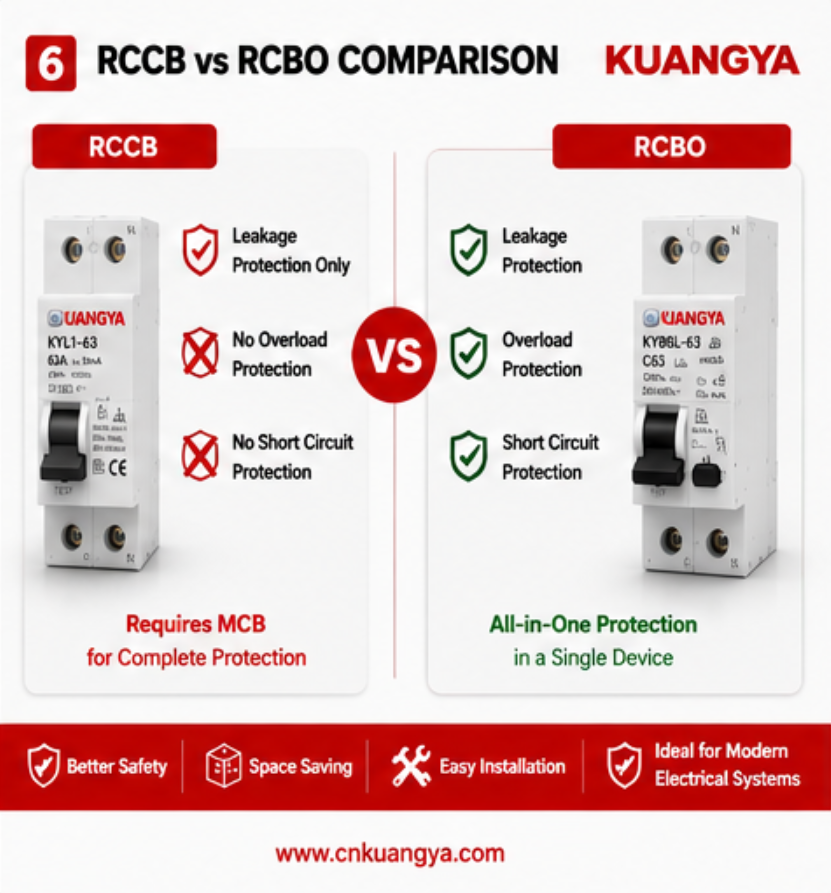
This is one of the most searched electrical safety questions on Google.
Many users struggle to understand the difference.
An RCCB only detects leakage current.
It cannot provide overload protection.
It cannot provide short-circuit protection.
Therefore, it must be used together with an MCB.
An RCBO combines:
into a single device.
| Feature | RCCB | RCBO |
|---|---|---|
| Leakage Protection | Yes | Yes |
| Overload Protection | No | Yes |
| Short Circuit Protection | No | Yes |
| Space Saving | Medium | High |
| Cost | Lower | Higher |
| Residential Use | Common | Increasingly Popular |
| Industrial Use | Common | Common |
Many users install an RCCB and never test it again.
This is a common mistake.
Like all safety devices, an RCCB requires periodic verification.
If the device does not trip, replacement may be necessary.
| Inspection Item | Frequency |
|---|---|
| Test Button Operation | Monthly |
| Terminal Tightness | Annually |
| Visual Inspection | Quarterly |
| Thermal Inspection | Annually |
| Load Verification | Annually |
Preventive maintenance greatly improves reliability.
Possible causes include:
Disconnect all downstream circuits and reconnect one at a time.
Potential causes:
Solutions:
Yes, transient currents may create temporary imbalance.
Not always. Additional inspection is necessary.
Yes, large insects can bridge conductive parts.
Not directly; some arc faults may indirectly cause tripping.
Nighttime humidity increases surface leakage.
Yes. Type B RCCB devices are recommended.
Negligible power consumption.
Yes. Mechanical wear and aging components affect performance.
No. Very sensitive devices may cause nuisance tripping.
Technically yes, but multiple RCCB zones are preferred.
RCCB is a critical electrical safety device. Proper selection, installation, and maintenance ensure protection against electric shock and electrical fires.
Visit https://www.cnkuangya.com/ for professional support and products.

