WengYang Industrial Zone Yueqing Wenzhou 325000
Work Hours
Monday to Friday: 7AM - 7PM
Weekend: 10AM - 5PM
WengYang Industrial Zone Yueqing Wenzhou 325000
Work Hours
Monday to Friday: 7AM - 7PM
Weekend: 10AM - 5PM

Why RCBO for Industrial Panel is the Ultimate Safety Standard for Modern Manufacturing
In the rapidly evolving landscape of 2026, the complexity of factory automation demands a more sophisticated approach to electrical safety. A standard circuit breaker is no longer enough. Implementing a high-performance RCBO for industrial panel systems is now the baseline for preventing both equipment downtime and electrical hazards.
RCBO (Residual Current Breaker with Overcurrent) | Safe & Reliable Kuangya
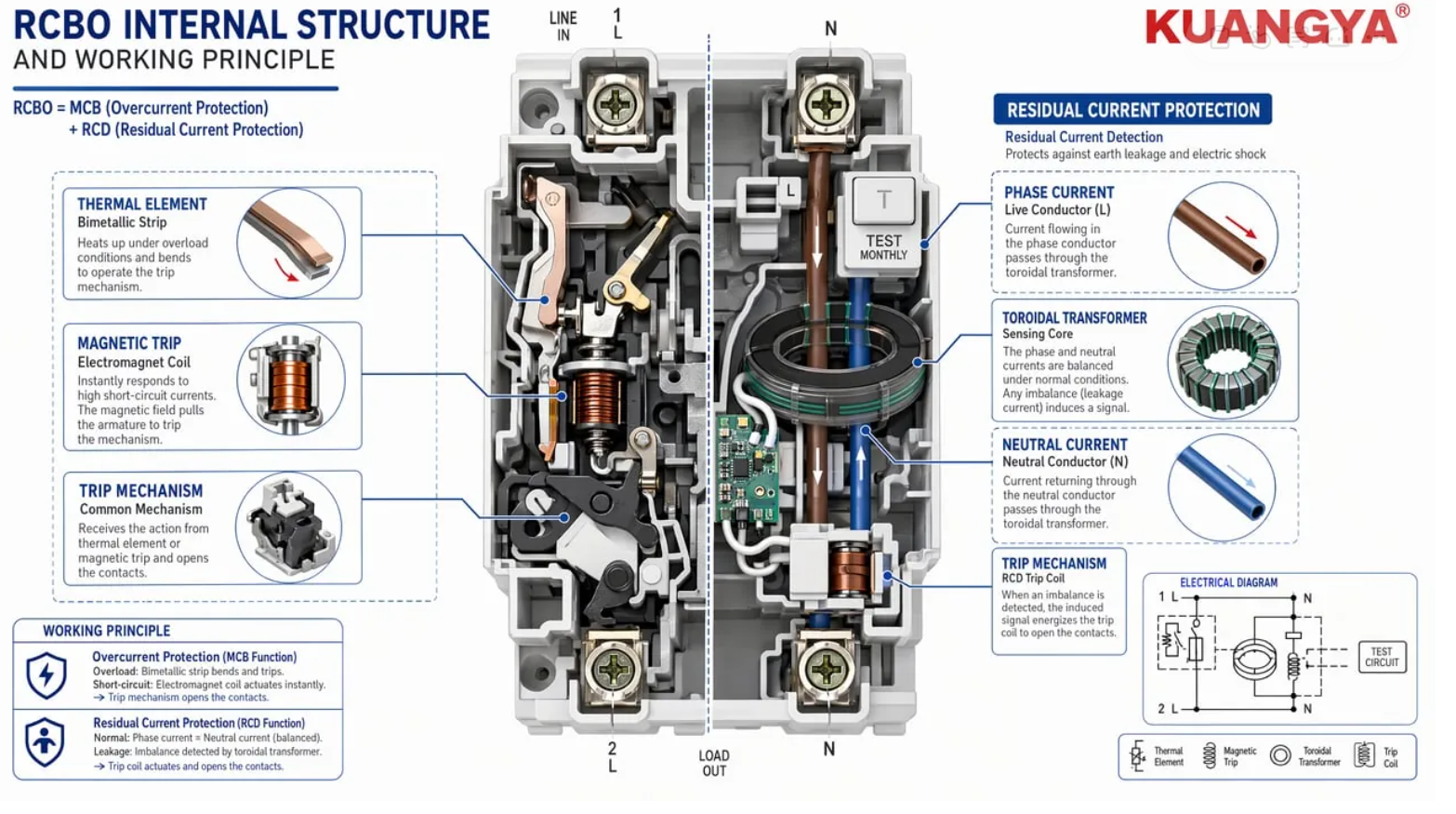
At its core, an RCBO represents an elegant engineering solution to a persistent challenge in electrical protection: how to safeguard circuits against fundamentally different types of faults without cluttering distribution panels with multiple discrete devices. Traditional protection schemes require separate Miniature Circuit Breakers (MCBs) for overcurrent protection and Residual Current Devices (RCDs) for ground fault detection. The RCBO integrates both functions into a single unit that occupies minimal DIN rail space while delivering comprehensive protection. citation
The overcurrent protection component functions identically to a standalone MCB, employing both thermal and magnetic trip mechanisms. The thermal element responds to sustained overload conditions—such as when machinery draws excessive current due to mechanical binding or degraded insulation—by heating a bimetallic strip that eventually triggers disconnection. The magnetic element provides instantaneous protection against short circuits, using an electromagnet that trips immediately when fault current exceeds a predetermined threshold, typically 3 to 20 times the rated current depending on the characteristic curve.
Simultaneously, the residual current protection monitors the balance between phase and neutral currents using a toroidal transformer. In a healthy circuit, these currents are equal; any imbalance indicates current leaking to ground through an unintended path—whether through damaged insulation, moisture ingress, or human contact. When this residual current exceeds the device’s sensitivity threshold (commonly 30mA for personnel protection or 100-300mA for equipment protection in industrial settings), the RCBO disconnects the circuit within milliseconds, preventing electric shock, equipment damage, and potential fire ignition. citation
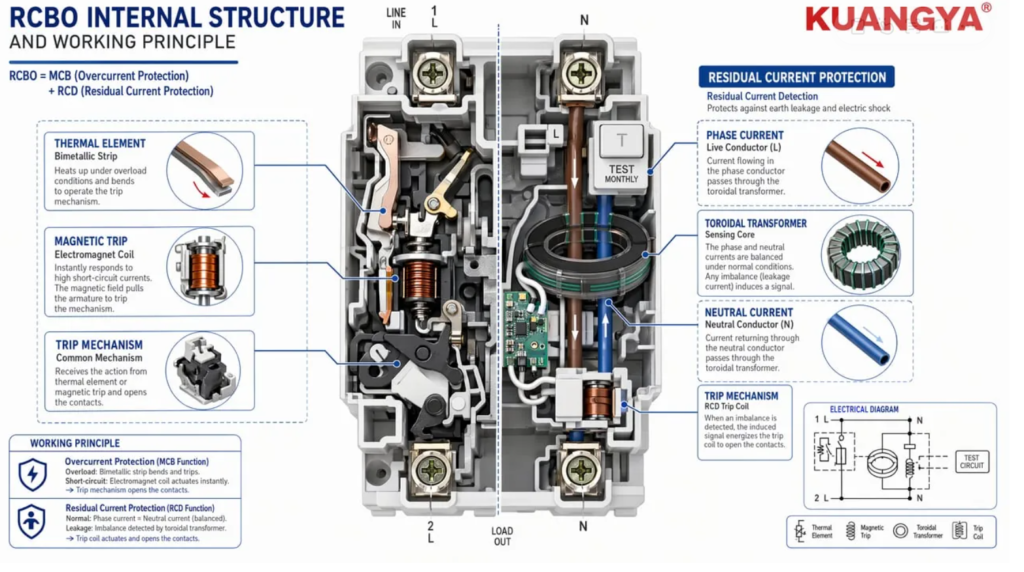
Figure 1: RCBO internal structure showing dual protection mechanisms – thermal-magnetic overcurrent protection (left) and residual current detection via toroidal transformer (right)
While the compact footprint of RCBOs offers obvious advantages in panel design—a single-module RCBO replacing what would otherwise require separate MCB and RCD units—the benefits for industrial applications extend far deeper into operational and safety considerations.
Enhanced Fault Discrimination and Reduced Downtime
In manufacturing environments, nuisance tripping represents more than an inconvenience; it translates to production stoppages, scrap material, equipment damage from abrupt shutdowns, and labor costs for investigation and reset. RCBOs installed on individual circuits provide superior fault discrimination compared to group RCD protection schemes. When a ground fault occurs on a specific machine or circuit, only that RCBO trips, leaving the remainder of the facility operational. This circuit-level selectivity is particularly valuable in continuous process industries where maintaining production on unaffected lines during fault investigation can save thousands of dollars per hour. citation
Comprehensive Personnel Protection in Hazardous Environments
Industrial facilities present unique electrical hazards: portable tools used in damp conditions, machinery with extensive metalwork providing conductive paths, maintenance personnel working on energized equipment, and outdoor installations exposed to weather. RCBOs with 30mA sensitivity provide the rapid disconnection required by IEC 60364-4-42 for circuits supplying portable equipment or installations in locations with increased shock risk. The combination of residual current and overcurrent protection ensures that both ground faults and equipment failures trigger protective action, creating redundant safety layers that are particularly valuable where human operators interact directly with electrical equipment. citation
Equipment Preservation and Fire Prevention
Ground faults in industrial machinery often begin as small leakage currents that gradually worsen as insulation degrades. Without residual current protection, these developing faults can persist undetected until they escalate into catastrophic failures—motor burnout, control system damage, or electrical fires. RCBOs detect these incipient faults at the earliest stage, disconnecting the circuit before damage occurs. For expensive CNC machines, robotic systems, and automated production lines, this early intervention can prevent repair costs that dwarf the investment in proper circuit protection. The fire prevention aspect is equally critical in facilities handling combustible materials, where electrical faults represent a primary ignition source. citation
RCBOs for industrial applications must comply with IEC 61009, the international standard governing residual current operated circuit-breakers with integral overcurrent protection. This standard, which harmonizes with European norm EN 61009 and references foundational requirements from IEC 60755, establishes rigorous performance criteria that ensure devices from different manufacturers provide consistent, reliable protection. citation
Key Rating Parameters
When specifying RCBOs for industrial panels, several critical parameters must be matched to the application:
Rated Current (In): Industrial RCBOs are available in ratings from 6A to 125A, with common industrial ratings including 16A for control circuits and portable equipment, 25A for moderate machinery loads, 32A for high-power equipment, and 40-63A for distribution circuits feeding multiple loads. The rated current must exceed the circuit’s maximum continuous operating current while remaining compatible with upstream protection for proper coordination. citation
Breaking Capacity (Icn): This parameter defines the maximum fault current the RCBO can safely interrupt. Industrial installations typically require breaking capacities of 6kA minimum, with 10kA preferred for facilities near utility transformers or with substantial on-site generation. Undersizing breaking capacity represents a serious safety hazard, as the device may fail violently when attempting to clear a fault current exceeding its rating.
Residual Current Sensitivity (IΔn): Industrial applications commonly employ 30mA for circuits supplying portable equipment or personnel-accessible outlets, 100mA for fixed machinery where nuisance tripping from motor starting currents or capacitive leakage must be avoided, and 300mA for distribution circuits where fire protection rather than shock protection is the primary concern. The selection involves balancing safety requirements against operational continuity.
Type Classification: IEC 61009 defines several RCBO types based on their response to different residual current waveforms. Type AC devices respond to sinusoidal alternating current, suitable for resistive loads. Type A devices additionally detect pulsating DC components, essential for circuits supplying variable frequency drives, rectifiers, and electronic equipment that can produce DC fault currents. Type B devices provide the broadest protection, responding to smooth DC and higher-frequency components, required for photovoltaic systems, EV charging equipment, and sophisticated industrial electronics. citation
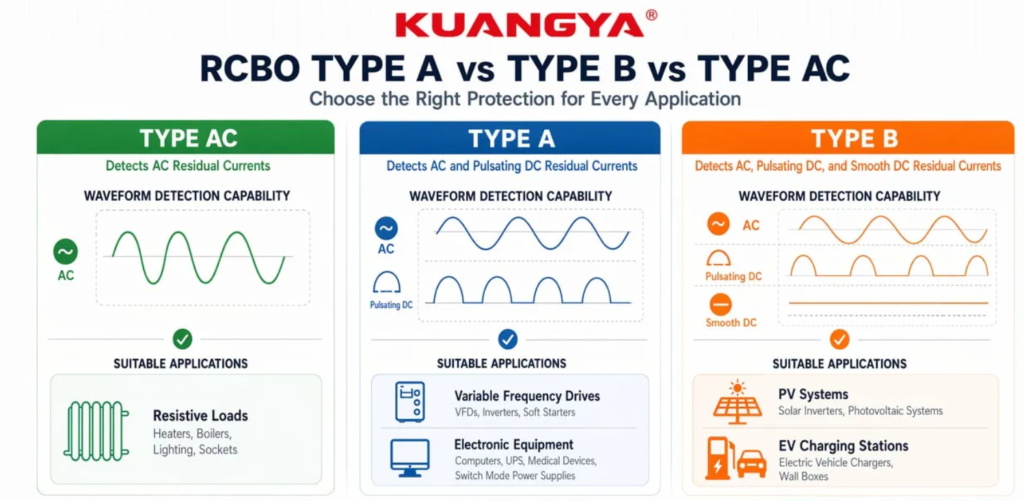
Figure 2: Comparison of RCBO Type AC, Type A, and Type B protection capabilities and suitable applications
When selecting the right RCBO for industrial panel applications, engineers must consider the specific leakage current characteristics of modern variable speed drives. Our latest RCBO for industrial panel series is designed to filter out nuisance tripping while providing instantaneous protection against earth faults. By integrating this RCBO for industrial panel solution, manufacturing facilities can achieve a 40% reduction in unexpected maintenance costs related to electrical failures.
Table 1: RCBO Type Classification and Applications
| Type | Detectable Waveforms | Typical Applications | Recommended For |
|---|---|---|---|
| Type AC | Sinusoidal AC only | Resistive loads, heating elements, incandescent lighting | Legacy installations with purely resistive loads |
| Type A | AC + Pulsating DC | VFDs, rectifiers, single-phase electronics, washing machines, HVAC systems | Modern industrial facilities (minimum standard) |
| Type B | AC + Pulsating DC + Smooth DC + High-frequency | PV systems, EV chargers, three-phase VFDs, medical equipment, data centers, UPS systems | Advanced industrial automation, renewable energy installations |
Characteristic Curves and Coordination
RCBOs employ the same characteristic curves as MCBs—B, C, and D types—defining their magnetic trip threshold. Industrial applications predominantly use C-curve devices (5-10 × In magnetic trip) for general machinery and D-curve devices (10-20 × In) for motors and transformers with high inrush currents. Proper curve selection prevents nuisance tripping during normal starting transients while ensuring reliable fault clearing.
Table 2: RCBO Key Rating Parameters for Industrial Applications
| Parameter | Symbol | Typical Industrial Range | Selection Criteria |
|---|---|---|---|
| Rated Current | In | 6A – 125A | Must exceed circuit maximum continuous current by 125% for motor loads |
| Breaking Capacity | Icn | 6kA – 10kA | 6kA minimum; 10kA for installations near transformers or with on-site generation |
| Residual Current Sensitivity | IΔn | 30mA, 100mA, 300mA | 30mA for personnel protection; 100-300mA for equipment/fire protection |
| Response Time | – | ≤300ms @ IΔn | Faster response enhances safety; verify compliance with IEC 61009 |
| Operating Temperature | – | -25°C to +60°C | Industrial-grade devices offer wider range than residential (−5°C to +40°C) |
| Characteristic Curve | – | B, C, D | C-curve for general loads; D-curve for motors with high inrush currents |
Manufacturing Machinery and Production Lines
Individual machine protection represents perhaps the most compelling RCBO application in industrial settings. CNC machines, injection molding equipment, packaging lines, and conveyor systems all benefit from dedicated RCBO protection that isolates faults without affecting adjacent equipment. The 16A and 25A ratings handle typical machinery control circuits and moderate motor loads, while the residual current protection guards against the insulation failures common in equipment subjected to vibration, contamination, and thermal cycling. citation
Portable Equipment and Temporary Installations
Industrial facilities routinely employ portable tools, welding equipment, temporary lighting, and mobile machinery. These applications present elevated shock risk due to equipment mobility, exposure to physical damage, and use in varied environmental conditions. RCBOs with 30mA sensitivity on circuits supplying portable equipment sockets provide the rapid disconnection required by electrical codes, while the overcurrent protection guards against tool failures and cable damage.
Outdoor and Wet Location Circuits
Exterior lighting, outdoor machinery, wash-down areas, and equipment in humid environments require enhanced protection against moisture-related faults. RCBOs rated for these applications combine appropriate IP ratings with sensitive residual current detection to address the elevated leakage currents and ground fault risks inherent in wet locations.
“One of the standout features of our RCBO for industrial panel is its dual-function design. Unlike traditional setups, this RCBO for industrial panel combines short-circuit protection and residual current sensing into a single, space-saving module, making it the ideal RCBO for industrial panel for crowded control cabinets.”
Critical Control Circuits
While production machinery can often tolerate brief interruptions for fault clearing, control systems, PLCs, and instrumentation circuits require both reliable protection and minimal nuisance tripping. RCBOs with carefully selected sensitivity thresholds (often 100mA) and Type A or B characteristics provide protection without the false trips that plague overly sensitive devices in electrically noisy industrial environments.
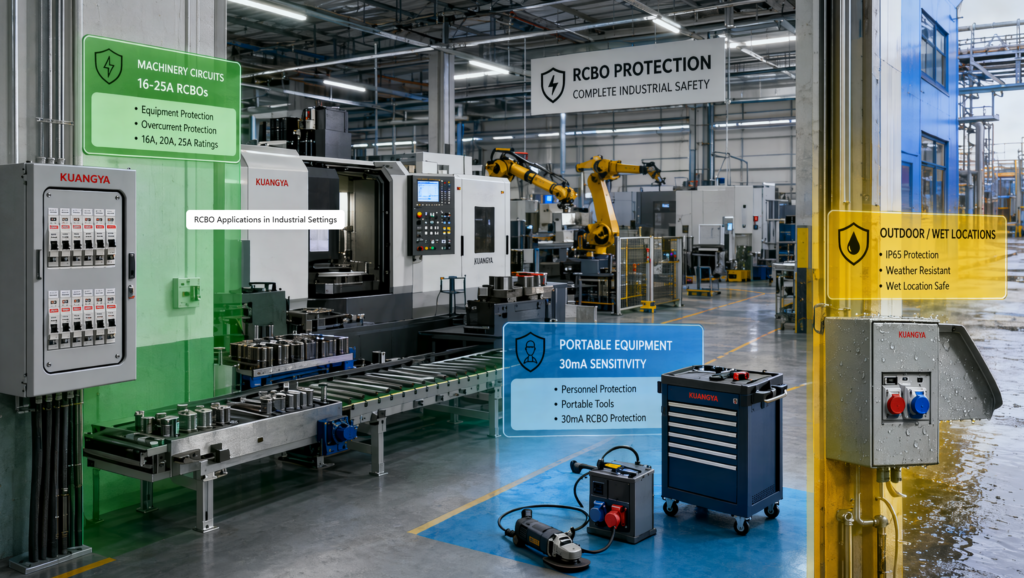
Figure 3: Industrial facility showing different RCBO protection zones – machinery circuits (green), portable equipment (blue), and outdoor/wet locations (yellow)
Table 3: RCBO Selection Guide by Industrial Application
| Application Type | Rated Current | Sensitivity (IΔn) | RCBO Type | Characteristic Curve | Key Considerations |
|---|---|---|---|---|---|
| CNC Machines | 16-32A | 100mA | Type A/B | C | Vibration resistance, thermal cycling tolerance |
| Portable Tools | 16-20A | 30mA | Type A | C | Personnel protection priority, frequent connection/disconnection |
| Motor Circuits | 25-63A | 100-300mA | Type A | D | High inrush current tolerance, nuisance trip prevention |
| Outdoor Equipment | 16-32A | 30-100mA | Type A | C | Enhanced IP rating, moisture/humidity resistance |
| Control Panels/PLCs | 6-16A | 100mA | Type B | C | Minimal nuisance tripping, high-frequency noise immunity |
| Welding Equipment | 32-63A | 100-300mA | Type A | D | High starting current, arc fault tolerance |
| Distribution Circuits | 40-125A | 300mA | Type A/B | C | Fire protection focus, coordination with downstream devices |
Specifying RCBOs for industrial panels requires systematic analysis of circuit characteristics, load requirements, environmental conditions, and regulatory obligations.
Load Analysis and Current Rating
Begin with accurate load calculation, accounting for continuous operating current, starting transients, and future expansion. The RCBO’s rated current should exceed the circuit’s maximum continuous load by an appropriate margin (typically 125% for motor circuits) while coordinating with upstream protection. Verify that the breaking capacity exceeds the maximum prospective fault current at the installation point, calculated from transformer impedance and circuit length.
Residual Current Sensitivity and Type Selection
Match sensitivity to the protection objective: 30mA for personnel protection on portable equipment circuits, 100-300mA for fixed machinery where equipment protection and fire prevention are primary concerns. Select Type A as the minimum for modern industrial facilities with electronic loads, upgrading to Type B where variable frequency drives, DC systems, or renewable energy equipment are present. citation
Environmental and Mechanical Considerations
Industrial panels may experience elevated ambient temperatures, vibration, dust, and humidity. Verify that selected RCBOs carry appropriate temperature ratings (many industrial-grade devices operate reliably from -25°C to +60°C), mechanical shock resistance, and pollution degree ratings for the installation environment. DIN rail mounting compatibility and terminal capacity for the required conductor sizes are practical considerations that affect installation quality.
Standards Compliance and Certification
Ensure devices carry IEC 61009-1 certification and any jurisdiction-specific approvals required (CE marking for European installations, CCC for China, UL listing for North American facilities). Documentation should include test certificates, coordination tables for selectivity with upstream devices, and characteristic curves for engineering analysis. citation
Proper RCBO installation extends beyond mechanical mounting to encompass circuit design, testing, and maintenance protocols that ensure long-term reliability.
“Whether it’s an automotive assembly line or a chemical processing plant, the deployment of a robust RCBO for industrial panel ensures continuous uptime. By isolating faults at the individual circuit level, the RCBO for industrial panel prevents localized issues from causing a total system blackout.”
Panel Layout and Thermal Management
Mount RCBOs on standard 35mm DIN rail with adequate spacing for heat dissipation—devices loaded near their rated current generate significant heat that can affect adjacent equipment and reduce service life. Group high-current devices together and provide panel ventilation where ambient temperatures approach device ratings. Maintain clear labeling identifying each RCBO’s protected circuit, rated current, and sensitivity for maintenance personnel.
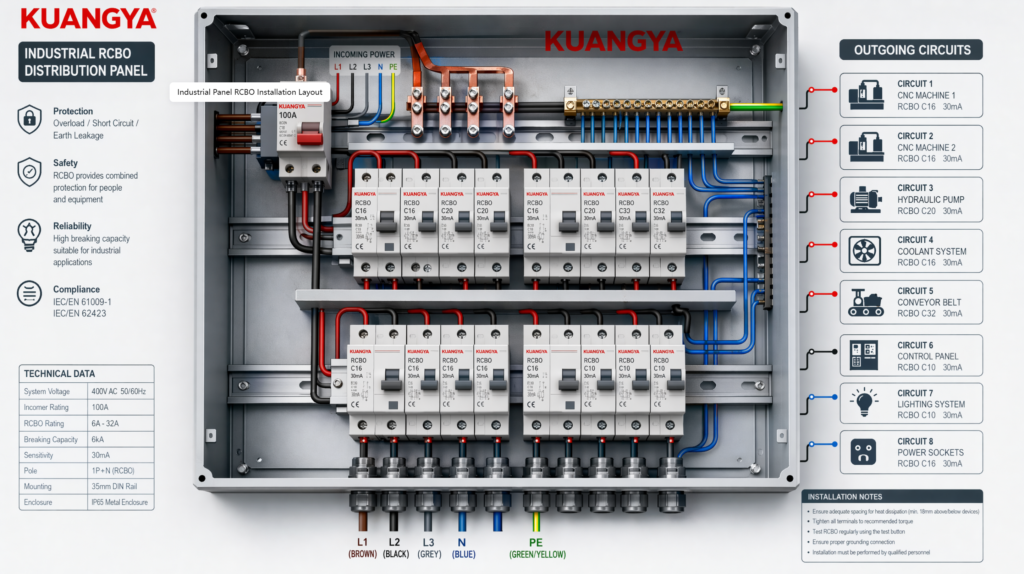
Figure 4: Professional industrial panel layout showing proper RCBO mounting on DIN rail with adequate spacing, clear labeling, and organized wiring
Wiring and Termination
Use conductors sized for the circuit’s continuous current and terminate connections with appropriate torque—loose terminals create resistance, heat, and eventual failure. Observe polarity requirements strictly; RCBOs must be installed with line voltage on designated terminals and load connections on the appropriate side. For three-phase installations, verify phase sequence and neutral connections according to manufacturer specifications.
Testing and Commissioning
Before energizing circuits, verify RCBO mechanical operation using the integral test button, which simulates a residual current fault. This confirms the trip mechanism functions correctly but does not validate the overcurrent protection or actual residual current sensitivity. Comprehensive commissioning should include insulation resistance testing of downstream circuits, verification of breaking capacity adequacy through fault level calculations, and functional testing under representative load conditions. Document baseline measurements for future comparison during maintenance inspections.
Maintenance and Lifecycle Management
Establish a routine testing schedule—quarterly or semi-annually for critical circuits—using the test button to verify trip function. Investigate any RCBO that trips repeatedly, as this indicates a developing fault requiring correction rather than a defective protective device. Monitor for signs of overheating, physical damage, or loose connections during routine inspections. Plan for eventual replacement; while quality RCBOs provide decades of service under normal conditions, devices subjected to frequent fault clearing or harsh environments may require earlier replacement.
Table 4: RCBO Maintenance Schedule and Inspection Checklist
| Maintenance Activity | Frequency | Critical Circuits | Standard Circuits | Harsh Environments |
|---|---|---|---|---|
| Test Button Verification | Routine | Quarterly | Semi-annually | Monthly |
| Visual Inspection | Routine | Monthly | Quarterly | Monthly |
| Thermal Imaging | Preventive | Annually | Every 2 years | Annually |
| Connection Torque Check | Preventive | Annually | Every 2 years | Annually |
| Insulation Resistance Test | Diagnostic | As needed | As needed | Annually |
| Trip Time Verification | Commissioning | Initial + after fault | Initial only | Initial + annually |
| Documentation Update | Continuous | After each test | After each test | After each test |
Inspection Checklist Items:
In industrial electrical systems, RCBOs represent more than components in a distribution panel—they embody a strategic approach to risk management that balances safety, operational continuity, and economic efficiency. The initial cost premium over basic MCB protection is recovered through reduced downtime, prevented equipment damage, enhanced personnel safety, and simplified panel design. For facilities designing new installations or upgrading aging infrastructure, the comprehensive protection offered by properly specified and installed RCBOs delivers measurable value that extends throughout the system’s operational life.
As industrial equipment becomes increasingly sophisticated and electrical codes evolve toward more stringent protection requirements, the RCBO’s combination of overcurrent and residual current protection in a single, space-efficient package positions it as the protection device of choice for modern manufacturing facilities. The engineering challenge lies not in whether to employ RCBOs, but in selecting the appropriate specifications, installing them correctly, and maintaining them properly to realize their full protective potential.
For electrical contractors, panel builders, and facility engineers, mastering RCBO technology—understanding the standards, selecting appropriate ratings, and implementing best practices—represents an essential competency in delivering electrical systems that protect people, preserve equipment, and support the uninterrupted operation that modern industry demands.
“Ultimately, choosing a certified RCBO for industrial panel is an investment in long-term operational reliability. If you are upgrading your facility, ensure your specifications prioritize a high-breaking capacity RCBO for industrial panel to meet modern safety codes.”
RCBO (Residual Current Breaker with Overcurrent) | Safe & Reliable Kuangya
Q1: What is the main difference between an RCBO and using separate MCB and RCD devices?
An RCBO combines both overcurrent protection (MCB function) and residual current protection (RCD function) in a single compact device. While separate MCB and RCD units can provide the same protection, RCBOs offer several advantages: they occupy less space in the distribution panel (typically one module width instead of two or more), simplify wiring and installation, provide circuit-level protection for better fault discrimination, and reduce the overall component count in the panel. For industrial applications, this integration means easier maintenance, clearer fault identification, and more efficient use of panel real estate.
Q2: How do I choose between 30mA, 100mA, and 300mA residual current sensitivity for industrial circuits?
The sensitivity selection depends on the protection objective and circuit characteristics. Use 30mA sensitivity for circuits supplying portable equipment, hand-held tools, or any application where personnel may come into direct contact with electrical equipment—this provides rapid protection against electric shock as required by IEC 60364-4-42. Select 100mA for fixed machinery and equipment circuits where some leakage current is normal (from motor windings, long cable runs, or electronic components) but you still need protection against developing ground faults. Choose 300mA for distribution circuits and applications where fire prevention is the primary concern rather than direct shock protection. Higher sensitivity settings help prevent nuisance tripping in circuits with inherent capacitive leakage while still detecting dangerous fault conditions.
Q3: When should I specify Type A versus Type B RCBOs for industrial applications?
Type A RCBOs are the minimum requirement for modern industrial facilities with electronic equipment. They detect both AC residual currents and pulsating DC currents, making them suitable for circuits supplying variable frequency drives (VFDs), rectifiers, single-phase electronic loads, and most standard industrial equipment. Upgrade to Type B RCBOs when the installation includes equipment that can produce smooth DC fault currents or high-frequency leakage: photovoltaic systems, EV charging stations, three-phase VFDs, medical equipment, data centers, or sophisticated industrial automation systems. Type B devices cost more but provide comprehensive protection across all residual current waveforms. If you’re unsure about the load characteristics, Type B provides future-proof protection as industrial equipment becomes increasingly electronic.
Q4: Can RCBOs cause nuisance tripping in industrial environments with electrical noise?
RCBOs can experience nuisance tripping if improperly specified, but this is typically a selection issue rather than a device limitation. To minimize false trips: ensure the residual current sensitivity matches the circuit’s normal leakage characteristics (use 100mA or 300mA rather than 30mA for circuits with inherent leakage), select the appropriate Type classification (Type A or B for electronic loads), verify that the breaking capacity and characteristic curve match the application (C-curve for general loads, D-curve for motors), and ensure proper installation with correct polarity and good terminations. If nuisance tripping occurs, investigate the root cause—it often indicates a developing ground fault, excessive leakage from aging insulation, or moisture ingress that requires correction. Repeatedly resetting a tripping RCBO without investigation can allow a dangerous condition to worsen.
Q5: What breaking capacity should I specify for industrial RCBOs?
The breaking capacity (Icn) must exceed the maximum prospective fault current at the installation point. For most industrial facilities, specify a minimum of 6kA breaking capacity, which handles typical distribution panel applications. Increase to 10kA for installations near utility transformers, facilities with large on-site generation, or main distribution panels where fault currents are highest. To determine the required breaking capacity, calculate the maximum fault current based on transformer impedance, cable length and size, and upstream protection characteristics. Undersizing breaking capacity is a serious safety hazard—the RCBO may fail catastrophically when attempting to interrupt a fault current exceeding its rating, potentially causing fire or equipment damage. When in doubt, specify the higher rating; the cost difference is minimal compared to the safety margin gained.
Q6: How often should RCBOs be tested in industrial installations?
Establish a routine testing schedule based on circuit criticality and operating environment. For critical production circuits, test quarterly using the integral test button to verify the trip mechanism functions correctly. For standard circuits in normal environments, semi-annual testing is typically adequate. For circuits in harsh environments (high humidity, temperature extremes, vibration, contamination), increase testing frequency to monthly or quarterly. Document all test results and investigate any RCBO that fails to trip when the test button is pressed—this indicates a mechanical failure requiring immediate replacement. The test button only verifies the residual current trip mechanism; comprehensive commissioning should include insulation resistance testing, fault level verification, and functional testing under load. Beyond routine testing, inspect RCBOs during scheduled maintenance for signs of overheating, physical damage, loose connections, or discoloration that might indicate problems.
Q7: Can I use residential-grade RCBOs in industrial panels?
While residential and industrial RCBOs share the same basic protection principles, industrial applications typically require devices with higher specifications. Industrial-grade RCBOs offer higher breaking capacities (10kA vs. 6kA), broader operating temperature ranges (-25°C to +60°C vs. -5°C to +40°C), enhanced mechanical durability for vibration and shock, higher pollution degree ratings for contaminated environments, and more robust construction for frequent switching operations. Additionally, industrial RCBOs are available in higher current ratings (up to 125A) and offer more Type B options for electronic loads. Using residential-grade devices in industrial settings may result in premature failure, inadequate fault clearing capability, or protection that doesn’t meet industrial electrical codes. Always specify devices rated for the actual operating environment and verify they carry appropriate industrial certifications.
Q8: What documentation should I require when purchasing RCBOs for industrial projects?
Comprehensive documentation is essential for proper specification, installation, and long-term maintenance. Require: IEC 61009-1 certification and test reports confirming compliance with international standards; jurisdiction-specific approvals (CE marking, CCC, UL listing) as required by local codes; complete technical specifications including rated current, breaking capacity, residual current sensitivity, Type classification, characteristic curve, and operating temperature range; coordination tables showing selectivity with upstream and downstream protective devices; characteristic curves for engineering analysis and fault studies; installation instructions with wiring diagrams, torque specifications, and mounting requirements; and warranty information. This documentation enables proper device selection, supports electrical design calculations, facilitates inspector approval, and provides maintenance personnel with the information needed for troubleshooting and replacement. Reputable manufacturers provide comprehensive technical documentation; inadequate documentation may indicate substandard products that don’t meet claimed specifications.
RCBO (Residual Current Breaker with Overcurrent) | Safe & Reliable Kuangya

