WengYang Industrial Zone Yueqing Wenzhou 325000
Work Hours
Monday to Friday: 7AM - 7PM
Weekend: 10AM - 5PM
WengYang Industrial Zone Yueqing Wenzhou 325000
Work Hours
Monday to Friday: 7AM - 7PM
Weekend: 10AM - 5PM

A PV string fuse keeps blowing? Check reverse current, string damage, fuse DC rating and holder temperature before replacing it. A safe diagnostic sequence for solar arrays.
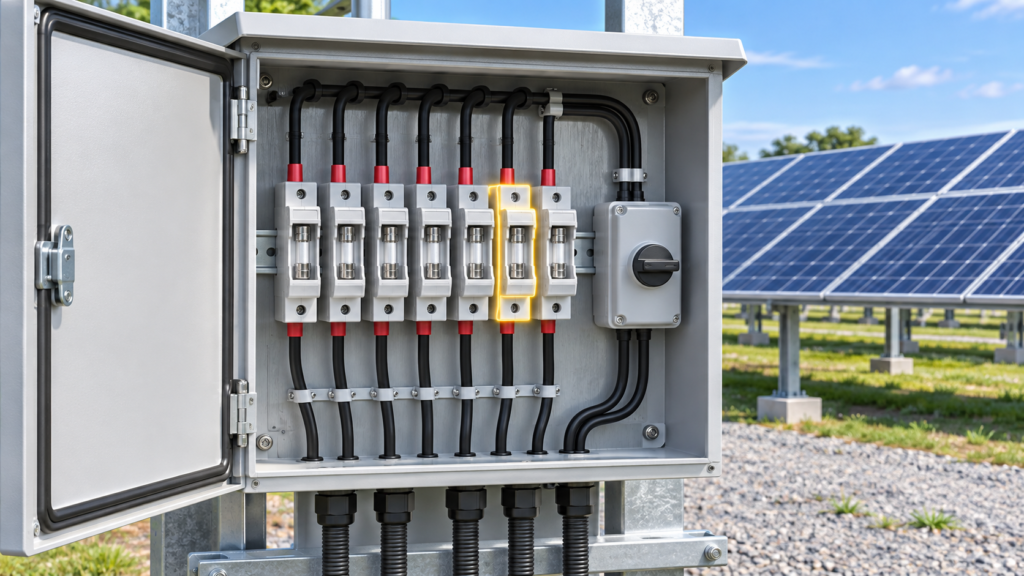
Quick answer: A PV string fuse that opens repeatedly is a symptom, not a maintenance item to replace indefinitely. Possible causes include reverse current from parallel strings into a faulted string, an undersized or unsuitable fuse, a damaged cable or connector, or excessive heat at the holder. Identify the failed circuit and confirm the design before energizing it again.
In a multi-string array, a fault in one string can allow current from other parallel strings to flow backward into it. String overcurrent protection is selected against the module’s permitted reverse current and the array configuration. ABB’s photovoltaic technical application paper describes gPV fuses and the need to check DC voltage, environment, temperature and the module data. A fuse’s ampere rating alone does not establish suitability.
Record the number of parallel strings, module short-circuit current, maximum series fuse rating and maximum reverse-current information from the module datasheet. Compare the installed fuse with the approved electrical design. Our PV string fuse sizing guide explains the separate current, voltage and temperature checks.
With the system isolated by a qualified technician under the inverter and combiner instructions, inspect cables, connectors and modules for damage, water ingress and polarity errors. Do not infer a harmless nuisance operation merely because a replacement fuse initially holds. Compare measurements between strings using approved instruments and procedures.
Use a fuse specified for PV DC duty and a voltage rating suitable for the maximum circuit voltage. An ordinary AC fuse is not an interchangeable substitute. Read our gPV versus standard fuse comparison and verify the chosen device’s manufacturer datasheet.
A poor contact or incompatible holder can overheat, even if the fuse element is correctly selected. Look for discoloration, deformation and loose terminals only after safe isolation. Check ambient-temperature limits and manufacturer derating information. Our PV fuse holder overheating guide covers this failure path in more detail.
No. A larger rating may remove required module or cable protection. Recalculate the protection and find the fault first.
Not necessarily. The need depends on parallel-string reverse-current exposure, module limits and the applicable design rules. Do not generalize from a single-string installation to a large combiner.
No. A surge protective device limits transient overvoltage; a string fuse addresses overcurrent. See our DC fuse versus DC SPD guide.
For a compatible protection-device quote, send the module datasheet, string count, maximum DC voltage and enclosure conditions through KUANGYA’s contact page. Final selection must be checked for the actual installation.

