ESS today’s rapidly evolving solar-plus-storage landscape, the risk of single-point failures bringing down entire power plants has become increasingly prominent. According to recent industry data, over 80% of PV-ESS system failures stem from inadequate protection coordination, with the vast majority being preventable through proper electrical protection design. Distributed coordination schemes, compared to centralized control, significantly reduce single-point failure risks and ensure systems maintain operation even during localized faults.
This article explores how professional electrical components from cnkuangya.com enable the construction of multi-layered, coordinated protection systems that effectively prevent fault propagation and ensure safe, stable operation of PV-ESS power plants.
Why Is Protection Coordination So Critical?
The Cascade Effect of Single-Point Failures
In PV-ESS systems, a single uncontained fault can trigger catastrophic consequences:
Overcurrent Fault Propagation: A short circuit in a single string, if not promptly isolated, can damage combiner boxes, inverters, or even the entire DC bus system
Insulation Fault Risks: When PV system insulation resistance drops, failure of protection devices to act promptly can cause electric shock hazards and equipment damage
Surge Energy Conduction: Lightning strikes or switching surges, without effective SPD protection and coordination, cause cascade damage to inverters, batteries, and monitoring equipment
ESS System Failure: Lack of coordination between Battery Management Systems (BMS) and upstream breakers can lead to overcharge, over-discharge, or thermal runaway
1. DC Surge Protective Device (SPD) – First Line of Defense
Product Features:
cnkuangya.com‘s Type 1+2 DC SPD designed specifically for 1000V/1500V PV systems
Effective voltage clamping minimizes component stress on PV arrays and ESS DC buses
Prevents cascade failures through coordinated protection with DC fuse protection
Application Scenarios:
PV String Side: Installed at combiner box inputs to protect strings from lightning and switching surges
ESS DC Bus: Protects Battery Management Systems (BMS) and Power Conversion Systems (PCS)
Inverter DC Input: Serves as final-stage surge protection before inverters
Coordination Strategy:\ According to IEC 61643-31 standards, SPDs must coordinate with upstream overcurrent protection devices. cnkuangya.com‘s SPD products ensure that when surge energy exceeds limits, upstream DC fuses or breakers safely disconnect, preventing SPD failure-induced fire risks.
2. DC Circuit Breaker (MCCB) – Intelligent Overcurrent Protection
Product Features:
KYDB-63 series supports 1000V/1500V DC systems
Thermal-magnetic trip characteristics accommodate PV system startup surges and normal operating currents
Excellent temperature rise control, maintaining voltage drop and temperature rise within design limits at 250-400A loads
Application Scenarios:
String-Level Protection: Each string configured with independent DC MCB for selective protection
Combiner Box Output: Protects main lines from combiner boxes to inverters
ESS Battery Clusters: Protects battery clusters from overcurrent and short-circuit damage
Coordination Strategy:\ DC breaker trip curves must coordinate with downstream fuses and upstream main breakers. cnkuangya.com‘s KYDB series features adjustable trip characteristics, ensuring the protection device closest to the fault operates first, achieving selective protection.
3. Photovoltaic Fuse (gPV Fuse) – Fast Backup Protection
Product Features:
gPV 14×85 series designed specifically for PV applications, compliant with IEC 60269-6
Replaceable modular design for convenient maintenance
Provides reliable short-circuit protection in 1000V/1500V systems
Application Scenarios:
String Protection: First-level protection for each string, rapidly cutting off short-circuit faults
Battery Cluster Protection: Protects ESS battery modules from internal short circuits
Inside Combiner Boxes: Works with SPDs to provide complete protection solutions
Coordination Strategy:\ Fuse I²t values should be less than the withstand values of protected equipment (such as PV modules, cables), while coordinating with upstream breaker trip characteristics to ensure fuses operate before breakers during short-circuit faults.
Integrates DC SPD, gPV fuses, and monitoring functions
IP65 protection rating suitable for harsh outdoor environments
Clear layout and durable UV-resistant labels for easy maintenance
Application Scenarios:
Rooftop PV Retrofits: Provides plug-and-play protection solutions for distributed rooftop systems
Ground-Mount Plants: Standard configuration for string combining and protection
Desert Environments: Passed 45°C sand-spray testing in Middle East high-temperature, dusty conditions
Coordination Advantages:\ cnkuangya.com‘s PV combiner boxes are factory pre-wired and certified, with internal protection devices pre-coordinated, reducing on-site installation errors and ensuring protection system reliability.
Application Scenario Details
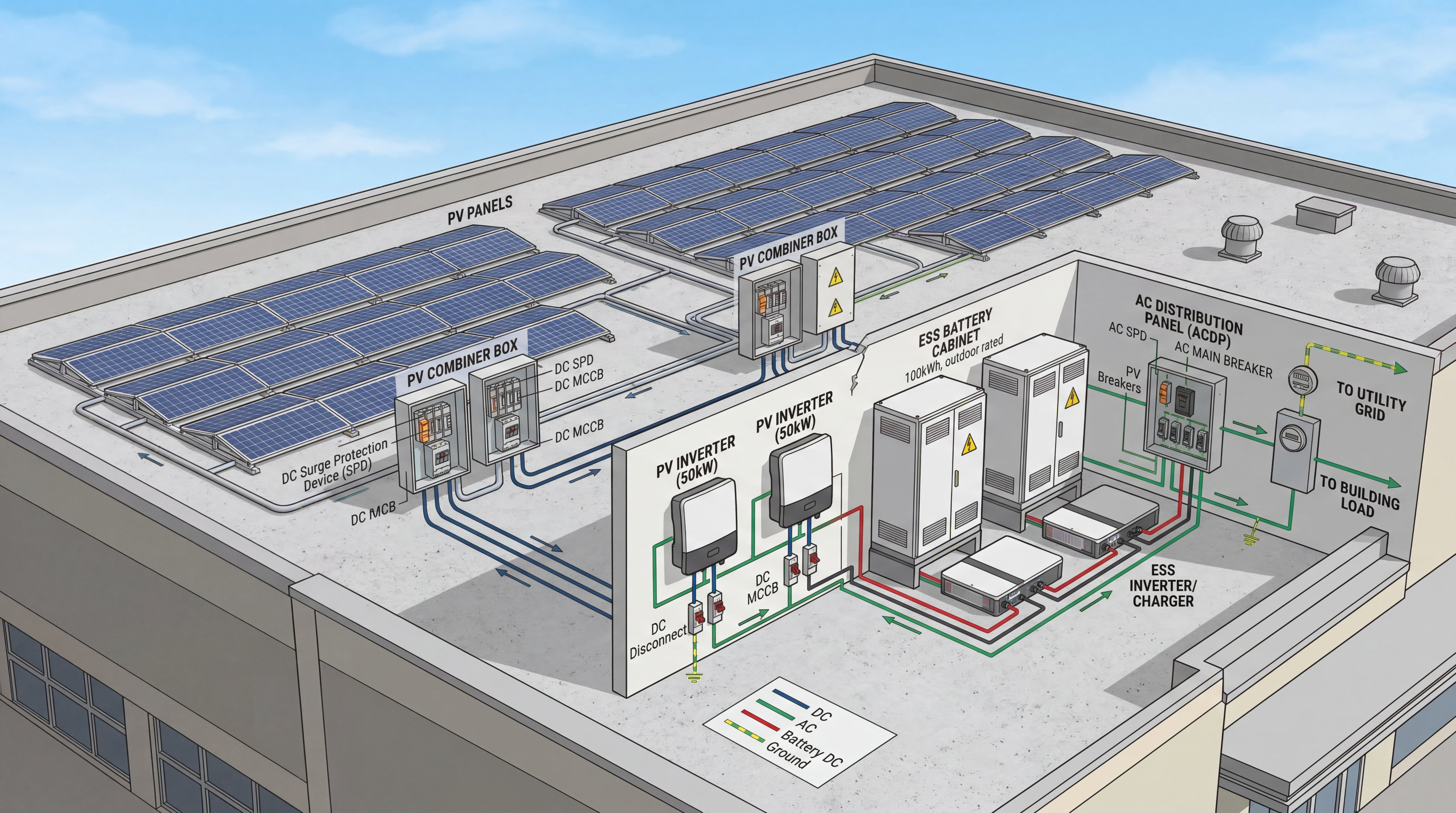
Scenario 1: Commercial Rooftop PV-ESS System
System Configuration:
100kW rooftop PV array + 200kWh energy storage system
20 strings, each configured with gPV fuse and DC MCB
2 PV combiner boxes with integrated Type 1+2 SPD
Centralized inverter + Power Conversion System (PCS)
AC Grid Connection Level: AC breaker + anti-islanding protection → AC-side safety
Real-World Results:\ A European residential storage project using cnkuangya.com‘s combiner box solution withstood thunderstorm conditions, with DC SPDs successfully clamping surge voltages while upstream fuses remained intact, enabling continuous system operation and avoiding downtime losses.
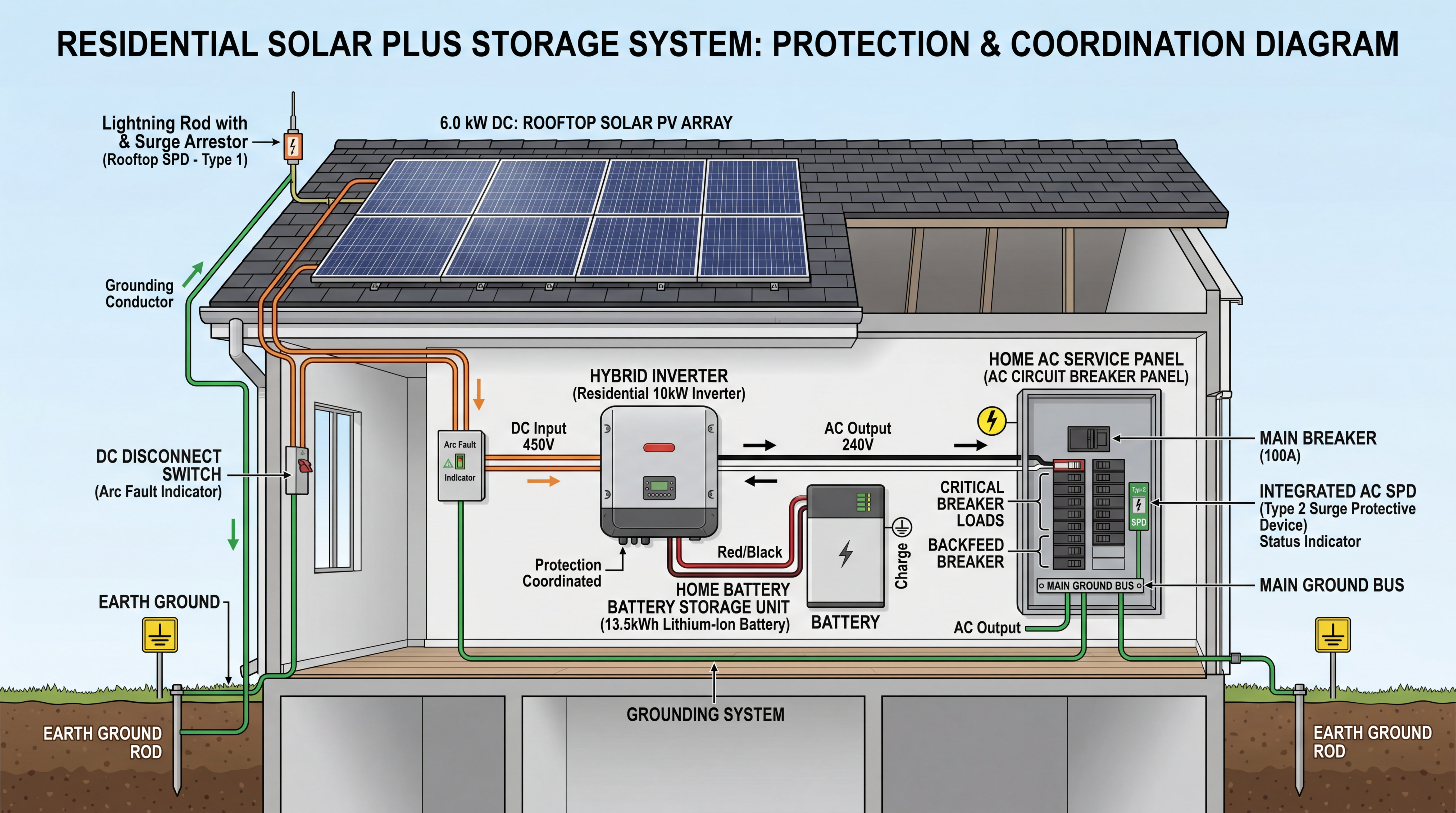
Scenario 2: Residential PV-ESS System
System Configuration:
10kW rooftop PV system + 15kWh home energy storage
These keywords reflect the industry’s continued focus on system safety, intelligence, and standardization, highlighting the critical importance of professional protection equipment in modern PV-ESS systems.
Protection Coordination Design Best Practices
1. Selective Protection Principle
Ensure faults disconnect only the minimum equipment scope:
Time Selectivity: Upper and lower-level protection devices should have 0.3-0.5 second time discrimination
Current Selectivity: Upper-level protection device operating current should be 1.5-2 times that of lower level
Energy Selectivity: Fuse I²t values should be less than upstream breaker let-through energy
2. Multi-Level Protection Strategy
Build defense-in-depth:
First Level: String fuses – Rapidly cut off string faults
Second Level: Combiner box breakers – Protect combiner lines
Third Level: Main breakers – Protect inverters and main equipment
Ensure cables use double insulation meeting PV-specific standards
System Optimization:
Adjust inverter insulation detection thresholds (requires professional personnel)
Install insulation monitoring devices for real-time resistance monitoring
Improve grounding systems to reduce leakage current
Emergency Response:
Rainy weather faults typically auto-recover after weather clears
For persistent faults, use megohm meters to test sections and locate fault points
Replace damaged modules or cables
Important Note: Isolation faults not only affect power generation efficiency but can also create electric shock hazards. According to safety regulations, inverters must stop working when insulation faults are detected.
Q2: How should DC circuit breakers and DC fuses be selected and coordinated?
A: DC circuit breakers (MCCBs) and DC fuses play different roles in PV-ESS systems. Proper selection and coordination are key to protection coordination.
Function Comparison:
Feature
DC Circuit Breaker (MCCB)
DC Fuse (gPV Fuse)
Protection Type
Overload + Short-circuit
Primarily short-circuit
Response Speed
Slower (ms-level)
Extremely fast (μs-level)
Reusable
Yes (resettable)
No (requires replacement)
Cost
Higher
Lower
Maintenance
Convenient
Requires spare parts
Selectivity
Adjustable
Fixed characteristics
Coordination Strategies:
Option 1: Fuse + Breaker (Recommended for Large Systems)
String Level: gPV fuse (1-10A) – Rapidly cuts off short circuits
Combiner Box Level: DC MCCB (16-63A) – Overload protection and maintenance isolation
Advantages: Dual protection, good selectivity, flexible maintenance
Option 2: Breakers Only (Suitable for Small Systems)
String Protection: gPV 14×85 fuse (select 1-15A based on string current)
Combiner Box Output: KYDB-63 series DC MCCB (32-63A)
Main Circuit: Large-capacity DC isolating switch (125-630A)
Selection Key Points:
Fuse Selection:
Rated current = String short-circuit current × 1.5
Breaking capacity > System maximum short-circuit current
Must select gPV type (PV-specific)
Breaker Selection:
Rated current = Line calculated current × 1.25
Rated voltage ≥ System maximum voltage (1000V/1500V)
DC breaking capacity must meet system requirements
Coordination:
Fuse I²t value < Breaker let-through energy
Ensure fuses operate before breakers during short circuits
During overloads, breakers trip while fuses remain intact
Real-World Case:\ An Indian ESS project using cnkuangya.com‘s gPV 14×85 fuse and KYDB-63 DC MCCB combination maintained stable voltage drop and temperature rise at 250-400A loads, with replaceable module design making maintenance simple and efficient.
Conclusion
Protection coordination in PV-ESS systems is a systematic engineering endeavor requiring full lifecycle management from design, selection, installation to maintenance. By adopting professional electrical protection components from cnkuangya.com combined with scientific protection coordination strategies, single-point failure propagation can be effectively prevented, ensuring safe and stable system operation.
Key Takeaways:
✅ Multi-Level Protection: Build multi-tier protection from string-combiner box-inverter-grid connection
✅ Selective Isolation: Ensure faults disconnect only minimum scope while remainder continues operation
✅ Surge Protection: Use Type 1+2 DC SPD coordinated with overcurrent protection
✅ Standardized Design: Follow IEC, NFPA international standards, use certified products
As PV-ESS systems evolve toward higher voltages (1500V), larger capacities, and AI-driven intelligent monitoring technologies, protection coordination will become increasingly intelligent and reliable. With 25 years of industry experience and trust from 500+ global customers, cnkuangya.com continues to provide safe, efficient electrical protection solutions for the renewable energy industry.
Take Action Now: Visit cnkuangya.com for professional PV-ESS protection solution consultation and product selection support.
References and Further Reading
IEC 61643-31: DC surge protective device application standards
IEC 60269-6: Photovoltaic system fuse standards
NFPA 855: Energy storage system installation standards
NEC Article 690 & 706: US PV and energy storage electrical codes
This article is written by the cnkuangya.com technical team based on the latest industry standards and practical engineering experience. For customized protection solutions, please contact our technical support team.