WengYang Industrial Zone Yueqing Wenzhou 325000
Work Hours
Monday to Friday: 7AM - 7PM
Weekend: 10AM - 5PM
WengYang Industrial Zone Yueqing Wenzhou 325000
Work Hours
Monday to Friday: 7AM - 7PM
Weekend: 10AM - 5PM

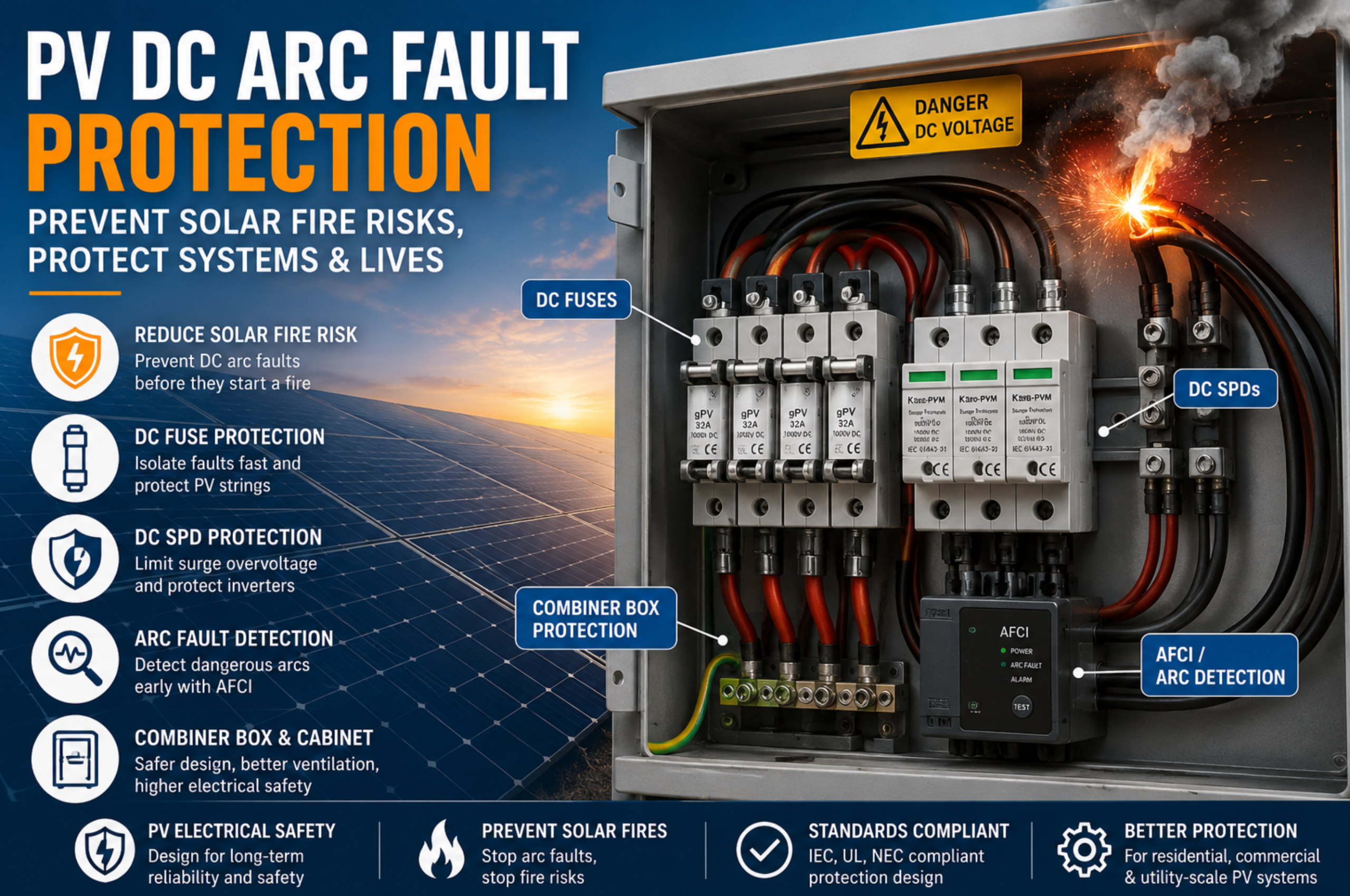
PV DC arc faults are one of the most dangerous hidden risks in solar power systems. They often begin from loose connectors, damaged cables, poor crimping, aging insulation, moisture, or incorrect installation. Unlike simple overcurrent faults, a DC arc can continue burning because DC current does not naturally cross zero like AC current.
Effective PV DC Arc Fault Protection should not rely on only one device. A safer design uses multiple protection layers: correct cable routing, high-quality DC connectors, gPV fuses, DC surge protective devices, combiner box protection, AFCI functions, thermal inspection, and electrical cabinet fire protection.
For EPC contractors, solar installers, electrical engineers, and O&M teams, the goal is not only to pass inspection. The real goal is to reduce inverter failure, avoid fire damage, improve system uptime, and make maintenance easier.
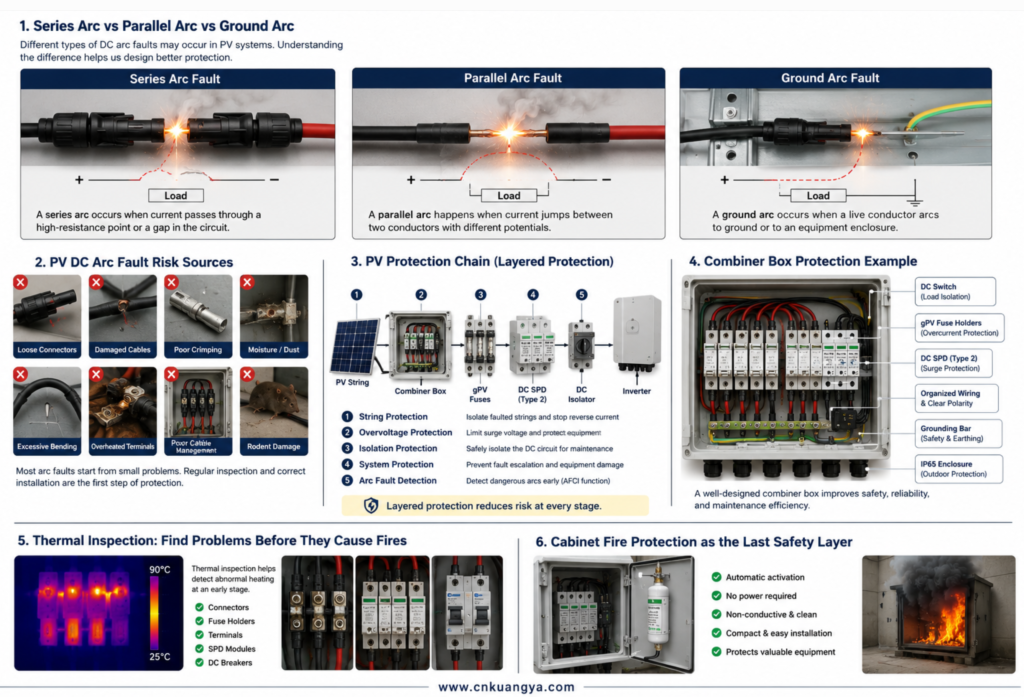
A PV DC arc fault is an abnormal electrical discharge that occurs in the direct current side of a photovoltaic system. It can happen when current jumps across a gap between conductors, connector contacts, damaged insulation, or loose wiring points.
In a solar PV system, DC arc faults are especially dangerous because the PV array continues generating power whenever sunlight is available. If the system voltage is high, especially in 1000V DC or 1500V DC projects, the arc can become stable enough to produce high temperature, carbonization, smoke, and eventually fire.
Modern solar projects use longer string circuits, higher DC voltage, larger combiner boxes, and more compact inverter stations. These designs improve efficiency, but they also increase the importance of PV DC Arc Fault Protection.
Research on DC arc faults in photovoltaic systems has repeatedly identified undetected arc faults as a serious fire hazard for residential, commercial, and utility-scale PV systems.
A DC arc fault is not just a small electrical spark. It can become a continuous high-temperature discharge. Once it starts, it may damage insulation, melt connector parts, burn cable jackets, and ignite nearby combustible materials.
The danger is higher in PV systems because the DC side is active during daylight. Even if the AC breaker is turned off, the PV modules may still provide voltage to the DC circuit.
This is why PV DC Arc Fault Protection must be considered from design to installation and maintenance. Waiting until visible smoke appears is too late.
A practical solar safety strategy should answer three questions:
PV safety is not achieved by a single product. It is achieved by coordinated protection.
Most PV DC arc faults are not caused by one single dramatic failure. They usually come from small problems that grow over time.
Common causes include:
In large PV plants, the problem is often not that engineers do not know the risk. The problem is that thousands of connectors, cables, fuses, terminals, and combiner boxes must remain reliable for many years under outdoor conditions.
That is why PV DC Arc Fault Protection should be treated as a system-level design issue, not only a product selection issue.
PV arc faults are commonly divided into three types: series arc faults, parallel arc faults, and ground arc faults.
A series arc happens when a conductor path is partially broken. For example, a connector may be loose, a cable may be damaged, or a terminal may have poor contact.
The current still flows through the circuit, but it crosses a small air gap or high-resistance point. This creates heat and arcing.
Series arcs are difficult because the current may remain within the normal operating range. A normal fuse may not operate because there is no large overcurrent.
A parallel arc happens when current jumps between two conductors of different potential. This can occur between positive and negative DC cables, between strings, or inside damaged insulation.
Parallel arcs may produce higher fault current than series arcs, especially when multiple strings are connected in parallel.
A ground arc happens when a live DC conductor arcs to a grounded metal part or equipment enclosure. This may be caused by insulation failure, mechanical damage, water ingress, or poor installation.
Each arc type requires different detection and protection methods. This is why PV DC Arc Fault Protection should combine installation quality, monitoring, fuse protection, surge protection, and enclosure-level safety.
Many people assume that a fuse or circuit breaker can solve every electrical fault. This is not true.
Overcurrent devices are designed to interrupt excessive current. But some DC arc faults may not create enough current to operate a fuse quickly, especially series arc faults.
This does not mean fuses are useless. It means fuses must be understood correctly.
A gPV fuse is essential for protecting PV strings and arrays against reverse current and certain fault conditions. IEC 60269-6 gives supplementary requirements for fuse-links used to protect photovoltaic strings and arrays up to 1500V DC.
However, PV DC Arc Fault Protection needs more than overcurrent protection. It also needs arc detection, correct wiring, surge protection, safe enclosures, and regular inspection.
Poor cable routing is one of the simplest ways to create long-term failure risk. DC cables should not be stretched, crushed, sharply bent, or exposed to unnecessary mechanical stress.
Good cable routing should:
A clean cable layout makes inspection easier and reduces hidden stress points.
Connector mismatch is a common but often ignored risk. Even if two connectors look similar, they may not have the same contact design, material tolerance, sealing performance, or certification.
Mismatched connectors can increase contact resistance. Higher resistance creates heat. Over time, heat can damage plastic parts, loosen contact pressure, and increase arc fault risk.
For PV DC Arc Fault Protection, installers should avoid mixing connector brands unless compatibility is clearly confirmed by the manufacturer.
Loose terminals are a major source of overheating. Over-tightened terminals can also damage conductors or equipment.
Every terminal in the combiner box, fuse holder, DC breaker, SPD, and inverter input should be tightened according to the manufacturer’s torque value.
For EPC projects, torque control should not be treated as optional. It should be part of the installation record.
PV strings should use fuses designed for photovoltaic DC circuits, not ordinary AC fuses.
gPV fuses are designed to interrupt DC fault currents in PV applications. They are widely used in combiner boxes, inverter input protection, and PV string protection.
IEC 60269-6 specifically covers fuse-links for the protection of solar photovoltaic energy systems.
For engineers, the fuse selection should consider:
A wrong fuse can either nuisance-trip or fail to protect the circuit correctly.
Lightning and switching surges can damage inverters, monitoring devices, combiner boxes, and insulation systems. Surge damage may not always cause immediate failure. Sometimes it weakens insulation and increases future fault risk.
DC surge protective devices are therefore an important part of PV DC Arc Fault Protection.
IEC 61643-31 applies to SPDs intended for the DC side of photovoltaic installations up to 1500V DC. These SPDs are designed to limit surge voltages and divert surge currents.
IEC 61643-32 also describes selection, installation, and coordination principles for SPDs used on the DC side of PV installations up to 1500V DC.
For better protection, DC SPDs are usually installed:
The combiner box is one of the most important locations for PV DC Arc Fault Protection. It contains multiple strings, fuses, terminals, SPD modules, DC switches, and cable entries.
If the combiner box is poorly designed, water ingress, heat buildup, loose wiring, and insulation failure can develop inside the enclosure.
A safer combiner box should include:
The combiner box should not be treated as a simple junction box. It is a protection center.
Arc-fault circuit interrupter technology is designed to detect dangerous arcing behavior and interrupt the circuit or shut down the system.
In some markets, PV arc-fault protection is required by electrical codes for certain PV systems. For example, NEC-related documents include requirements for PV DC arc-fault circuit protection when DC circuits operate at 80V DC or greater between conductors.
For international projects, engineers should check local codes, inverter functions, and project specifications. AFCI requirements may vary depending on country, system type, installation location, and authority having jurisdiction.
Thermal inspection is one of the most practical methods for early risk detection. Many arc fault risks begin as abnormal heating.
O&M teams should inspect:
A small hot spot should not be ignored. It may indicate loose contact, overload, corrosion, poor crimping, or internal component degradation.
Even with good electrical design, no system can completely eliminate risk. For critical cabinets, electrical cabinet fire protection can act as the last layer of safety.
Automatic fire extinguishing devices can be installed inside electrical cabinets, combiner boxes, distribution panels, telecom cabinets, and energy storage auxiliary cabinets.
For solar projects, cabinet-level fire protection is especially useful in:
The purpose is not to replace good electrical protection. The purpose is to suppress a small internal fire before it spreads to nearby equipment.
A gPV fuse is one of the most important protection components in solar DC circuits.
In multi-string PV systems, reverse current can flow from healthy strings into a faulted string. This can overheat cables, connectors, and modules. A correctly selected gPV fuse helps interrupt this fault current before damage spreads.
Industrial AC Fuse Holder RT18 Series 32A–125A | Kuangya
For PV DC Arc Fault Protection, the fuse helps in several ways:
However, fuse quality matters. A low-quality fuse or fuse holder may overheat during normal operation. Poor contact inside the fuse holder can become a risk point itself.
For this reason, engineers should consider both the fuse link and the fuse holder as one protection system.
IEC 60269-6 photovoltaic fuse requirements
Some installers ask whether DC SPD protection is still necessary if the inverter already includes protection.
The answer is yes, especially in exposed PV installations.
A PV array often has long outdoor cable runs. These cables can pick up induced surge energy from nearby lightning strikes. Surge energy can travel through DC cables into the inverter, monitoring equipment, and communication systems.
A DC SPD helps divert surge current and limit transient overvoltage before it damages sensitive equipment.
For a complete PV DC Arc Fault Protection strategy, SPD protection matters because surge events can weaken insulation, damage electronic components, and create hidden degradation. A system may still work after a surge, but its long-term reliability may be reduced.
Good SPD design should consider:
For utility-scale and commercial PV projects, SPDs should not be selected only by price. They should be selected according to system voltage, installation risk, and protection coordination.
A combiner box can either reduce risk or create risk. The difference is design quality.
A good PV combiner box should make the system easier to inspect, safer to maintain, and more reliable during abnormal events.
Important design points include:
All components inside the combiner box must be suitable for DC voltage and PV application. AC-rated devices should not be used as substitutes.
Positive and negative conductors should be arranged clearly. Poor wiring layout increases the possibility of insulation stress, confusion during maintenance, and accidental contact.
The DC SPD should be installed with short and direct wiring. Long SPD connection wires reduce protection effectiveness.
The fuse holder must match the fuse size, voltage, current, and thermal requirements. Overheated fuse holders are a common problem in low-quality combiner boxes.
Outdoor combiner boxes should resist water, dust, UV exposure, and temperature changes. Water ingress can create insulation breakdown and corrosion.
Labels, wiring diagrams, indicator windows, and remote signaling can help maintenance teams quickly locate failed components.
A combiner box is not only a connection point. It is the first protection station between the PV array and inverter.
Electrical protection devices reduce the probability of failure. Fire protection reduces the consequence when failure happens.
This distinction is important.
A fuse does not extinguish fire.
An SPD does not extinguish fire.
A breaker does not extinguish fire.
An AFCI does not repair damaged insulation.
For high-value PV projects, engineers should think in layers:
Cabinet fire protection is especially useful when electrical equipment is installed in remote or unmanned locations. If a fault starts at night, during high irradiance periods, or in a remote desert plant, human response may be delayed.
An automatic cabinet fire extinguishing device can help suppress early-stage fires inside enclosed electrical spaces before the fire spreads to the entire cabinet or nearby equipment.
Use this checklist during installation, commissioning, and regular maintenance.
A strong PV DC Arc Fault Protection design should use a layered architecture.
| Risk Area | Main Cause | Recommended Protection |
|---|---|---|
| PV string cables | Insulation damage, poor routing | Correct cable design, inspection |
| Connectors | Loose contact, mismatch, poor crimping | Compatible connectors, torque control |
| Combiner box | Water ingress, heat, terminal failure | IP enclosure, gPV fuse, DC SPD |
| Inverter DC input | Surge, insulation stress, cable fault | DC SPD, monitoring, AFCI |
| DC distribution cabinet | High current, thermal stress | DC protection devices, thermal inspection |
| Critical electrical cabinet | Internal ignition | Automatic cabinet fire protection |
| O&M stage | Hidden degradation | Thermal inspection and maintenance records |
This architecture helps engineers move from single-device thinking to system-level protection.
For EPC and solar project procurement teams, product selection should be based on project risk, not only unit price.
Choose a DC SPD based on:
Choose a gPV fuse based on:
Choose a combiner box based on:
Choose cabinet fire protection based on:
PV DC Arc Fault Protection means reducing, detecting, isolating, and controlling arc faults on the DC side of a solar PV system. It includes good installation practices, connector control, DC cable management, gPV fuses, DC SPDs, AFCI functions, monitoring, inspection, and cabinet fire protection.
No. A fuse helps protect against overcurrent and reverse current faults, but some series arc faults may not create enough current to operate the fuse quickly. This is why arc fault protection needs multiple layers.
DC current does not naturally cross zero like AC current. This means a DC arc can be more difficult to extinguish once it is established, especially in high-voltage PV systems.
DC SPD protection is commonly installed inside PV combiner boxes, near inverter DC inputs, and in DC distribution cabinets. The exact position depends on cable length, lightning exposure, system voltage, and protection coordination.
Yes. gPV fuses are designed for photovoltaic DC circuits. They are used to protect PV strings and arrays from reverse current and certain fault conditions. Ordinary AC fuses should not be used as substitutes.
Combiner boxes may overheat because of loose terminals, poor fuse holder contact, incorrect fuse selection, high ambient temperature, water ingress, corrosion, or poor ventilation.
Not always. But it is highly recommended for critical electrical cabinets, inverter stations, remote PV plants, industrial rooftop projects, telecom power cabinets, and high-value equipment rooms.
The best method is layered protection. Use correct cable routing, compatible connectors, proper torque, gPV fuses, DC SPDs, AFCI or arc detection where required, thermal inspection, and cabinet fire suppression for critical enclosures.
PV DC arc faults are hidden but serious risks in solar power systems. They can start from small installation problems such as loose connectors, poor crimping, damaged insulation, water ingress, or overheated terminals.
A safe solar project should not depend on one device. Real PV DC Arc Fault Protection requires a complete protection chain: correct design, quality installation, gPV fuses, DC surge protective devices, safer combiner boxes, AFCI functions, regular inspection, and automatic cabinet fire protection for critical enclosures.
For EPC contractors, solar installers, and electrical engineers, the value of this approach is clear. It reduces fire risk, protects inverters, improves system uptime, supports safer maintenance, and helps solar projects operate reliably over the long term.
KUANGYA provides electrical protection components for PV and energy infrastructure projects, including DC SPDs, gPV fuses, fuse holders, combiner box protection components, circuit breakers, and automatic cabinet fire extinguishing solutions. For project-based selection, OEM customization, or technical datasheets, contact KUANGYA for support.

