Address
304 North Cardinal
St. Dorchester Center, MA 02124
Work Hours
Monday to Friday: 7AM - 7PM
Weekend: 10AM - 5PM
Address
304 North Cardinal
St. Dorchester Center, MA 02124
Work Hours
Monday to Friday: 7AM - 7PM
Weekend: 10AM - 5PM

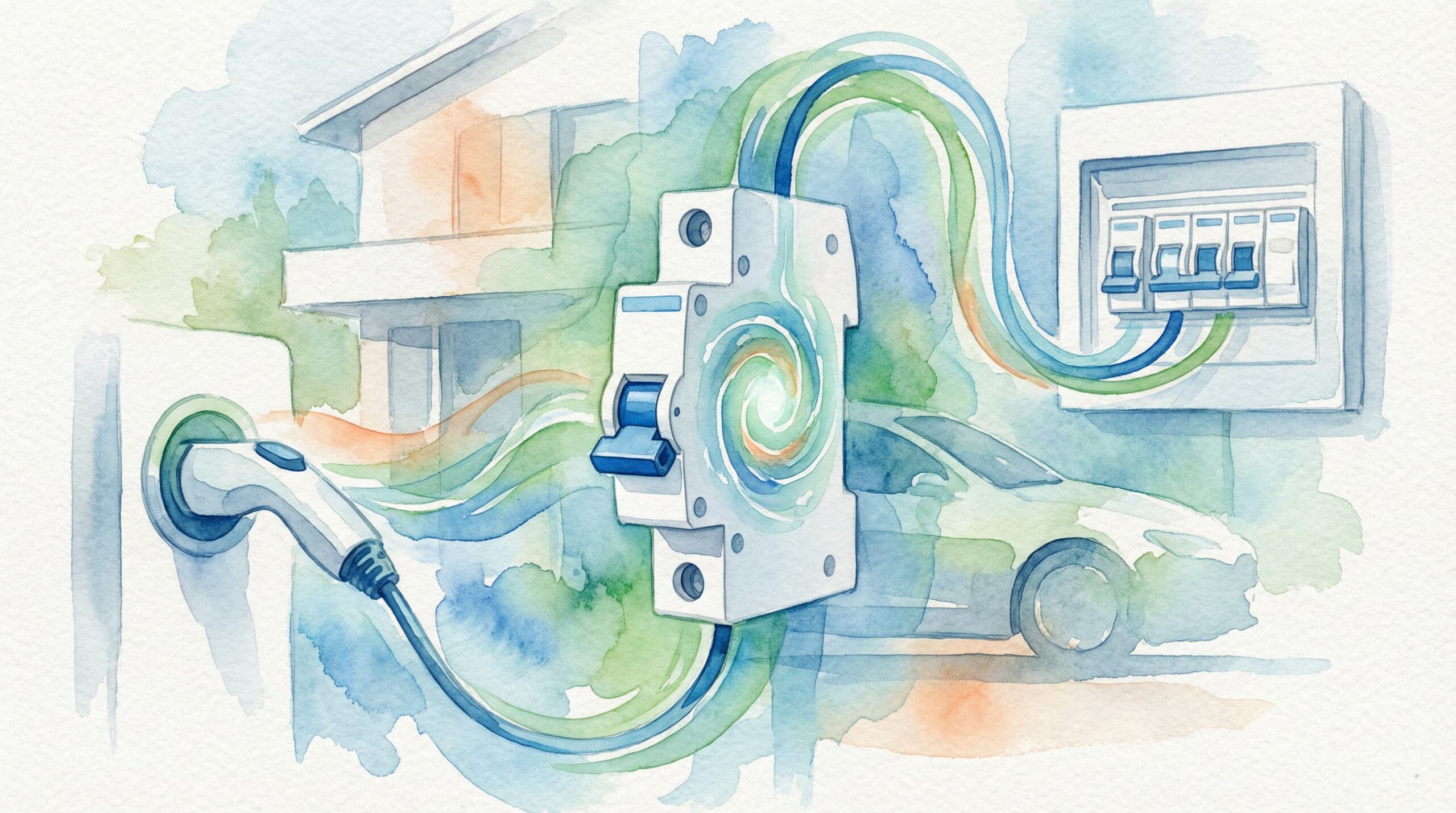
Type B RCBOs: transition to electric mobility represents one of the most significant shifts in residential energy consumption since the widespread adoption of air conditioning. As millions of homeowners embrace electric vehicles, a critical but often overlooked component of safe EV charging emerges: the Type B Residual Current Breaker with Overcurrent protection (RCBO). This sophisticated electrical protection device serves as the invisible guardian standing between your high-powered vehicle charging system and the safety of your home’s electrical infrastructure.
The global electric vehicle market has experienced explosive growth, with residential charging representing the dominant charging paradigm. Home charging accounts for approximately 80% of all EV charging events, making the safety and reliability of residential charging infrastructure paramount. When you plug your electric vehicle into a home charging station, you are connecting a powerful energy storage system—often exceeding 60 kilowatt-hours of capacity—directly to your domestic electrical supply. This connection, while enabling the convenience of overnight charging, introduces unique electrical safety challenges that traditional circuit protection devices were never designed to address.
Modern electric vehicle charging involves complex power electronics that convert alternating current from your home supply into direct current suitable for battery storage. This conversion process, performed by the vehicle’s onboard charger or an external wallbox, generates specific types of electrical faults that differ fundamentally from those produced by conventional household appliances. The physics of these faults demands protection technology that goes far beyond the capabilities of standard circuit breakers or even Type A residual current devices.
To understand why Type B RCBOs are essential for EV charging protection, we must examine the nature of electrical faults generated by power electronic converters. When AC power is converted to DC for battery charging, any insulation failure or fault condition can produce residual currents with distinct characteristics. Traditional Type AC residual current devices respond only to pure sinusoidal alternating current faults—the kind typically associated with direct contact with live conductors or basic insulation failures in resistive loads.
Type A devices extended this protection to cover pulsating DC residual currents, which occur when AC voltage is rectified but not fully smoothed. However, modern EV chargers employ sophisticated rectification and power factor correction circuits that can generate smooth DC residual currents—continuous unidirectional current flow without the pulsating component that Type A devices can detect. This smooth DC current presents a critical safety blind spot.
When smooth DC residual current flows through a Type A RCD, it effectively saturates the magnetic core within the detection mechanism, rendering the device unable to respond to subsequent AC fault currents. This phenomenon, known as “DC blinding” or “core saturation,” means that a Type A device could remain completely inoperative even during a dangerous earth fault condition, providing no protection at all. For a device rated at 30mA sensitivity, DC residual currents as low as 6mA can begin this saturation process, progressively reducing the device’s ability to detect AC faults.
The international standard IEC 61851-1:2017 explicitly addresses this safety concern, mandating that electric vehicle charging systems must provide protection against smooth DC residual current. The standard recognizes that the unique electrical characteristics of EV charging demand specific protective measures beyond those required for conventional electrical installations. This regulatory framework has been adopted and strengthened by national codes worldwide, including BS 7671:2018+A2:2022 in the United Kingdom and similar provisions within the National Electrical Code in North America.
BS 7671 Section 722.531.3.101 provides particularly clear guidance: “Each socket-outlet or connection point for the exclusive use of electric vehicle charging shall be protected by an RCD of Type A, Type F, or Type B having a rated residual operating current not exceeding 30 mA, or by another protective measure providing disconnection of all live conductors.” The specification of Type B as an acceptable option acknowledges that this device category provides comprehensive protection against all forms of residual current that may occur during EV charging.
The standard further clarifies that where protection against smooth DC residual current is required, and such protection is not provided within the charging equipment itself, Type B protection is mandatory. This creates a decision framework for installers and homeowners: either the charging station incorporates internal DC fault detection and disconnection capability, or the upstream protection must be Type B rated.
A Type B RCBO integrates three critical protection functions within a single compact device. The overcurrent protection element responds to overload conditions and short-circuit faults, interrupting the circuit when current exceeds rated capacity. The residual current protection element continuously monitors the balance between line and neutral currents, detecting any leakage to earth. Crucially, the Type B classification specifies that this residual current detection covers AC, pulsating DC, smooth DC, and high-frequency components up to 1000 Hz.
The technical specifications of Type B RCBOs reveal the sophistication of this protection. For a device rated at 30mA sensitivity, the smooth DC detection threshold typically falls within the 6mA range—precisely calibrated to prevent the DC blinding effect that would compromise protection integrity. The frequency response extends well beyond the fundamental 50/60 Hz of the power supply, capturing harmonic currents generated by modern power electronics that might otherwise go undetected.
The integration of MCB (Miniature Circuit Breaker) and RCD (Residual Current Device) functions into a single RCBO unit provides practical advantages for installation and coordination. Rather than requiring separate devices occupying multiple DIN rail positions, a Type B RCBO delivers complete protection within a standard 2-module width for single-phase applications or 4-module width for three-phase installations. This space efficiency proves particularly valuable in residential consumer units where available mounting positions are often limited.
The KUANGYA VRL11 RCBO exemplifies the technical capabilities required for modern EV charging protection. This device combines 1P+N (single-pole plus neutral) configuration with Type B residual current detection, providing comprehensive protection for single-phase EV charging installations up to 40A capacity.
The VRL11 technical specifications demonstrate suitability for residential EV charging applications:
| Parameter | Specification |
|---|---|
| Poles | 1P+N (single-pole + neutral) |
| Rated Current (In) | 5–40 A |
| Rated Voltage (Ue) | AC 240V / AC 120V |
| Residual Current Type | Type B (AC, pulsating DC, smooth DC to 6mA) |
| Rated Residual Current (IΔn) | 30 mA (standard for EV charging) |
| Breaking Capacity (Icn) | 10 kA @ 240V / 15 kA @ 120V |
| MCB Tripping Curve | B (3–5×In) or C (5–10×In) |
| Standards Compliance | IEC/EN 61009-1, IEC 62943 |
| Certifications | SEMKO, UKCA, CE, SAA |
For typical 7kW residential EV chargers operating on single-phase 240V supply, the 32A or 40A rating provides appropriate overcurrent protection with adequate headroom for continuous operation. The Type B residual current detection ensures protection against smooth DC faults up to 6mA while maintaining full sensitivity to AC and pulsating DC faults at the 30mA level. The 10kA breaking capacity exceeds typical domestic fault current levels, ensuring safe interruption under worst-case short-circuit conditions.
The curve selection (B or C) allows coordination with upstream protective devices and accommodation of inrush currents. Curve B (3–5×In instantaneous trip) suits installations with minimal inrush characteristics, while Curve C (5–10×In) accommodates the higher starting currents associated with some EV charger designs. For most modern EV chargers with active power factor correction, Curve B provides optimal protection sensitivity without nuisance tripping.
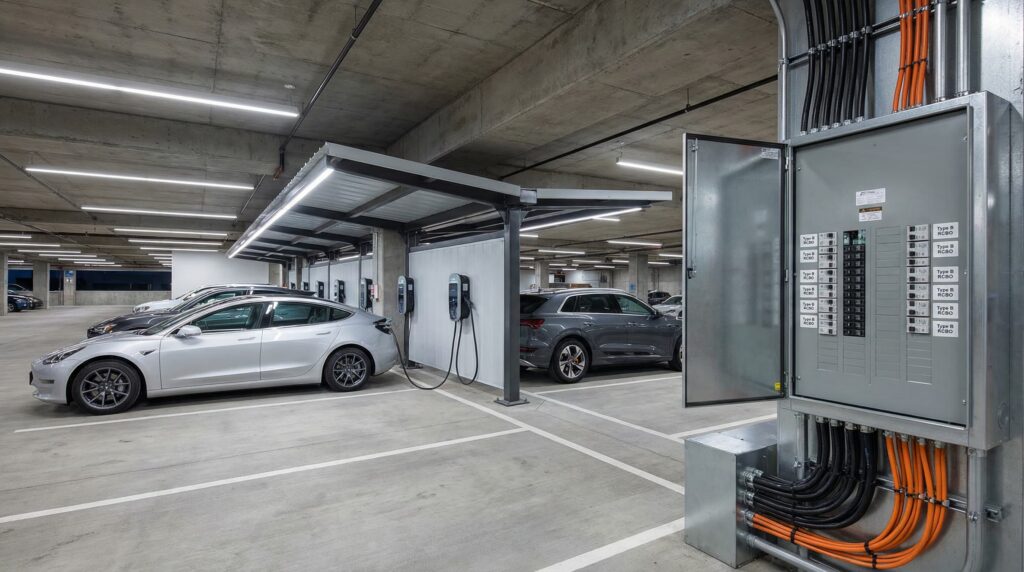
Proper installation of Type B RCBOs for EV charging requires attention to several critical factors beyond basic device selection. The RCBO must provide double-pole disconnection, interrupting both line and neutral conductors under fault conditions. This requirement addresses potential hazards from neutral-earth voltage differences and ensures complete isolation of the charging circuit.
Each EV charging point requires dedicated RCBO protection. Sharing an RCBO between multiple charging outlets or other household circuits violates the fundamental principle of selective protection and can result in unwanted disconnection of non-charging loads when EV-specific faults occur. The dedicated protection approach also simplifies fault diagnosis and maintenance by isolating the charging circuit independently.
Coordination with upstream protective devices demands careful consideration of tripping characteristics and time-current curves. The Type B RCBO should coordinate with the main incoming circuit breaker to ensure that faults within the charging circuit result in local disconnection rather than whole-house outages. This selectivity requires analysis of the available fault current at the installation point and comparison of device characteristics.
Earthing arrangements for EV charging installations warrant particular attention. The protective earth connection must maintain low impedance to ensure that fault currents are sufficient to operate protective devices within specified time limits. Where TT earthing systems are employed (common in rural installations), the earth electrode resistance must be low enough to permit reliable Type B RCBO operation under earth fault conditions.
The cost differential between Type A and Type B protective devices represents a legitimate consideration for homeowners and installers. Type B RCBOs typically command a price premium of $300–$400 compared to Type A equivalents, reflecting the additional complexity of smooth DC detection circuitry and broader frequency response capabilities. However, this upfront cost must be evaluated within the broader context of installation compliance, safety assurance, and long-term reliability.
Alternative compliance approaches exist that may influence cost calculations. Some EV charging stations incorporate internal RDC-DD (Residual Direct Current Detecting Device) modules compliant with IEC 62955. These internal devices detect smooth DC residual current and disconnect the charging circuit when 6mA DC is exceeded, permitting the use of Type A protection upstream. While this approach reduces the cost of external protection, it places critical safety functionality within the charging equipment, which may have implications for maintenance access and device lifetime.
The long-term value proposition of Type B RCBOs extends beyond basic compliance. As EV charging technology evolves and battery capacities increase, charging currents and power electronic sophistication will likely grow correspondingly. A Type B RCBO installation provides headroom for these developments, potentially accommodating future charger upgrades without protective device replacement. The comprehensive protection profile also adds value to the property by demonstrating adherence to best-practice electrical safety standards.
The landscape of EV charging protection continues to evolve as the technology matures and regulatory frameworks adapt to emerging requirements. Bidirectional charging capability—where EV batteries can supply power back to the home or grid—introduces additional protection considerations. The power flow reversal inherent in vehicle-to-home (V2H) and vehicle-to-grid (V2G) applications may generate residual current profiles distinct from unidirectional charging, further reinforcing the value of Type B protection’s comprehensive detection capabilities.
Integration of smart functionality into protective devices represents another significant trend. Advanced Type B RCBOs with communication capability can provide remote monitoring of residual current trends, enabling predictive maintenance and early warning of developing insulation degradation. These features support the broader transition toward intelligent electrical installations that optimize energy consumption and enhance safety through data-driven insights.
The harmonization of international standards continues to drive consistency in protection requirements across markets. While regional differences persist in installation practices and regulatory frameworks, the fundamental safety need for smooth DC detection in EV charging applications enjoys universal recognition. This convergence simplifies product development and specification while ensuring that protection levels remain consistently high regardless of geographic location.
The installation of a Type B RCBO for electric vehicle charging protection represents an investment in safety that extends far beyond mere regulatory compliance. These sophisticated devices address the unique electrical hazards associated with modern power electronic conversion, providing comprehensive protection against all forms of residual current including the smooth DC components that can compromise traditional protection devices.
As electric vehicle adoption accelerates and home charging becomes increasingly central to the mobility experience, the importance of proper electrical protection cannot be overstated. The Type B RCBO stands as a critical interface between the high-energy world of electric vehicle batteries and the domestic electrical environment where families live and work. By understanding the technology, respecting the standards, and investing in quality protection devices like the KUANGYA VRL11, homeowners and installers can ensure that the transition to electric mobility proceeds safely and reliably for decades to come.
The road to sustainable transportation is paved with countless technical innovations, but none matter more than those protecting the users of this transformative technology. Type B RCBOs may operate silently behind the distribution panel, but their role in enabling safe EV charging is as essential as the chargers themselves. Power your drive, protect your home—choose Type B protection for your EV charging installation.
Type B RCBOs provide critical protection against smooth DC residual currents that Type A devices cannot detect. When an EV charger converts AC to DC for battery charging, any earth fault can produce smooth DC residual current. This DC current can saturate the magnetic core of a Type A device, causing “DC blinding” that renders the device unable to detect subsequent AC faults. Type B devices detect AC, pulsating DC, smooth DC up to 6mA, and high-frequency currents up to 1000 Hz, ensuring comprehensive protection throughout the charging cycle. Regulatory standards including IEC 61851-1:2017 and BS 7671 explicitly require this level of protection for EV charging installations.
Yes, if your EV charger incorporates an internal RDC-DD (Residual Direct Current Detecting Device) compliant with IEC 62955, you may use Type A protection upstream. The RDC-DD detects smooth DC residual current and disconnects the charging circuit when 6mA DC is exceeded, thereby preventing DC blinding of the Type A device. However, this approach places critical safety functionality within the charging equipment rather than the fixed installation, which may have implications for maintenance and equipment replacement. Many installers prefer Type B RCBOs for the charging circuit regardless of charger capabilities, providing redundant protection and simplifying compliance verification.
For a typical 7kW single-phase EV charger operating at 240V, select a Type B RCBO rated at 32A or 40A with 30mA residual current sensitivity. The device must provide double-pole disconnection (interrupting both line and neutral conductors) and have adequate breaking capacity—typically 10kA minimum for domestic installations. Choose Curve B for most modern EV chargers with active power factor correction, or Curve C if your charger exhibits significant inrush current characteristics. Ensure the device carries appropriate certifications (CE, UKCA, SEMKO) and complies with IEC/EN 61009-1 standards. The KUANGYA VRL11, for example, meets all these requirements with its 1P+N configuration, Type B detection, and 10kA breaking capacity.
This article provides general technical guidance. Always consult a qualified electrician and refer to local electrical codes when planning EV charging installations. Standards and regulations may vary by jurisdiction and are subject to periodic updates.