WengYang Industrial Zone Yueqing Wenzhou 325000
Work Hours
Monday to Friday: 7AM - 7PM
Weekend: 10AM - 5PM
WengYang Industrial Zone Yueqing Wenzhou 325000
Work Hours
Monday to Friday: 7AM - 7PM
Weekend: 10AM - 5PM

SOLAR PV · ENCLOSURE SELECTION
A higher number does not tell the whole story. Choose enclosure protection for the water exposure your installation will actually face.
Cover image: AI-generated concept illustration. It does not represent a specific KUANGYA product or a certified enclosure test.
When comparing quotations for a solar combiner box, an IP67 option can look like an automatic upgrade over IP66. Both are described as dust-tight, and the higher second digit appears to promise better water protection.
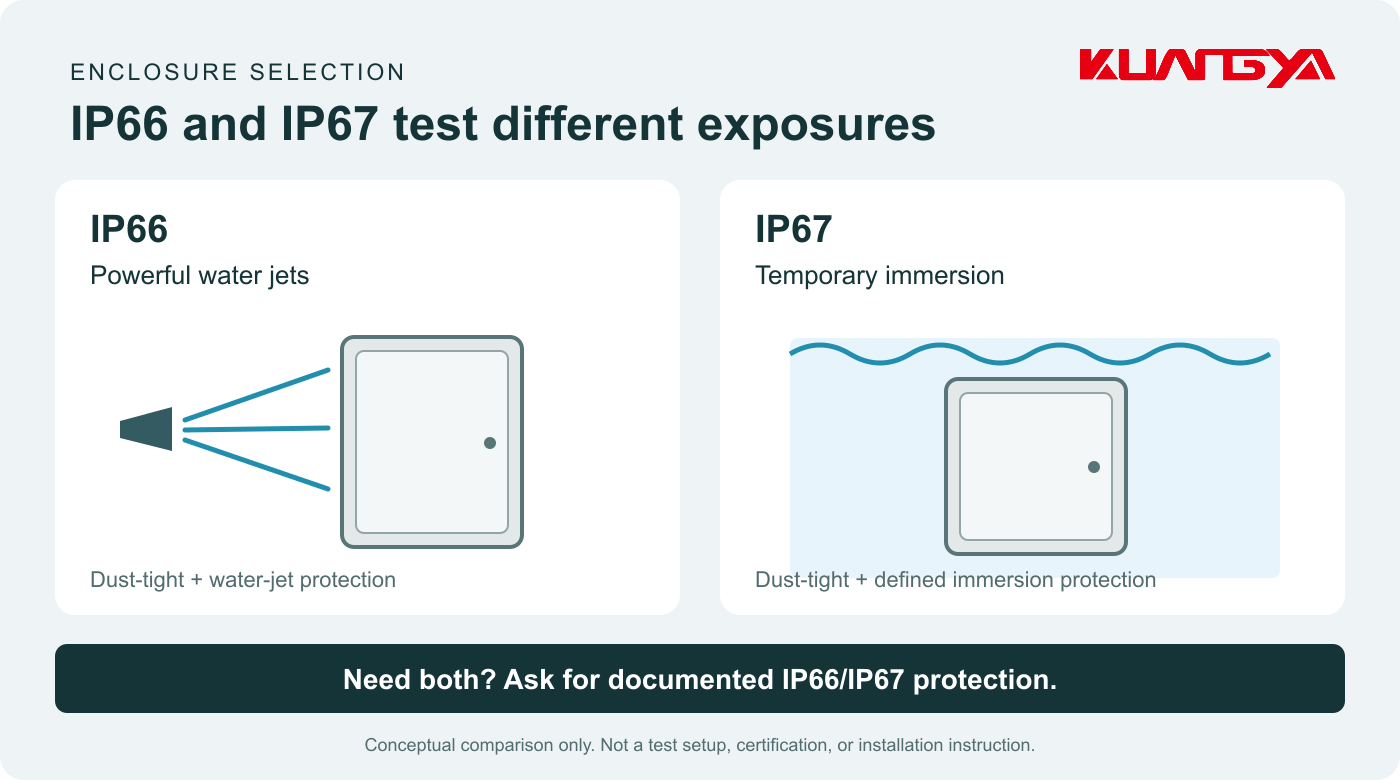
The important distinction is the type of exposure. A box that has passed an immersion test has not, simply by carrying that marking, demonstrated resistance to powerful water jets. Understanding this difference helps buyers ask for the right evidence before approving a product.
An IP code uses two digits to describe ingress protection. In these two ratings, the first digit is 6, meaning dust-tight. The second digit identifies the water-protection category.
| Selection point | IP66 | IP67 |
|---|---|---|
| Dust protection | Dust-tight | Dust-tight |
| Water exposure addressed | Powerful water jets | Temporary immersion |
| Immersion performance established? | No | Yes, under specified test conditions |
| IP66 jet performance established? | Yes | Not from the IP67 marking alone |
| Continuous immersion established? | No | No |
| Corrosion resistance established? | Not by this IP code alone | Not by this IP code alone |
IP65 is often enough for a sheltered rooftop, while IP66 is designed for powerful water jets and IP67 for temporary immersion. Choose from the exposure at the actual mounting position, not from the highest number alone.
| Rating | Water exposure tested | Typical PV use | When to ask for more evidence |
|---|---|---|---|
| IP65 | Water jets | Sheltered rooftop or wall-mounted box | Strong wash-down, coastal spray or pooling water |
| IP66 | Powerful water jets | Exposed rooftop, ground-mount or wash-down area | Temporary immersion or flood risk |
| IP67 | Temporary immersion under standardized conditions | Low mounting points or short-term flood exposure | Powerful jets, unless IPX6 is separately documented |
KUANGYA’s HD-3/1 PV combiner box, for example, is specified as a 1000VDC, 3-string, IP65 assembly. Match that published configuration to the site requirement and request a different rating when the exposure demands it.
These are defined protection categories, not promises that equipment will remain suitable under every possible outdoor condition. Hammond’s IEC 60529 guide distinguishes water-jet, temporary-immersion and continuous-immersion protection.
A water jet and standing water apply different challenges to an enclosure. Immersion classifications are evaluated separately from spray-water classifications. This is why a product may be marked IP66/IP67 rather than only carrying the higher number.
Phoenix Contact’s technical guidance explicitly explains that the immersion tests do not establish spray protection. A dual rating identifies products that have met both relevant categories. Read the manufacturer’s housing technical paper.
For procurement, the useful question is: “Which exposures have been evaluated for this exact enclosure configuration?” A general description such as “waterproof,” “outdoor grade” or “premium sealing” does not answer that question.
Start with a short site description. Record the mounting position, shelter, cleaning practices, drainage, environmental conditions and the project’s specified requirements. Then ask the supplier to explain how the proposed assembly meets them.
| Site condition | What to establish | Evidence to request |
|---|---|---|
| Exposed rooftop or ground-mounted array | Actual weather exposure, installation orientation and water paths | Outdoor suitability, declared IP rating and installation instructions |
| Water-jet cleaning nearby | Whether jets can reach the enclosure and under what conditions | Relevant water-jet rating; permitted cleaning conditions |
| Possible temporary immersion | Whether relocation or drainage can remove the exposure | Immersion conditions and confirmation of complete-assembly suitability |
| Both jets and immersion | Separate requirements for both exposures | Documented dual protection, such as IP66/IP67 where specified |
| Coastal or corrosive location | Material and coating durability | Separate corrosion-resistance evidence |
| Large temperature swings or humidity | Internal temperature and condensation risks | Application-specific thermal and moisture-control assessment |
This table is a specification aid, not a universal minimum-rating rule. The project designer must determine the requirements for the actual installation. An IP67 marking is not permission to place an ordinary combiner box where flooding is expected.
Example: A buyer receives one quotation for an IP66 assembly and another for an IP67 assembly. If the project requires powerful-water-jet protection, the buyer should request that evidence from both suppliers. The IP67 quotation should not receive automatic preference just because its number is higher.
For the electrical side of the specification, use our solar combiner box engineering guide alongside the enclosure review.
A solar combiner box includes more than a shell. Depending on the design, it may have cable glands, connectors, blanking plugs, handles, indicators or pressure-management accessories. Ask exactly which configuration the declared rating covers.
The sample-approval file should identify the enclosure model and its fitted accessories. It should also record the permitted cable diameters, closure requirements and mounting conditions from the relevant instructions.
A useful purchase requirement is:
Provide documentation supporting the specified ingress protection for the supplied assembly, including the identified enclosure, cable entries, sealing accessories and installation conditions.
Agree in advance how changes will be handled. Additional holes, substitute glands or new external accessories should trigger a review rather than an assumption that the original declaration still applies.
Our solar combiner box wiring guide provides related context for cable entries and internal components.
Water inside an enclosure is not always evidence of rainwater entering through a seal. Condensation can form when internal surfaces fall below the dew point. Humidity, temperature changes and moisture introduced during maintenance can all matter.
Rittal describes enclosure heating, appropriate cooling and pressure-management measures as options that depend on the application. A higher IP number alone does not resolve the internal climate. Read Rittal’s moisture-control guidance.
When a box is wet inside, first separate two failure modes. Water ingress usually points to a damaged gasket, loose cover, incorrect cable gland, unsealed spare opening or a change made after testing. Condensation can occur even when the enclosure passes its IP test: trapped humid air cools during a night-time temperature drop and reaches its dew point.
Check the door seal, cable entries, drain path, mounting orientation and maintenance history before upgrading the IP number. For recurring humidity, specify an application-appropriate pressure-equalizing vent or climate-control measure and follow the manufacturer’s instructions. An IP67 label alone does not solve condensation.
Ask separately about the enclosure material, coatings, seals, UV suitability and permitted temperature range. An ingress-protection code should not be used as the complete environmental specification. Rittal’s outdoor-enclosure guidance treats corrosion protection and climate control as distinct design considerations.
Do not convert IP66 directly into NEMA 4X. The rating systems have different scopes, including additional environmental criteria within NEMA classifications. Hammond labels its cross-reference as approximate and specifically warns against converting IEC classifications into NEMA type ratings.
Use this checklist to compare offers on documented suitability rather than catalogue wording.
| Check | Ask the supplier for | Keep in the project file |
|---|---|---|
| Product identity | Exact model, revision and assembly configuration | Approved drawing and component list |
| Ingress protection | Declared rating and supporting test documentation | Report identifying the relevant product and conditions |
| Dual exposure | Separate confirmation for jets and immersion if required | Evidence for both protection categories |
| Cable entries | Gland models, cable-size ranges and sealing instructions | Approved cable-entry schedule |
| Other openings | Specified plugs, handles, vents and external accessories | Assembly drawings and installation requirements |
| Environment | Material, corrosion, UV and temperature information | Evidence matched to the site requirements |
| Maintenance | Seal inspection and replacement instructions | Operating and maintenance documentation |
IP66 addresses powerful water jets; IP67 addresses temporary immersion under defined conditions. Both use the first digit 6 to identify dust-tight protection.
Not automatically. The appropriate rating depends on the expected exposure. Where both jets and temporary immersion are relevant, request evidence covering both.
No—not from the marking alone. Ask for a separate water-jet declaration or documented dual rating when that protection is required.
IP66 provides relevant ingress-protection information, but it does not establish every aspect of outdoor suitability. Review material durability, temperature, sunlight exposure, installation conditions and the project specification as well.
IP67 does not establish continuous-immersion capability. That is a separate category with conditions that must be checked with the manufacturer. Nor does an enclosure rating alone establish that a complete electrical assembly is suitable for submerged operation.
Yes. Moisture can condense when internal surfaces fall below the dew point. Ingress protection and condensation control address different parts of the environmental problem.
Do not infer the rating of the complete assembly from one component. Request documentation for the supplied configuration and follow the specified installation conditions.
Provide system voltage, string configuration, electrical protection requirements, mounting location and expected environmental exposure. Identify the required IP rating and whether jet protection, immersion protection or both must be documented.
PLAN YOUR NEXT PV PROJECT
Share your combiner box requirements with KUANGYA, including the installation location, expected exposure and required documentation. Ask for confirmation of the available configuration before sample approval.
View KUANGYA PV combiner box models → Review the HD-3/1 specification
Need a different string count, voltage or enclosure rating? Request a quotation from KUANGYA with the site exposure and documentation requirements.
Technical scope: this article explains enclosure selection concepts. Product-specific instructions and the project’s applicable requirements govern the final design.

