WengYang Industrial Zone Yueqing Wenzhou 325000
Work Hours
Monday to Friday: 7AM - 7PM
Weekend: 10AM - 5PM
WengYang Industrial Zone Yueqing Wenzhou 325000
Work Hours
Monday to Friday: 7AM - 7PM
Weekend: 10AM - 5PM

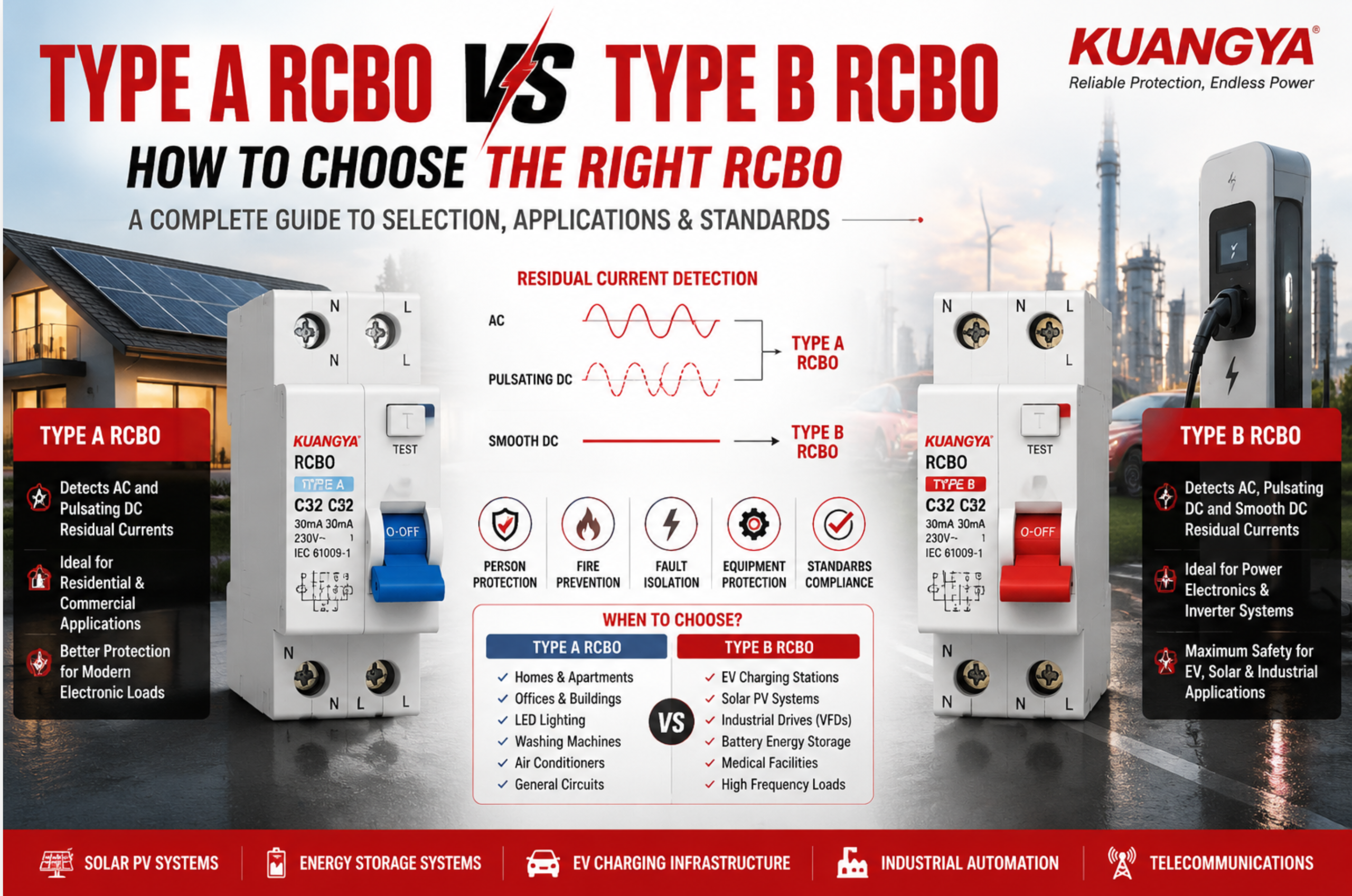
Selecting the correct Residual Current Circuit Breaker with Overcurrent Protection (RCBO) is critical for electrical safety, equipment protection, and compliance with modern electrical standards. As electrical installations increasingly include electronic devices, variable speed drives, electric vehicle chargers, solar inverters, and industrial automation systems, choosing the wrong RCBO type can lead to nuisance tripping, inadequate fault protection, or even dangerous safety risks.
Among the most commonly discussed RCBO categories are Type A RCBO and Type B RCBO. While both provide residual current protection and overcurrent protection in a single device, they are designed to detect different types of residual currents.
This guide explains the differences between Type A and Type B RCBOs, their operating principles, applications, advantages, and how to choose the right RCBO for your installation.
RCBO (Residual Current Breaker with Overcurrent) | Safe & Reliable Kuangya
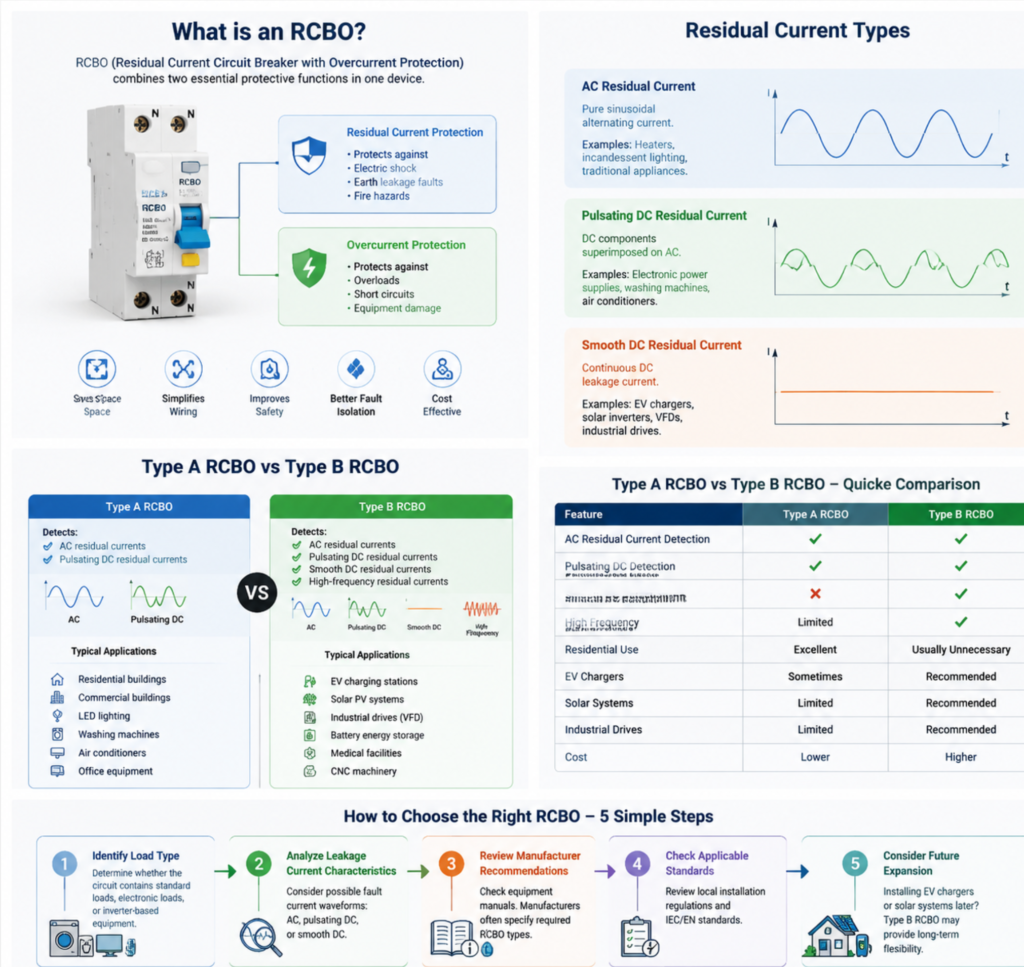
An RCBO (Residual Current Circuit Breaker with Overcurrent Protection) combines two essential protective functions:
Protects against:
Protects against:
Unlike a separate RCCB and MCB combination, an RCBO integrates both functions into a single compact device.
Many modern electrical loads generate residual currents that are no longer purely sinusoidal AC.
Examples include:
Traditional protection devices may fail to detect these fault currents properly.
Choosing the correct RCBO type ensures:
RCBO (Residual Current Breaker with Overcurrent) | Safe & Reliable Kuangya
Before comparing RCBO types, it is important to understand residual current waveforms.
Pure sinusoidal alternating current.
Examples:
Direct current components superimposed on AC waveforms.
Commonly generated by:
Continuous DC leakage current.
Commonly generated by:
Different RCBO types are designed to detect different leakage current waveforms.
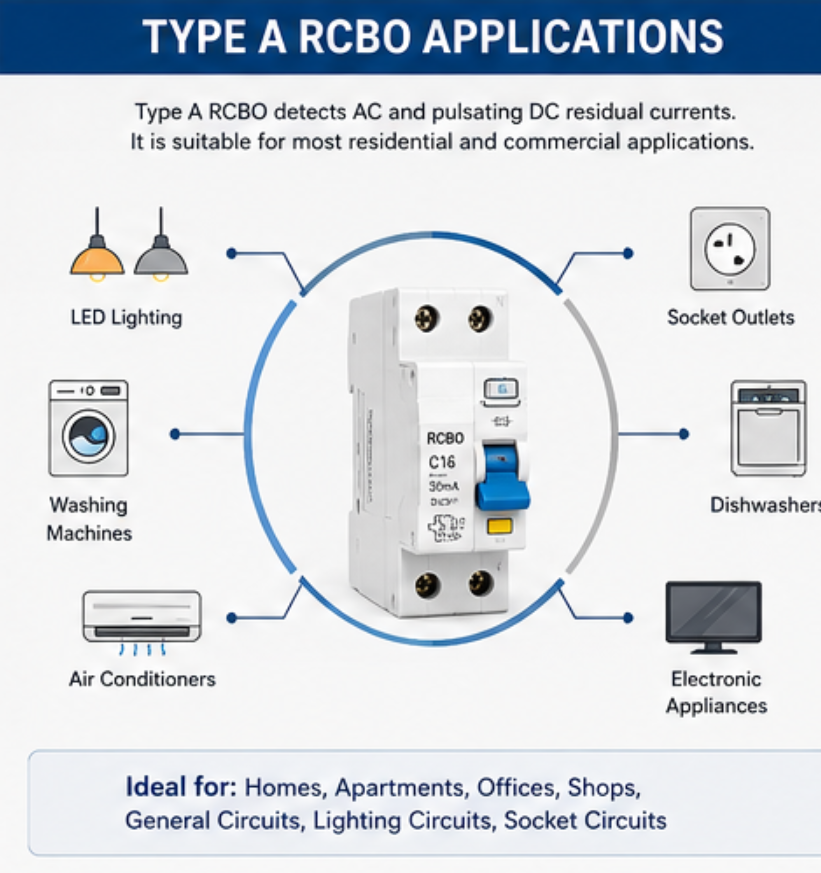
A Type A RCBO is designed to detect:
✔ AC residual currents
✔ Pulsating DC residual currents
Type A RCBO can respond to:
Type A RCBOs are suitable for:
Can detect leakage currents generated by modern electronic devices.
Provides advanced protection without the higher cost of Type B devices.
Recommended by many modern wiring regulations.
Better suited for electronic loads than Type AC devices.
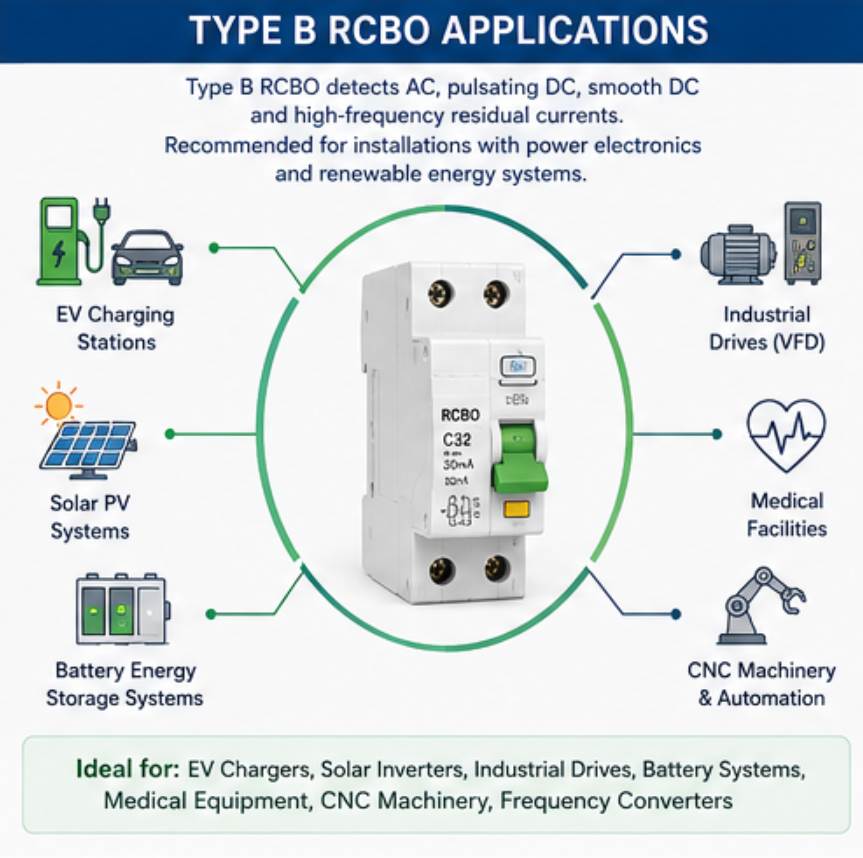
A Type B RCBO is designed to detect:
✔ AC residual currents
✔ Pulsating DC residual currents
✔ Smooth DC residual currents
✔ High-frequency residual currents
Type B RCBO provides the broadest residual current detection range.
It can detect:
Type B RCBOs are commonly used in:
Provides protection against all known residual current forms.
Specifically designed for modern inverter technologies.
Protects where smooth DC leakage could blind traditional protection devices.
Suitable for evolving electrical infrastructures.
| Feature | Type A RCBO | Type B RCBO |
|---|---|---|
| AC Residual Current Detection | Yes | Yes |
| Pulsating DC Detection | Yes | Yes |
| Smooth DC Detection | No | Yes |
| High Frequency Detection | Limited | Yes |
| Residential Use | Excellent | Usually Unnecessary |
| EV Chargers | Sometimes | Recommended |
| Solar Systems | Limited | Recommended |
| Industrial Drives | Limited | Recommended |
| Cost | Lower | Higher |
Choose a Type A RCBO if your installation includes:
For most modern residential applications, Type A RCBO is considered the minimum recommended protection level.
Choose a Type B RCBO when smooth DC residual currents may occur.
Electric vehicle chargers often generate DC leakage currents that Type A devices may not detect reliably.
PV inverters can produce smooth DC fault currents.
Variable frequency drives and servo systems create complex leakage waveforms.
Energy storage systems increasingly require Type B protection.
Certain medical installations demand enhanced residual current detection.
Using an incorrect RCBO type can lead to:
Dangerous leakage currents may remain undetected.
Personnel protection may be compromised.
Earth faults can generate excessive heat.
Incorrect protection selection may cause unnecessary shutdowns.
Failure to meet IEC and local electrical standards.
Several standards influence RCBO design and selection:
Always verify local regulations before selecting an RCBO.
Determine whether the circuit contains:
Consider possible fault current waveforms:
Check equipment manuals.
Manufacturers often specify required RCBO types.
Review local installation regulations.
Installing EV chargers or solar systems later?
A Type B RCBO may provide long-term flexibility.
Yes.
Type A RCBO detects both AC and pulsating DC leakage currents, making it suitable for modern electronic equipment.
No.
Type A devices cannot reliably detect smooth DC residual currents.
In many cases, yes.
Many EV charging installations either require Type B RCBOs or equivalent DC leakage protection.
Type B devices contain more advanced sensing technology capable of detecting a wider range of residual current frequencies and waveforms.
Choosing the correct RCBO is essential for electrical safety, equipment reliability, and regulatory compliance.
For most residential and commercial installations, a Type A RCBO provides excellent protection against both AC and pulsating DC residual currents generated by modern electronic devices.
For advanced applications involving electric vehicle charging, solar energy systems, industrial drives, battery storage, and inverter technology, a Type B RCBO is the preferred choice because it can detect smooth DC residual currents and complex leakage waveforms.
By understanding your electrical loads, evaluating potential fault current characteristics, and following applicable standards, you can confidently select the right RCBO and ensure long-term protection for people, property, and equipment.

