WengYang Industrial Zone Yueqing Wenzhou 325000
Work Hours
Monday to Friday: 7AM - 7PM
Weekend: 10AM - 5PM
WengYang Industrial Zone Yueqing Wenzhou 325000
Work Hours
Monday to Friday: 7AM - 7PM
Weekend: 10AM - 5PM

GFCI vs RCD: both detect current imbalance, but ratings, standards and device formats differ. Compare UL 943 GFCIs with IEC RCCBs and RCBOs before specifying.
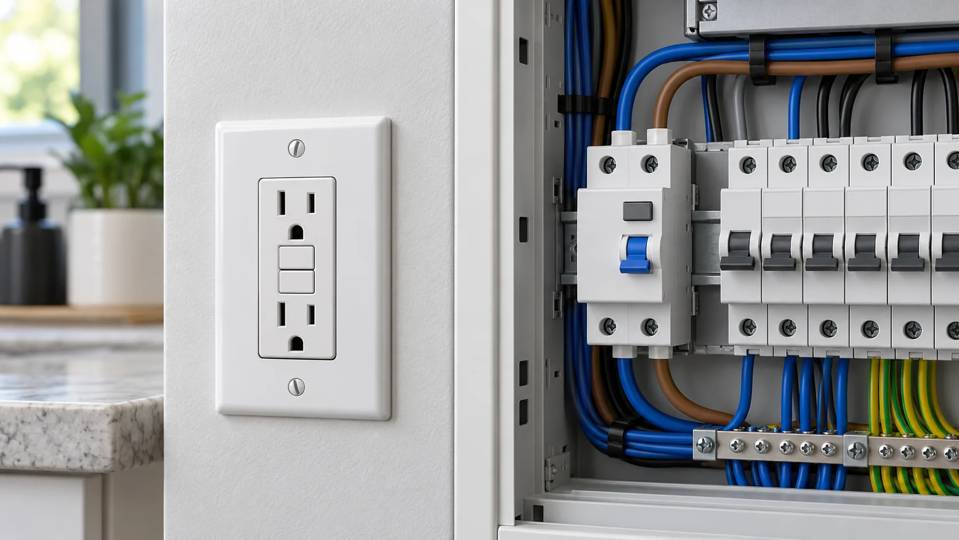
Quick answer: GFCI and RCD protection use the same basic idea: compare current leaving a circuit with current returning, then disconnect when an unsafe imbalance is detected. But GFCI vs RCD is not simply a spelling difference. “GFCI” usually refers to products specified under North American rules, while “RCD” is a broader term used in IEC-based systems. Their ratings, product standards, form factors and permitted applications must be checked separately.
For a distributor or project buyer, the practical question is not which abbreviation sounds familiar. It is which device is certified for the country, supply system and circuit you need to protect.
| Question | North American GFCI | IEC-market RCD |
|---|---|---|
| Full term | Ground-fault circuit interrupter | Residual current device |
| Basic function | Detects an imbalance caused by current taking an unintended path | Detects residual current: the imbalance among conductors passing through its sensing element |
| Common formats | Receptacle, portable device and circuit-breaker GFCI | RCCB, RCBO and other residual-current devices |
| Typical personal-protection example | Class A GFCI trips in the 4–6 mA range | A 30 mA RCD is commonly used for additional protection; other ratings also exist |
| Product standard to verify | UL 943 for the relevant GFCI category | IEC 61008 for RCCBs or IEC 61009 for RCBOs, as applicable |
| Interchangeable? | No automatic substitution: local code, listing, voltage, poles and installation conditions control the choice. | |
These are representative examples, not a universal sizing table. The US Occupational Safety and Health Administration (OSHA) describes the GFCI sensing principle, while Schneider Electric’s Electrical Installation Guide explains residual-current sensing in RCDs.
Both devices watch the current balance in a protected circuit. If some current returns by an unintended path, the difference can operate the device. That similarity helps explain why people sometimes call an RCD a “GFCI.” It does not prove that two products meet the same standard or provide the same trip performance.
In IEC terminology, RCD is an umbrella term. A residual current circuit breaker without integral overcurrent protection is an RCCB. A residual current circuit breaker with integral overcurrent protection is an RCBO. See our RCD vs RCCB explanation for the terminology inside that family.
A familiar North American Class A GFCI example operates in the 4–6 mA range. In many IEC-based installations, a 30 mA RCD is used as an additional measure of protection against electric shock. These numbers describe different product and installation frameworks. They do not mean that every RCD is 30 mA, or that a 30 mA RCCB is an acceptable replacement for a required Class A GFCI.
RCDs are available with different rated residual operating currents, and the appropriate value depends on the protection objective and local design rules. For a 30 mA application example, see the Electrical Installation Guide’s additional-protection discussion. For the GFCI range, see UL’s ground-fault protective-device guide.
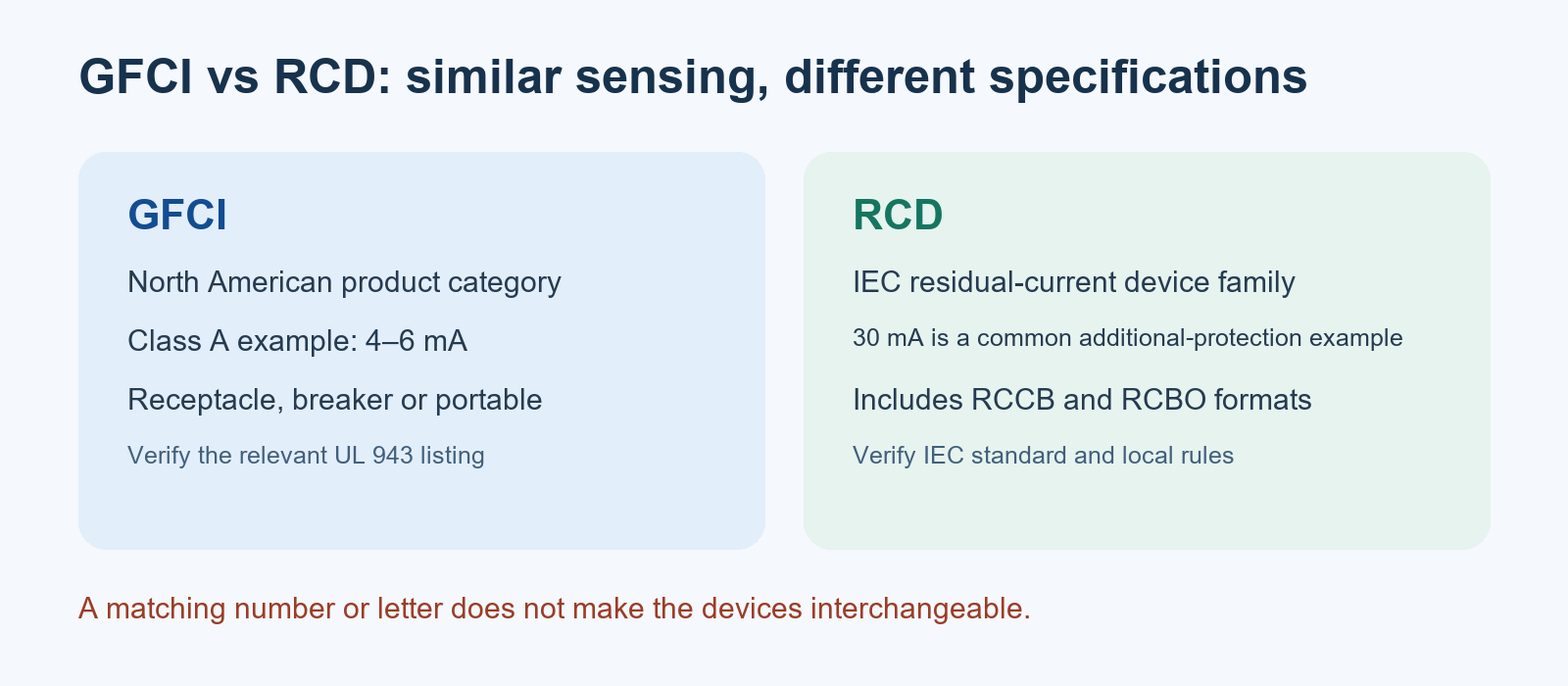
Many buyers picture a wall outlet with TEST and RESET buttons. Yet GFCI protection may also be built into a circuit breaker or a portable device. UL Solutions lists these GFCI formats under its testing and certification service. Likewise, IEC-market RCD protection can be delivered by several device forms rather than one universal DIN-rail unit.
The letters matter when specifying a panel. An RCCB does not contain integral overload or short-circuit protection; an RCBO combines residual-current and overcurrent protection. The IEC descriptions of IEC 61008 and IEC 61009 distinguish these product groups. A GFCI receptacle is also not a replacement for the circuit’s required overcurrent protective device. Some GFCI circuit breakers include breaker protection, but the exact functions must be verified from the listing and datasheet.
For project options, review KUANGYA’s RCCB range and RCBO range. Select by system voltage, poles, residual-current type and sensitivity, rated current, breaking capacity, certification and intended installation—not by product name alone.
This is a costly terminology trap. Class A is a North American GFCI classification. Type A is an IEC RCD classification associated with the residual-current waveforms a device can detect, including pulsating DC as well as sinusoidal AC. Similar letters do not establish equivalence. If a load contains electronics, an inverter or an EV charger, review the applicable residual-current waveform requirements instead of assuming any “A” marking is sufficient. Our Type A vs Type B RCCB guide explains that separate IEC choice.
Do not import a device merely because it has a similar trip-current number or a familiar TEST button. Product suitability is determined by its verified construction and the installation rules in the destination market.
Do not assume so. The devices may differ in trip behavior, listing, voltage, installation format and code acceptance. Have a qualified designer or electrician check the exact requirements for the circuit and jurisdiction.
No. An RCCB needs the appropriate associated overcurrent protection. An RCBO includes overcurrent protection, but its ratings and breaking capacity still need to match the circuit.
No. A GFCI or RCD responds to residual-current faults; an SPD addresses transient overvoltage. They solve different problems and may both be relevant in one installation.
Send KUANGYA the destination country, supply system, required residual-current type and sensitivity, poles, rated current, and applicable certification request. Contact our team to review suitable RCCB or RCBO options and documentation before ordering.

