Address
304 North Cardinal
St. Dorchester Center, MA 02124
Work Hours
Monday to Friday: 7AM - 7PM
Weekend: 10AM - 5PM
Address
304 North Cardinal
St. Dorchester Center, MA 02124
Work Hours
Monday to Friday: 7AM - 7PM
Weekend: 10AM - 5PM

EV Charging RCCB Selection: global electric vehicle revolution is accelerating at an unprecedented pace. With EV sales projected to exceed 20 million units annually by 2030, the demand for safe and reliable charging infrastructure has never been more critical. At the heart of every EV charging installation lies a crucial yet often overlooked component: the Residual Current Circuit Breaker (RCCB). This life-saving device serves as the silent guardian of electrical safety, protecting users from lethal electric shocks and preventing costly electrical fires.
However, selecting the right RCCB for EV charging applications is far from straightforward. Unlike traditional electrical loads, EV chargers present unique challenges that can render conventional protection devices ineffective or even dangerous. The presence of rectifiers, inverters, and sophisticated power electronics within modern EV chargers creates fault current waveforms that standard RCCB types simply cannot detect. This comprehensive guide will navigate you through the complexities of EV charging RCCB selection, ensuring your installations meet the highest safety standards while complying with evolving international regulations.
Whether you are an electrical contractor, facility manager, or EV charging station developer, understanding the nuances of RCCB selection is not merely a technical requirement—it is a fundamental responsibility for public safety and infrastructure reliability.
Modern EV chargers are essentially sophisticated power conversion systems. They take alternating current (AC) from the grid and convert it to direct current (DC) suitable for charging vehicle batteries. This conversion process involves rectifiers that can produce what engineers call “smooth DC” residual currents during fault conditions. Herein lies the critical challenge: traditional Type AC RCCBs, which have served residential and commercial applications for decades, are completely “blind” to smooth DC leakage currents.
When a smooth DC fault occurs—for instance, through insulation degradation in the charger’s internal DC bus or through damaged cables—the current flowing through the protective earth conductor contains a significant DC component. A standard Type AC RCCB uses a current transformer to detect imbalances between live and neutral conductors. However, DC currents can saturate the magnetic core of this transformer, effectively disabling the protection mechanism. The result is a dangerous false sense of security: the RCCB appears functional, passes routine testing, yet fails to trip when a real DC fault occurs.
The International Electrotechnical Commission (IEC) has recognized this vulnerability through standard IEC 60364-7-722, which specifically addresses electrical installations for EV charging. This standard mandates that EV charging points must be protected by residual current devices with appropriate sensitivity and waveform detection capabilities. The standard explicitly acknowledges that conventional protection may be inadequate and requires either Type B RCCBs or alternative protection schemes incorporating DC fault detection.
Furthermore, IEC 62955 defines specific requirements for DC fault detection devices intended for use with EV charging systems. These devices, often integrated within the EV supply equipment (EVSE) itself, provide an additional layer of protection specifically targeting the smooth DC fault currents that EV chargers can generate.
Type AC RCCBs represent the most basic form of residual current protection. They detect pure sinusoidal alternating current and trip when the residual current exceeds their rated sensitivity, typically 30mA for personnel protection. While suitable for purely resistive loads like incandescent lighting or heating elements, Type AC devices are fundamentally unsuitable for EV charging applications due to their inability to detect DC components.
Key Limitations for EV Charging:
Type A RCCBs offer enhanced protection compared to Type AC by detecting both pure AC and pulsating DC residual currents. These devices are designed to handle the half-wave rectified currents produced by single-phase power electronics, making them suitable for modern appliances with switched-mode power supplies. For many residential EV charging installations, Type A represents the minimum acceptable protection level, provided that additional DC fault protection is implemented within the EVSE itself.
However, Type A devices still cannot reliably detect smooth DC currents—the specific fault type most associated with EV charger failures. Therefore, while Type A RCCBs may meet minimum regulatory requirements when combined with appropriate DC fault detection, they do not provide comprehensive standalone protection for EV charging circuits.
Type F RCCBs build upon Type A capabilities by adding detection of high-frequency residual currents up to 1kHz. This enhanced frequency response makes Type F devices particularly valuable in installations with variable frequency drives, power converters, and other high-frequency switching equipment. While not specifically designed for EV charging, Type F RCCBs can provide superior protection in complex electrical environments where multiple electronic loads create harmonic-rich fault conditions.
Type B RCCBs represent the universal solution for modern electrical installations, including EV charging infrastructure. These advanced devices can detect:
The comprehensive detection capabilities of Type B RCCBs make them the only standalone solution that provides complete protection for EV charging applications without requiring additional DC fault detection devices. When a Type B RCCB is installed, it monitors for all possible fault current waveforms that an EV charger might generate, ensuring reliable protection regardless of the fault type.
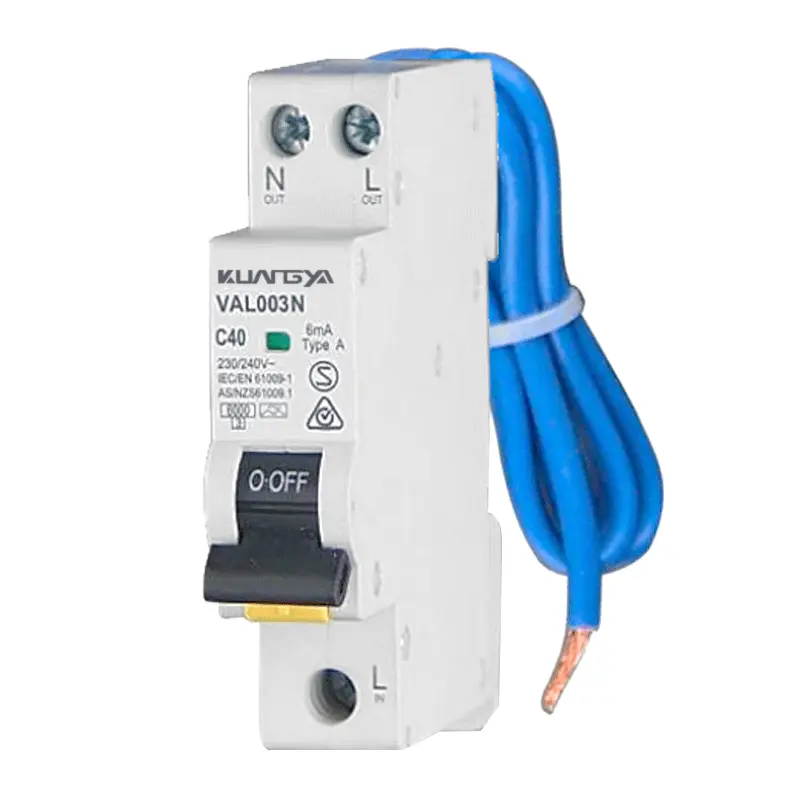
KUANGYA Type B RCBO combines residual current protection with overcurrent protection in a single compact device, ideal for EV charging applications.
| Feature | Type AC | Type A | Type F | Type B |
|---|---|---|---|---|
| AC Detection | Yes | Yes | Yes | Yes |
| Pulsating DC Detection | No | Yes | Yes | Yes |
| Smooth DC Detection | No | No | No | Yes |
| High-Frequency Detection | No | No | Up to 1kHz | Yes |
| EV Charging Suitability | Not Suitable | Conditional* | Limited | Ideal |
| Typical Cost | $ | $$ | $$$ | $$ |
| IEC 60364-7-722 Compliance | No | With DC detection | Limited | Full |
*Type A is acceptable only when combined with compliant DC fault detection devices integrated in the EVSE.
For EV charging applications, the standard sensitivity rating of 30mA provides appropriate protection against electric shock while minimizing nuisance tripping. However, certain installations may benefit from alternative sensitivities:
30mA Sensitivity: The standard choice for personnel protection in residential and commercial EV charging. This rating provides rapid disconnection (typically within 40ms at rated residual current) when dangerous leakage is detected.
100mA-300mA Sensitivity: Higher sensitivity ratings are typically used for upstream protection in selective coordination schemes or for fire protection in large installations. These ratings are generally inappropriate for direct EV charging protection due to reduced shock protection.
EV charging installations vary significantly in their electrical requirements:
Single-Phase Charging (7-11kW): Most residential and light commercial EV chargers operate on single-phase power. For these applications, a 2-pole RCCB (protecting both live and neutral conductors) provides comprehensive protection while maintaining cost-effectiveness.
Three-Phase Charging (22kW+): High-power commercial and fleet charging stations often utilize three-phase power. These installations require 4-pole RCCBs capable of monitoring all three phases plus neutral. Type B protection becomes even more critical in three-phase installations due to the increased complexity of potential fault conditions.
RCCBs provide protection against earth leakage currents but do not protect against overloads or short circuits. Therefore, every EV charging circuit requires coordinated overcurrent protection, typically provided by Miniature Circuit Breakers (MCBs). Installers have two primary options:
RCCB + MCB Combination: A separate RCCB installed upstream of individual MCBs protecting each charging circuit. This approach is cost-effective for multiple charging points but offers reduced selectivity—an earth fault on any circuit will disconnect power to all downstream loads.
RCBO (Residual Current Breaker with Overcurrent): A combined device integrating both RCCB and MCB functions in a single unit. RCBOs provide superior selectivity by localizing trips to the affected circuit only. For critical or high-availability EV charging installations, RCBOs are the preferred solution despite their higher unit cost.
The residential EV charging market represents the largest growth segment globally. Homeowners typically install Level 2 chargers (7-11kW) requiring dedicated 32A or 40A circuits. For these installations, a Type B 30mA RCCB or RCBO provides comprehensive protection without requiring complex coordination with EVSE-integrated DC fault detection.

Proper Type B RCCB installation in residential distribution boards ensures complete protection for home EV charging systems.
Best Practice Recommendation: Install a dedicated Type B 30mA RCBO for each EV charging circuit. This configuration provides both residual current and overcurrent protection while ensuring that faults affect only the charging circuit, not other household loads.
Commercial EV charging installations face unique challenges including higher utilization rates, multiple simultaneous charging sessions, and the need for maximum uptime. These factors make protection device selection and coordination particularly critical.
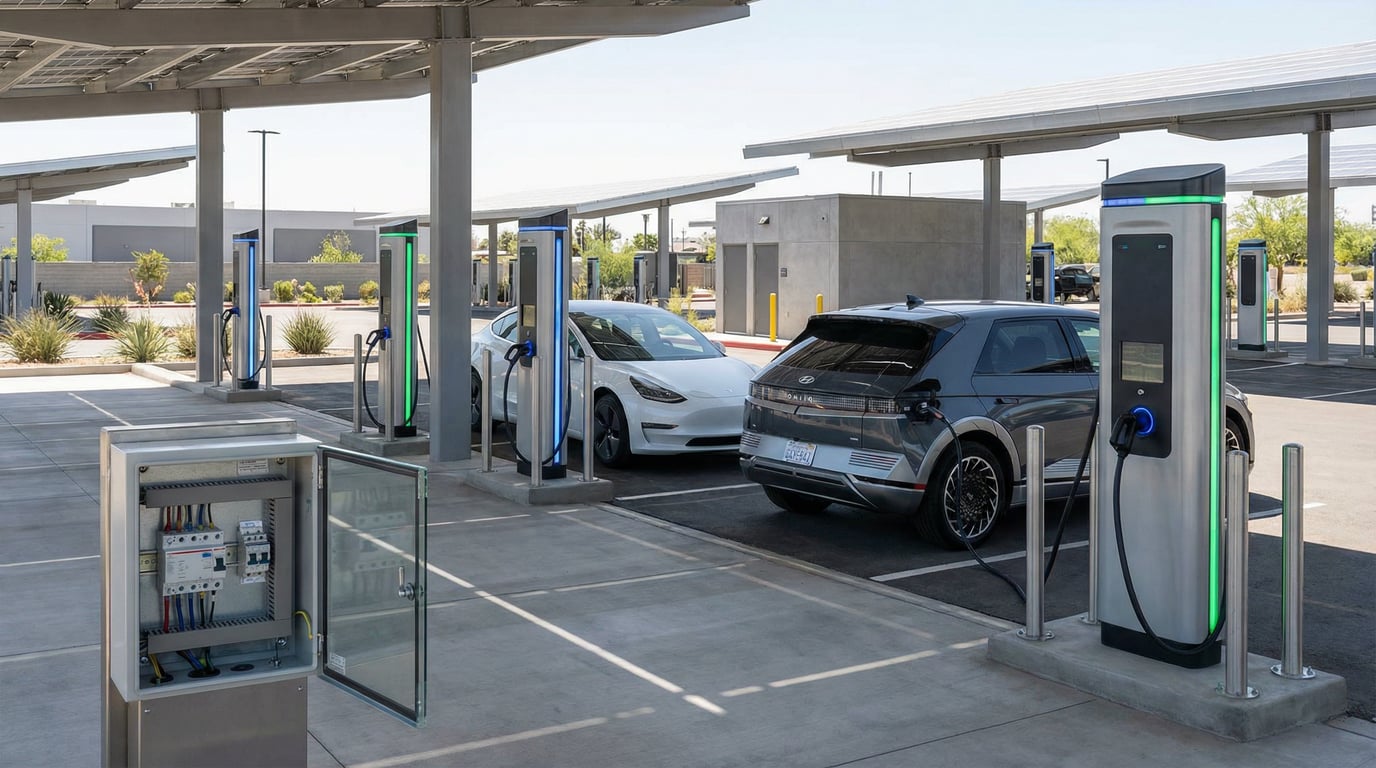
Modern commercial charging stations require comprehensive Type B protection to handle multiple high-power chargers safely.
Selective Coordination Strategy: Large commercial installations should implement selective protection using time-delayed (Type S) RCCBs upstream and instantaneous RCCBs or RCBOs on individual charging circuits. This coordination ensures that faults trip only the affected circuit while maintaining power to other charging points.
Consider a scenario where an electrical contractor installs a standard Type AC RCCB to protect a new 7kW home EV charger, believing all RCCBs provide equivalent protection. Six months after installation, insulation degradation in the charger’s internal DC bus creates a smooth DC fault path to earth. The fault current flows steadily at 50mA—well above the RCCB’s 30mA sensitivity rating—but because it is predominantly DC, the Type AC device does not detect it.
Over weeks, the persistent leakage current generates localized heating in the installation’s protective earth conductor. The heat degrades adjacent cable insulation, eventually creating a secondary fault. When the insulation finally fails completely, the resulting short circuit triggers a dramatic arc flash that ignites surrounding materials. The result is a devastating electrical fire that could have been prevented by proper Type B protection.
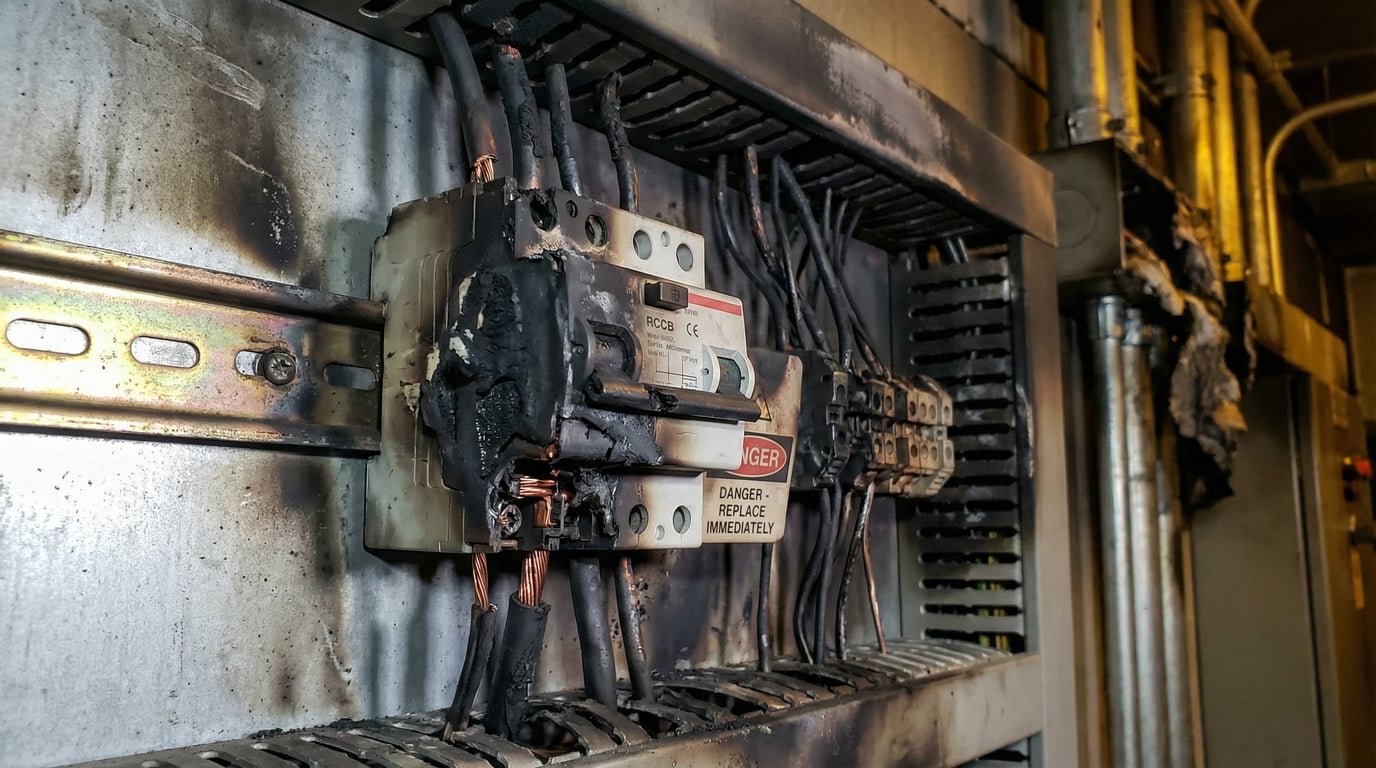
The devastating consequences of inadequate protection: fire-damaged electrical equipment resulting from substandard RCCB selection.
This scenario is not hypothetical. Fire investigators worldwide have documented cases where improper residual current protection contributed to electrical fires in EV charging installations. The financial cost of such incidents—often exceeding hundreds of thousands of dollars in property damage—far outweighs the incremental cost of installing appropriate Type B protection from the outset.
KUANGYA Electrical Equipment brings over 25 years of manufacturing expertise to the challenge of EV charging protection. Our Type B RCCB and RCBO product lines represent the culmination of extensive research, rigorous testing, and real-world validation across more than 2,000 new energy projects worldwide.
Type B RCCB (KYR2-B Series):
Type B RCBO (KYR6-B Series):
Universal Waveform Detection: KUANGYA Type B devices detect all residual current waveforms including smooth DC up to specified levels, ensuring comprehensive protection regardless of fault type.
High Breaking Capacity: With short-circuit breaking capacities up to 10kA (RCBO series), our devices can safely interrupt fault currents in demanding commercial installations.
Nuisance Trip Immunity: Advanced filtering algorithms distinguish between harmless leakage currents from normal EV charger operation and dangerous fault conditions, minimizing unwanted disconnections.
Temperature Stability: Extended operating temperature ranges (-25°C to +40°C standard, -40°C to +70°C for special models) ensure reliable performance in harsh environments including outdoor charging stations.
Yes, using a Type A RCCB is acceptable when the EV charging equipment (EVSE) incorporates compliant DC fault detection according to IEC 62955. In this configuration, the EVSE’s internal DC detection handles smooth DC faults, while the external Type A RCCB provides protection against AC and pulsating DC residual currents. However, this approach creates a dependency on the EVSE’s internal protection systems and requires verification that the specific EVSE model includes properly certified DC fault detection. For maximum safety and simplicity, many installers prefer the standalone protection provided by Type B RCCBs, which eliminates this dependency and provides a single point of verification for protection compliance.
Sizing an RCCB for EV charging involves several considerations beyond simply matching the charger’s rated current. First, determine the maximum continuous current of your EV charger—this is typically 32A for a 7kW single-phase unit or up to 32A per phase for 22kW three-phase chargers. Select an RCCB with a rated current at least equal to the circuit design current, considering any applicable derating factors for ambient temperature, installation conditions, or grouping with other devices. For the residual current sensitivity, 30mA is the standard choice for personnel protection in most EV charging applications. Higher sensitivities (100mA or 300mA) are generally reserved for upstream selective protection or fire protection applications rather than direct EV charging protection. Always consult local electrical codes and manufacturer specifications, as specific installations may have unique requirements based on cable sizing, earthing arrangements, or coordination with other protective devices.
The choice between separate RCCB and MCB devices versus a combined RCBO involves trade-offs between cost, selectivity, and space efficiency. An RCCB+MCB combination typically costs less per circuit and allows multiple MCBs to be protected by a single RCCB, making it economical for installations with many charging points. However, this configuration has a significant drawback: any earth fault on one circuit will trip the shared RCCB, disconnecting power to all circuits it protects. In contrast, an RCBO combines both functions in a single device, providing residual current and overcurrent protection independently for each circuit. When a fault occurs, only the affected circuit’s RCBO trips, maintaining power to other charging points. RCBOs also save valuable DIN rail space in distribution boards—an important consideration in compact installations. For residential and small commercial EV charging where circuit count is limited, RCBOs often provide the best balance of protection, selectivity, and installation convenience despite their higher unit cost.
The transition to electric transportation represents one of the most significant shifts in energy infrastructure since the electrification of the industrial age. As EV adoption accelerates, the electrical safety systems protecting this new infrastructure must evolve to meet unprecedented challenges. The selection of appropriate residual current protection for EV charging installations is not merely a technical specification detail—it is a fundamental investment in safety, reliability, and long-term operational success.
Type B RCCBs and RCBOs have emerged as the gold standard for EV charging protection, offering comprehensive detection capabilities that address the unique fault current characteristics of modern power electronics. While the incremental cost of Type B devices compared to traditional Type AC or Type A alternatives may seem significant in isolation, this investment pales in comparison to the potential costs of electrical accidents, fire damage, or liability exposure resulting from inadequate protection.
For electrical professionals, facility managers, and EV charging developers, the message is clear: specify Type B protection for all EV charging installations unless you can definitively verify that alternative protection schemes meet or exceed the safety level provided by comprehensive Type B detection. The future of sustainable transportation depends not only on advancing battery technology and charging speed but equally on ensuring that every charging session is protected by devices capable of detecting and interrupting every type of fault that modern electrical systems can produce.
KUANGYA Electrical Equipment stands ready to support your EV charging projects with comprehensive protection solutions engineered for performance, safety, and longevity. Our Type B RCCB and RCBO product lines represent the culmination of 25 years of manufacturing excellence and real-world validation across thousands of installations worldwide. Visit cnkuangya.com to explore our complete product catalog, download technical specifications, and request quotations. Together, we’ll build the safe, reliable charging infrastructure that powers the future of sustainable transportation.
For technical support and product inquiries, contact KUANGYA Electrical Equipment at [website contact] or visit our comprehensive resource center for EV charging protection guides, installation manuals, and certification documentation.

