Address
304 North Cardinal
St. Dorchester Center, MA 02124
Work Hours
Monday to Friday: 7AM - 7PM
Weekend: 10AM - 5PM
Address
304 North Cardinal
St. Dorchester Center, MA 02124
Work Hours
Monday to Friday: 7AM - 7PM
Weekend: 10AM - 5PM

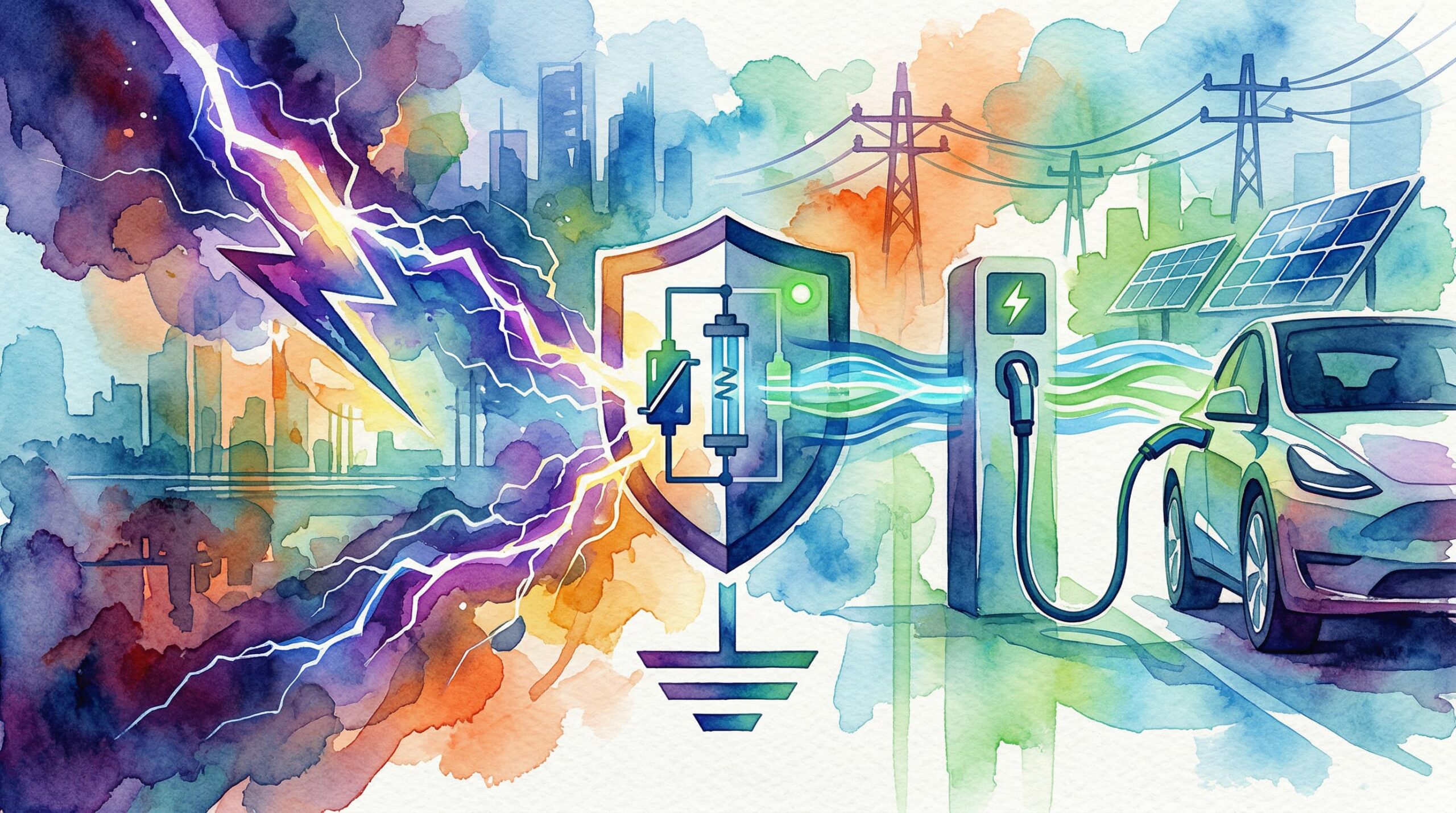
DC SPD: the global transition to clean energy accelerates, electric vehicle (EV) charging networks and battery energy storage systems (BESS) have become two of the most critical pillars of modern power infrastructure. Billions of dollars are being invested in charging corridors, grid-scale storage facilities, and distributed energy resources — yet one of the most overlooked threats to this infrastructure is also one of the most destructive: transient voltage surges. A single lightning strike or switching event can generate surge voltages of tens of thousands of volts in milliseconds, silently destroying inverters, battery management systems, and charging controllers worth hundreds of thousands of dollars. This is precisely why the DC SPD — the DC Surge Protective Device — has become an indispensable component in every serious clean energy installation.
A DC surge protector is a device connected in parallel with a DC power circuit, designed to detect and divert transient overvoltages before they can reach sensitive downstream equipment. Unlike AC systems, DC circuits present unique protection challenges: there is no natural zero-crossing point in the current waveform, which means arc suppression is inherently more difficult, and the continuous DC voltage can sustain fault arcs far longer than in AC environments. A purpose-built DC surge protection device addresses these challenges through specialized varistor (MOV) technology, gas discharge tubes (GDTs), and arc-quenching mechanisms engineered specifically for direct-current applications.
The physics of surge propagation in DC systems is unforgiving. When a lightning-induced surge travels along a cable connecting a rooftop solar array to a ground-floor battery storage unit, or when a high-power DC fast charger switches loads rapidly on a shared DC bus, the resulting voltage spike can exceed the insulation withstand voltage of connected electronics in under one microsecond. Without a properly rated DC SPD in place, the energy has nowhere to go except through the very components it is meant to power.
Modern surge protection devices for DC applications are classified under IEC/EN 61643-31, the international standard governing SPDs for use in low-voltage DC power distribution systems. This standard defines performance requirements for voltage protection level (Up), nominal discharge current (In), maximum continuous operating voltage (Ucpv), and short-circuit current rating (SCCR) — all parameters that must be carefully matched to the specific DC voltage and current characteristics of EV charging and energy storage applications.
Electric vehicle charging stations — particularly DC fast chargers (DCFC) operating at 150 kW, 350 kW, or higher — represent one of the most demanding environments for surge protection. These systems combine high DC bus voltages (typically 400 V to 1,000 V), significant switching transients from power electronics, and exposure to outdoor environments where direct and indirect lightning strikes are a constant threat.
A typical DC fast charging station architecture includes a grid-connected AC/DC rectifier, a DC distribution bus, individual charging modules, and communication/control electronics. Each of these subsystems is vulnerable to surge damage at different points. The AC input side requires AC SPDs, but the DC bus and the cable runs between the charging cabinet and the vehicle connector demand dedicated DC surge protectors rated for the full DC operating voltage of the system.
Consider a 400 V DC charging bus serving multiple charging points in a commercial parking facility. A nearby lightning strike inducing a 10 kA surge current into the DC cable infrastructure can generate a voltage spike of several thousand volts across the bus — far exceeding the 600 V or 800 V breakdown threshold of the power electronics inside each charger. A Type 2 DC SPD installed at the DC distribution board, rated with a nominal discharge current (In) of 20 kA and a voltage protection level (Up) of ≤2.0 kV, will clamp this transient within nanoseconds, diverting the surge energy safely to the protective earth conductor and preserving the integrity of every charger connected to that bus.
Beyond lightning protection, DC fast chargers also generate their own internal switching surges. The rapid on/off cycling of IGBT transistors and the inductive energy stored in cable harnesses create repetitive low-energy transients that, over time, degrade MOV-based protection components. This is why selecting a DC surge protection device with a high maximum discharge current (Imax) rating — not just a high In — is critical for EV charging applications where surge events may occur thousands of times per year.
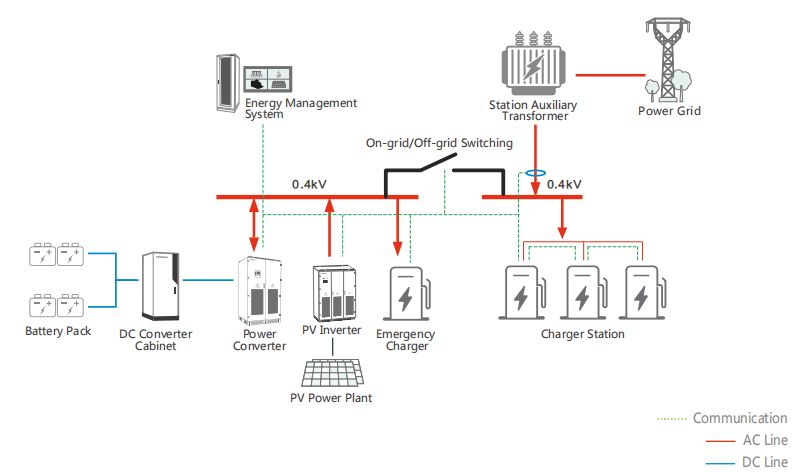
Battery energy storage systems introduce a different but equally serious set of surge protection requirements. A grid-scale BESS installation typically consists of battery modules connected in series/parallel strings to achieve system voltages of 600 V, 800 V, or even 1,500 V DC, feeding into bidirectional DC/AC inverters for grid interconnection. The sheer scale of these systems — with cable runs extending hundreds of meters between battery racks, inverters, and switchgear — creates extensive antenna-like structures that are highly susceptible to lightning-induced surges.
The battery management system (BMS) is the brain of any energy storage installation, continuously monitoring cell voltages, temperatures, and state of charge. It is also one of the most surge-sensitive components in the entire system. A surge event that bypasses protection and reaches the BMS communication buses or measurement circuits can corrupt firmware, destroy analog front-end ICs, or trigger false fault conditions that take the entire storage system offline. Installing DC SPDs at every interface point — between the battery strings and the DC bus, between the DC bus and the inverter, and on all signal and communication lines — creates a layered defense that protects both the high-power circuits and the sensitive control electronics simultaneously.
For lithium-ion based BESS installations, there is an additional fire safety dimension to surge protection. Overvoltage events that reach battery cells can trigger thermal runaway — a self-sustaining exothermic reaction that is extremely difficult to extinguish once initiated. While a DC surge protection device is not a substitute for proper battery thermal management, it eliminates one of the key electrical triggers for this catastrophic failure mode, making it an essential component of any responsible BESS safety architecture.
Among the various classes of DC surge protective devices, the Type 2 DC SPD has emerged as the most widely deployed solution across EV charging and energy storage applications. Classified under IEC/EN 61643-31 as a device tested with an 8/20 μs current waveform, Type 2 devices are designed for installation at the distribution level — downstream of the main service entrance but upstream of sensitive loads and equipment.
The Type 2 DC SPD offers the ideal balance between surge energy handling capacity and voltage protection level for most EV charging and BESS applications. Key performance parameters for a well-specified Type 2 device in these applications typically include:
| Parameter | Typical Value | Notes |
|---|---|---|
| Max. continuous operating voltage (Ucpv) | 600 V – 1,500 V DC | Matched to system DC bus voltage |
| Nominal discharge current (In) | 20 kA (8/20 μs) | Suitable for indirect lightning & switching surges |
| Maximum discharge current (Imax) | ≥ 40 kA | For high-lightning-risk zones |
| Voltage protection level (Up) | ≤ 2.0 kV at In | Protects standard-insulation equipment |
| Response time | < 25 ns | Clamps steepest lightning surge fronts |
| Short-circuit current rating (SCCR) | Per installation point | Matched to available fault current |
The modular design of modern Type 2 DC SPDs also provides a significant operational advantage: individual protection modules can be replaced in the field without de-energizing the entire system, minimizing downtime in commercial EV charging operations where every hour of unavailability represents lost revenue.
The following diagram illustrates a real-world deployment scenario combining solar PV generation, battery energy storage, and DC fast charging — a configuration increasingly common in highway rest stops, commercial fleet depots, and urban mobility hubs.
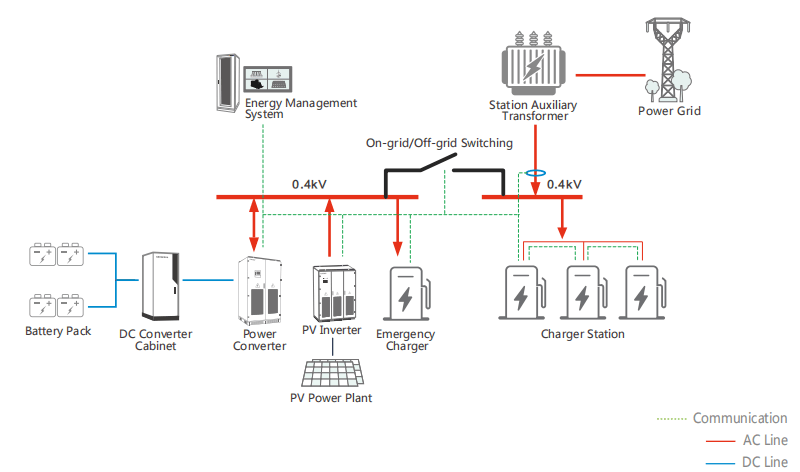
Figure 1: Integrated DC power architecture combining solar PV, BESS, and DC fast charging, with DC SPD protection points at each DC interface. KUANGYA DC surge protectors are deployed at every critical node to ensure system-wide transient protection.
In this architecture, DC surge protectors are deployed at four critical protection points:
Point 1 — Solar PV Array Output: A Type 1+2 DC SPD rated for the open-circuit voltage of the PV string (typically 1,000 V or 1,500 V DC) protects the combiner box and DC cable run from direct and indirect lightning strikes on the rooftop array.
Point 2 — Battery Storage DC Bus: A Type 2 DC SPD rated for the BESS system voltage (600 V or 800 V DC) protects the battery management system, cell monitoring circuits, and the DC/AC bidirectional inverter from surges propagating along the battery string cables.
Point 3 — DC Fast Charger Input: A Type 2 DC SPD installed at the DC distribution board feeding the charging stations protects all charger power electronics and communication systems from surges on the shared DC bus.
Point 4 — Vehicle Connector Interface: A Type 3 DC SPD provides point-of-use protection at the charging gun interface, guarding against residual surges and electrostatic discharge events during vehicle connection and disconnection.
This coordinated, multi-level protection strategy — combining DC surge protection devices at every interface — ensures that no single surge event, regardless of its origin or magnitude, can propagate through the system and cause cascading equipment failures.
Selecting the right DC SPD for an EV charging or energy storage application requires careful attention to both international standards and application-specific parameters. The primary governing standard is IEC/EN 61643-31, which defines the test methods, performance requirements, and marking requirements for DC SPDs used in low-voltage power distribution systems up to 1,500 V DC.
Additional standards relevant to EV charging and BESS applications include:
When evaluating DC surge protectors for a specific project, engineers should verify that the selected device carries third-party certification from a recognized testing laboratory (TÜV, UL, CE, or equivalent) to the applicable standard. Self-declared compliance without independent certification provides no assurance of actual performance under surge conditions.
At KUANGYA, every DC surge protection device we manufacture undergoes a rigorous multi-stage quality assurance process before leaving our facility. Our commitment to reliability is backed by internationally recognized certifications and a comprehensive warranty program designed to give installers and end-users complete confidence in the long-term performance of our products.
Figure 2 : KUANGYA DC SPD product line — CE & TÜV certified, IEC/EN 61643-31 compliant, ISO 9001 quality management, with 5-year product warranty. Every unit is 100% electrically tested before shipment.
Our quality assurance framework encompasses the following key pillars:
Material & Component Qualification: All metal oxide varistors (MOVs), gas discharge tubes (GDTs), and thermal disconnectors used in KUANGYA DC SPDs are sourced from qualified suppliers and subjected to incoming inspection against defined electrical and mechanical specifications. No substandard components enter our production line.
In-Process Quality Control: Every production batch undergoes 100% electrical testing, including voltage protection level verification, insulation resistance measurement, and continuity testing, using calibrated automated test equipment traceable to national standards.
Type Testing & Certification: Our Type 2 DC SPD product range has been type-tested to IEC/EN 61643-31 by accredited third-party laboratories, with CE marking and TÜV certification confirming compliance with European safety and performance requirements.
5-Year Product Warranty: KUANGYA stands behind every DC surge protector with a 5-year limited warranty covering defects in materials and workmanship under normal operating conditions. Our technical support team provides responsive assistance for installation questions, specification queries, and warranty claims throughout the product lifecycle.
A: The distinction between Type 1 and Type 2 DC SPD comes down to the magnitude of surge energy each device is designed to handle and the location within the electrical system where it should be installed.
A Type 1 DC SPD is tested with a 10/350 μs current waveform — the waveform that approximates a direct lightning strike — and is rated to handle the high-energy, long-duration surges that occur at the service entrance of a building or at the point where overhead lines transition to underground cables. Type 1 devices are mandatory in installations with external lightning protection systems (lightning rods) where a portion of the direct lightning current may be conducted into the electrical installation.
A Type 2 DC SPD, tested with an 8/20 μs waveform, is designed for installation at the distribution level — inside distribution boards, combiner boxes, and equipment enclosures — where it protects against the residual surges that have already been partially attenuated by the building’s electrical infrastructure and any upstream Type 1 protection. For most EV charging stations installed in commercial buildings or parking structures with standard grid connections, a Type 2 DC SPD installed at the DC distribution board feeding the chargers provides the appropriate level of protection. In installations with direct overhead line connections, exposed rooftop equipment, or locations in high-lightning-incidence zones, a coordinated Type 1 + Type 2 approach is recommended, with the Type 1 device at the service entrance and the Type 2 DC SPD at the charger distribution board.
A: Unlike circuit breakers or fuses, a DC surge protection device does not provide a visible indication of normal operation — it only activates during a surge event. This makes regular inspection essential, because a DC surge protector that has been degraded by repeated surge events may appear functional while actually providing little or no protection.
Most modern DC SPDs incorporate a built-in status indicator — typically a green/red window or a remote signaling contact — that changes state when the internal protection components have been consumed and the device needs replacement. These indicators should be visually inspected at least quarterly as part of routine maintenance of the EV charging or energy storage system. In high-lightning-risk locations or installations that have experienced known surge events (such as a nearby lightning strike), immediate inspection is warranted regardless of the scheduled maintenance interval.
In terms of proactive replacement, the industry consensus is that DC surge protection devices in outdoor or high-surge-exposure environments should be replaced every 5 to 7 years, even if the status indicator has not triggered, because MOV degradation is a cumulative process that is not always reflected in the indicator status until the device is near complete failure. KUANGYA’s 5-year warranty aligns with this replacement cycle, ensuring that covered installations are always operating with fully rated surge protection throughout the warranty period.
The economics of EV charging and energy storage are fundamentally about uptime and reliability. A DC fast charger that is offline for two weeks while a damaged inverter is repaired or replaced represents not just the cost of the repair — it represents lost charging revenue, frustrated customers, and potential contractual penalties. A grid-scale BESS that trips offline due to a surge-induced BMS fault can destabilize the grid services contract it was installed to support, with financial consequences that dwarf the cost of the protection equipment that could have prevented the event.
The DC SPD is not a luxury accessory for clean energy infrastructure — it is a foundational protection component whose cost, typically a fraction of one percent of total system cost, is justified many times over by the equipment damage, downtime, and liability it prevents. As DC system voltages continue to rise with the adoption of 800 V EV platforms and 1,500 V BESS architectures, the importance of properly specified, certified DC surge protection devices will only grow.
KUANGYA’s range of DC surge protectors, including our flagship Type 2 DC SPD series, is engineered to meet the exacting demands of next-generation EV charging and energy storage infrastructure — delivering the protection, reliability, and peace of mind that clean energy professionals require.
For technical specifications, application engineering support, or to request a product sample, contact the KUANGYA technical team.