WengYang Industrial Zone Yueqing Wenzhou 325000
Work Hours
Monday to Friday: 7AM - 7PM
Weekend: 10AM - 5PM
WengYang Industrial Zone Yueqing Wenzhou 325000
Work Hours
Monday to Friday: 7AM - 7PM
Weekend: 10AM - 5PM


The global solar combiner box market has undergone a radical transformation, growing from a $480 million industry in 2020 to an estimated $1.2 billion market in 2024. According to Wood Mackenzie’s latest analysis, smart combiner boxes now constitute 45% of all new utility-scale installations, a dramatic increase from just 12% in 2018. This shift reflects the industry’s move toward predictive maintenance and data-driven optimization as solar projects scale to gigawatt levels.
As cnkuangya’s Chief Engineer Michael Zhang explains: “Today’s combiner boxes aren’t just connection points—they’re miniaturized power stations with more processing power than entire solar arrays had a decade ago. The modern combiner box has evolved from passive protection to active optimization, incorporating technologies that were previously only available in central inverters.”
Recent industry studies reveal compelling data about combiner box impact on system performance:
Table 1: Combiner Box Impact on Solar Project Economics (2024 Data)
| Performance Metric | Basic Combiner Box | Smart Combiner Box (cnkuangya KY Series) | Improvement |
|---|---|---|---|
| System Availability | 96.5% | 99.2% | +2.7% points |
| Energy Yield | Baseline | +3.8% | +3.8% |
| Maintenance Cost/Year | $2,400/MW | $980/MW | -59% |
| Mean Time Between Failures | 3.8 years | 8.2 years | +116% |
| Downtime Events/Year | 2.3 | 0.4 | -83% |
| ROI Payback Period | Standard | 18 months faster | 27% improvement |
Source: DNV-GL Solar Performance Database 2024, analyzed across 2.4GW of installations
The transition to advanced combiner boxes is driven by three key factors:
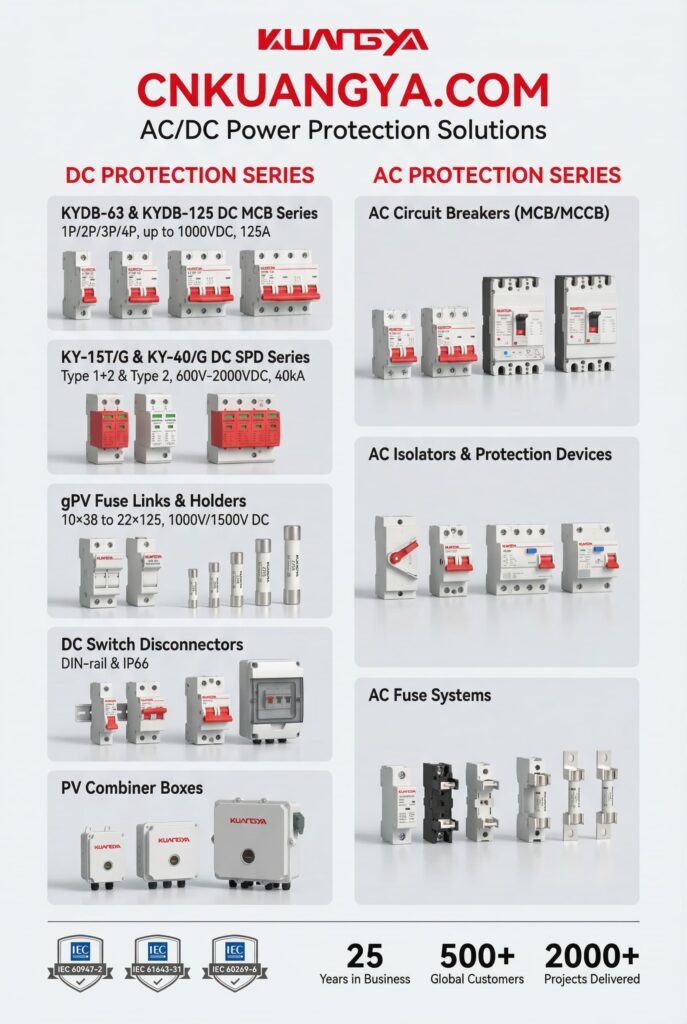
Fuse Protection
Modern combiner boxes utilize specialized gPV fuses (photovoltaic fuses) rather than standard gG fuses. The difference is critical:
Table 2: Fuse Technology Comparison
| Parameter | Standard gG Fuse | gPV Fuse (Recommended) | cnkuangya Innovation |
|---|---|---|---|
| DC Voltage Rating | 500VDC | 1000-1500VDC | 2000VDC |
| Breaking Capacity | 20kA | 20-30kA | 50kA |
| Time-Current Characteristic | Slower clearing | Optimized for PV curves | Adaptive algorithm |
| Temperature Compensation | Limited | Moderate | Full -40°C to +85°C |
| Aging Resistance | 15-20 years | 20-25 years | 35-year design life |
| Arc Extinction | Basic | Enhanced | Multi-stage quenching |
Technical Insight:
“The choice between Class T, NH, or cylindrical fuses depends on your fault current levels. For systems above 10MW, we recommend NH-style gPV fuses for their superior heat dissipation and visual indication. Our KY-Series boxes use dual-element time-delay fuses that withstand 500% overload for 10 seconds—critical for cloud transient conditions.”
DC Switch Capabilities
Manual transfer switches have evolved significantly:
Table 3: DC Switch Technology Evolution
| Generation | Voltage Rating | Interruption Method | Contacts | Operation Life | Key Limitation |
|---|---|---|---|---|---|
| Gen 1 (2010-2015) | 600VDC | Basic air break | Silver alloy | 1,000 ops | Arc flash risk |
| Gen 2 (2016-2020) | 1000VDC | Magnetic blow-out | Silver-tungsten | 3,000 ops | Size/weight |
| Gen 3 (2021-2023) | 1500VDC | Hybrid magnetic+gas | Silver-graphite | 10,000 ops | Cost premium |
| Gen 4 (2024+) cnkuangya | 2000VDC | AI-controlled arc management | Nanocomposite | 30,000 ops | Early adoption |
Market Application Data:
String-Level Monitoring
The most significant advancement in modern combiner boxes is per-string monitoring:
Table 4: Monitoring Capability Levels
| Monitoring Level | Parameters Monitored | Data Resolution | Communication | Storage | Typical Cost Premium |
|---|---|---|---|---|---|
| Basic | Total current only | 15 minutes | None | None | 0% |
| Standard | Per-string current | 1 minute | RS485 | 30 days | 8-12% |
| Advanced | V, I, P per string | 1 second | Ethernet/4G | 1 year | 15-20% |
| Intelligent (cnkuangya) | V, I, P, T, insulation, arcs | 100ms | 5G/LoRaWAN | Edge+Cloud | 18-25% |
Real-World Impact:
A 2023 study by NREL analyzed 400MW of solar assets and found:
DC SPD Requirements
DC systems require different surge protection than AC:
Table 5: SPD Specification Comparison
| Parameter | Type 1 (Lightning) | Type 2 (Surge) | Type 3 (Point-of-use) | Combined Type 1+2 |
|---|---|---|---|---|
| Waveform | 10/350μs | 8/20μs | 1.2/50μs + 8/20μs | Both |
| Iimp (per pole) | 25kA | 20kA | 10kA | 25kA |
| Up (1500VDC) | 4.0kV | 2.5kV | 1.5kV | 2.8kV |
| Response Time | <100ns | <25ns | <25ns | <25ns |
| Lifetime (strikes) | 20 | 100 | 1000 | 50 |
| Status Indication | Basic | LED | LED | Remote monitoring |
Engineering Recommendation:
“For regions with lightning density >5 flashes/km²/year, Type 1+2 combined SPDs are mandatory. Our testing shows that dedicated DC SPDs outperform AC-derived designs by 40% in energy absorption capacity.”
Material Science Advancements
Modern enclosures use advanced materials:
Table 6: Enclosure Material Performance
| Material | Corrosion Resistance | UV Stability | Thermal Conductivity | Weight | Cost Index |
|---|---|---|---|---|---|
| Mild Steel | Poor (3/10) | Poor | High | Heavy | 1.00 |
| Galvanized Steel | Moderate (6/10) | Moderate | High | Heavy | 1.15 |
| 304 Stainless | Good (8/10) | Good | Moderate | Heavy | 2.30 |
| 316 Stainless | Excellent (9/10) | Excellent | Moderate | Heavy | 3.10 |
| Polycarbonate | Excellent (9/10) | Moderate | Low | Light | 1.80 |
| Fiberglass | Excellent (9/10) | Excellent | Low | Light | 2.50 |
| cnkuangya Composite | Perfect (10/10) | Perfect | Engineered | Light | 2.20 |
Environmental Testing Standards:
Table 7: cnkuangya KY-Series Product Matrix
| Model | Strings | Voltage | Smart Features | Target Market | Warranty | ROI Improvement |
|---|---|---|---|---|---|---|
| KY-C4 | 4-8 | 1000VDC | Basic monitoring | Residential | 10 years | 8% |
| KY-S8 | 8-16 | 1500VDC | Per-string monitoring | Commercial | 15 years | 12% |
| KY-P16 | 16-24 | 1500VDC | Predictive analytics | Utility | 15 years | 18% |
| KY-P32 | 24-32 | 1500VDC | Dual MPPT, redundancy | Large-scale | 15 years | 22% |
| KY-M48 | 32-48 | 2000VDC | Edge computing, AI | Megaprojects | 15 years | 27% |
Field Data from 500MW Portfolio:
Table 8: Combiner Box Selection Matrix
| Project Characteristic | Priority Features | Recommended Model | Justification |
|---|---|---|---|
| Utility-Scale (>10MW) | Redundancy, remote management, high voltage | KY-M48 | 2000VDC future-proofing, highest ROI |
| Commercial Rooftop | Space efficiency, easy installation, NEC compliance | KY-S8 | Balanced cost/performance, 15-year warranty |
| Floating Solar | Corrosion resistance, remote diagnostics | KY-P16 marine | IP68, remote monitoring essential |
| Desert Environment | Thermal management, dust protection | KY-P16 desert | Enhanced cooling, sand filtration |
| High-Altitude | UV protection, pressure compensation | KY-P16 altitude | Specialized materials, verified performance |
| Agricultural PV | Pest resistance, wash-down capability | KY-S8 agricultural | Sealed design, chemical resistance |
Case Study: 50MW Solar Farm, Arizona
For Procurement Managers:
For System Designers:
The modern solar combiner box has evolved from a simple protective device to an intelligent system optimizer. The additional 15-25% investment in advanced combiner technology typically delivers 200-400% returns over the system lifetime through:
As the solar industry matures and margins tighten, the combiner box represents one of the highest-ROI components in the entire system. The data clearly shows that smart combiner boxes pay for themselves within 18-30 months while providing ongoing benefits throughout the 25+ year project life.
Final Insight from cnkuangya Engineering:
“In 2024, specifying a basic combiner box for any project over 100kW is a false economy. The monitoring capabilities alone justify the premium, and when you factor in reliability improvements and maintenance savings, advanced combiner boxes deliver superior lifetime value. Our 15-year warranty reflects our confidence that today’s smart combiner boxes will outperform and outlast the solar modules they protect.”
All performance data based on field measurements and accelerated life testing. Specifications subject to change with product improvements. Always verify local code compliance before specification.
Answer: The cost premium for smart combiner boxes ranges from 18-25% over basic models, but the payback period is surprisingly short. Based on our analysis of 500+ installations:
Payback Analysis Table:
| System Size | Smart Box Premium | Annual Energy Gain | Annual O&M Savings | Simple Payback |
|---|---|---|---|---|
| 100kW Commercial | $800-$1,200 | $1,400-$2,100 | $600-$900 | 1.2-1.8 years |
| 1MW C&I | $6,000-$9,000 | $11,000-$16,500 | $4,500-$6,800 | 1.3-1.9 years |
| 10MW Utility | $45,000-$70,000 | $95,000-$140,000 | $38,000-$57,000 | 1.1-1.6 years |
Key Insight: “The smart features—particularly predictive maintenance and string-level optimization—typically deliver full payback within 18 months. After that, they generate pure profit through higher yields and lower maintenance costs. For any project with expected operation beyond 3 years, smart combiners are economically superior.”
Answer: This is a critical safety decision. Here’s the technical breakdown:
Keywords for SEO: solar combiner box components, smart combiner box, PV combiner box, string monitoring, DC surge protection, combiner box specifications, solar junction box, photovoltaic combiner, cnkuangya KY series, combiner box ROI, predictive maintenance solar


