WengYang Industrial Zone Yueqing Wenzhou 325000
Work Hours
Monday to Friday: 7AM - 7PM
Weekend: 10AM - 5PM
WengYang Industrial Zone Yueqing Wenzhou 325000
Work Hours
Monday to Friday: 7AM - 7PM
Weekend: 10AM - 5PM

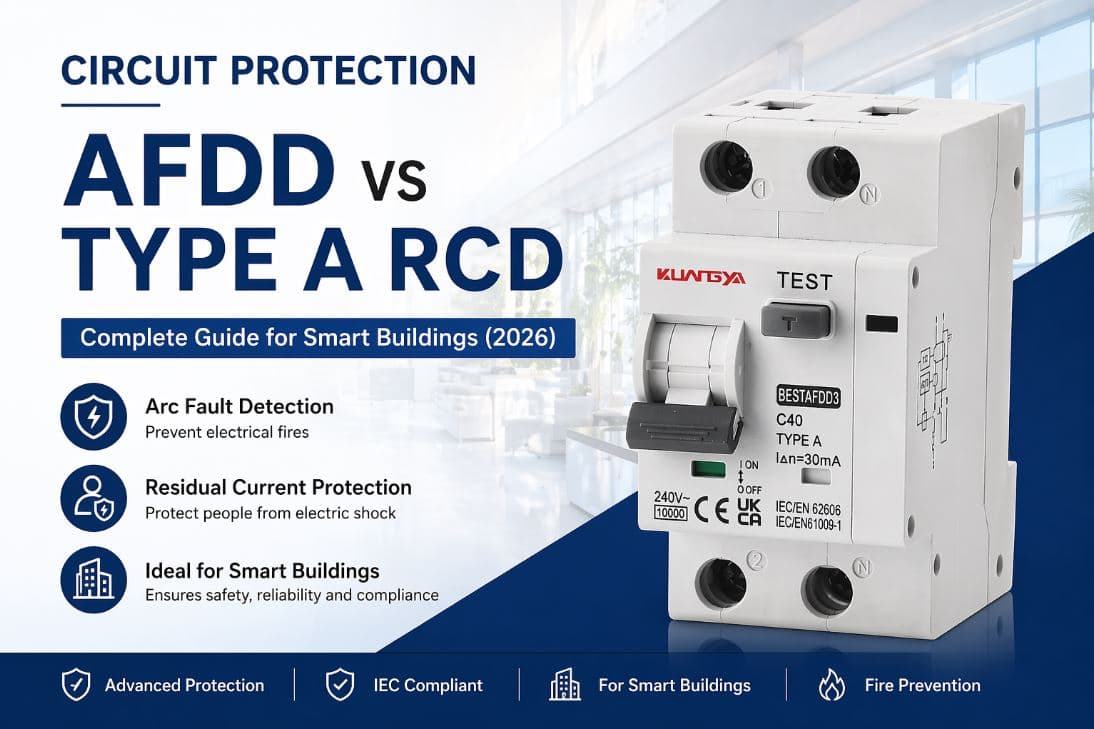
In modern smart buildings, circuit protection is more critical than ever. With the rapid growth of IoT devices, EV charging systems, automation controls, and energy-efficient equipment, electrical systems have become significantly more complex than traditional installations.
Conventional circuit breakers alone are no longer sufficient to detect all types of electrical faults. In fact, many dangerous conditions—such as arc faults or DC leakage currents—can remain undetected until they cause serious damage.
According to global safety data, the two leading causes of electrical incidents are:
To address these risks, engineers and contractors are increasingly adopting a dual-layer circuit protection solution:
👉 AFDD (Arc Fault Detection Device)
👉 Type A RCD (Residual Current Device)
Together, they provide a comprehensive approach to modern electrical safety.
Circuit protection refers to a system of devices designed to prevent electrical hazards and ensure safe operation of electrical installations.
A complete circuit protection system helps to:
In traditional systems, protection mainly relies on circuit breakers and basic RCDs. However, these devices cannot detect all fault types—especially arc faults, which are one of the most common causes of electrical fires.
👉 This is why advanced circuit protection solutions now include both AFDD and Type A RCD.
Although both devices are essential for safety, they serve completely different purposes.
| Device | Function | Detection Method | Main Protection |
|---|---|---|---|
| Type A RCD | Detects leakage current | Monitors imbalance between live and neutral | Protects people from electric shock |
| AFDD | Detects arc faults | Analyzes waveform for arc signatures | Prevents electrical fires |
👉 A complete circuit protection system requires both devices working together
To better understand where AFDD is used, watch the video below.
This video explains the most common applications of AFDD in modern circuit protection systems, including smart buildings, EV charging stations, and commercial facilities.
👉 It helps you quickly determine whether AFDD is suitable for your project.
Modern applications demand higher levels of safety. The combination of AFDD and Type A RCD is particularly suitable for:
Smart systems include automation, sensors, and communication devices that generate complex electrical signals.
Electric vehicle chargers introduce DC leakage currents and high loads, increasing both shock and fire risks.
Downtime can result in massive financial losses. Advanced circuit protection ensures continuous operation.
High temperatures, heavy loads, and grease increase fire hazards.
Older wiring systems are more prone to insulation failure and arc faults.
👉 If your project falls into any of these categories, upgrading your circuit protection system is strongly recommended.
Modern buildings use:
These components generate harmonics and DC leakage currents that can interfere with traditional protection devices.
👉 Type A RCD can detect DC leakage
👉 AFDD can distinguish real arc faults from electrical noise
Arc faults can occur due to:
Unlike short circuits, arc faults may not trigger standard circuit breakers.
👉 This makes AFDD essential for fire prevention.
In facilities like:
Even a short interruption can result in significant losses.
👉 Advanced circuit protection solutions help prevent unexpected failures.
Electrical safety standards are evolving globally:
👉 The trend is clear: advanced circuit protection is becoming the global standard
To meet these modern requirements, Kuangya provides a complete range of circuit protection solutions designed for international markets.
Our solutions are available in multiple configurations:
👉 Designed to meet different project requirements across Southeast Asia, the Middle East, and Europe.
Selecting the right configuration is essential for both safety and compliance.
Focus on areas with higher load or fire risk.
Decide between combined devices or separate installations.
Check that devices meet IEC standards.
Ensure selective tripping to avoid full system shutdown.
Always perform proper testing before operation.
👉 A well-designed circuit protection system ensures long-term reliability.
Without proper protection, electrical faults can go unnoticed.
👉 Many electrical fires start silently and spread quickly.
This is why relying only on traditional circuit breakers is no longer sufficient.
In a smart building project in Southeast Asia, upgrading to a full circuit protection system with AFDD and Type A RCD resulted in:
👉 This solution is now widely adopted in similar projects.
Circuit protection refers to devices that prevent electrical hazards such as shock, fire, and equipment damage.
Yes. They protect against different risks and should be used together.
No. AFDD works together with circuit breakers and RCDs.
In many regions, it is becoming mandatory or strongly recommended.
In high-risk circuits such as residential buildings, EV charging systems, and commercial facilities.
👉 We focus on delivering reliable circuit protection solutions for modern electrical systems.
Choosing the right circuit protection system can be complex—but we’re here to help.
We offer:
👉 Contact us today to get a tailored recommendation
👉 Send your project details and our engineers will assist you
As electrical systems become more advanced, the need for reliable circuit protection continues to grow.
AFDD and Type A RCD are no longer optional—they are essential components of a modern electrical safety strategy.
By combining protection against electric shock and fire hazards, they provide a complete solution for smart buildings and industrial applications.
👉 Investing in advanced circuit protection today means building a safer and more reliable future.
Explore Kuangya’s circuit protection products here: [Kuangya]

