Address
304 North Cardinal
St. Dorchester Center, MA 02124
Work Hours
Monday to Friday: 7AM - 7PM
Weekend: 10AM - 5PM
Address
304 North Cardinal
St. Dorchester Center, MA 02124
Work Hours
Monday to Friday: 7AM - 7PM
Weekend: 10AM - 5PM


Focus Keyword: DC Fuse | SEO Title: China Fuse Factory Suggest – How to Source a High-Quality DC Fuse Manufacturer\
Published on: cnkuangya.com | Category: Sourcing Guide / Technical Blog
Picture this: You’ve just commissioned a 500kW solar farm. The inverters are humming, the panels are gleaming, and the project manager is smiling. Three weeks later, a batch of undersized, poorly rated DC fuses fail silently under a high-current fault — not tripping fast enough, not interrupting cleanly. The result? Burned busbars, damaged inverter modules, and a warranty dispute that drags on for six months.
This isn’t a hypothetical. It’s a scenario that plays out repeatedly across solar, EV charging, and industrial battery storage projects — almost always traced back to one root cause: the wrong DC fuse from the wrong factory.
Sourcing a DC fuse seems deceptively simple. It’s a passive component. It doesn’t have firmware. It doesn’t need calibration. But here’s the brutal truth that 15 years in electrical automation has taught me: a DC fuse is the last line of defense in your entire circuit. Its quality is binary — it either saves your system or it doesn’t. There is no middle ground.
This guide is written for engineers and procurement managers who are serious about getting it right. We’ll walk through exactly how to evaluate, shortlist, and qualify a China fuse factory that can deliver DC fuses worthy of your application.
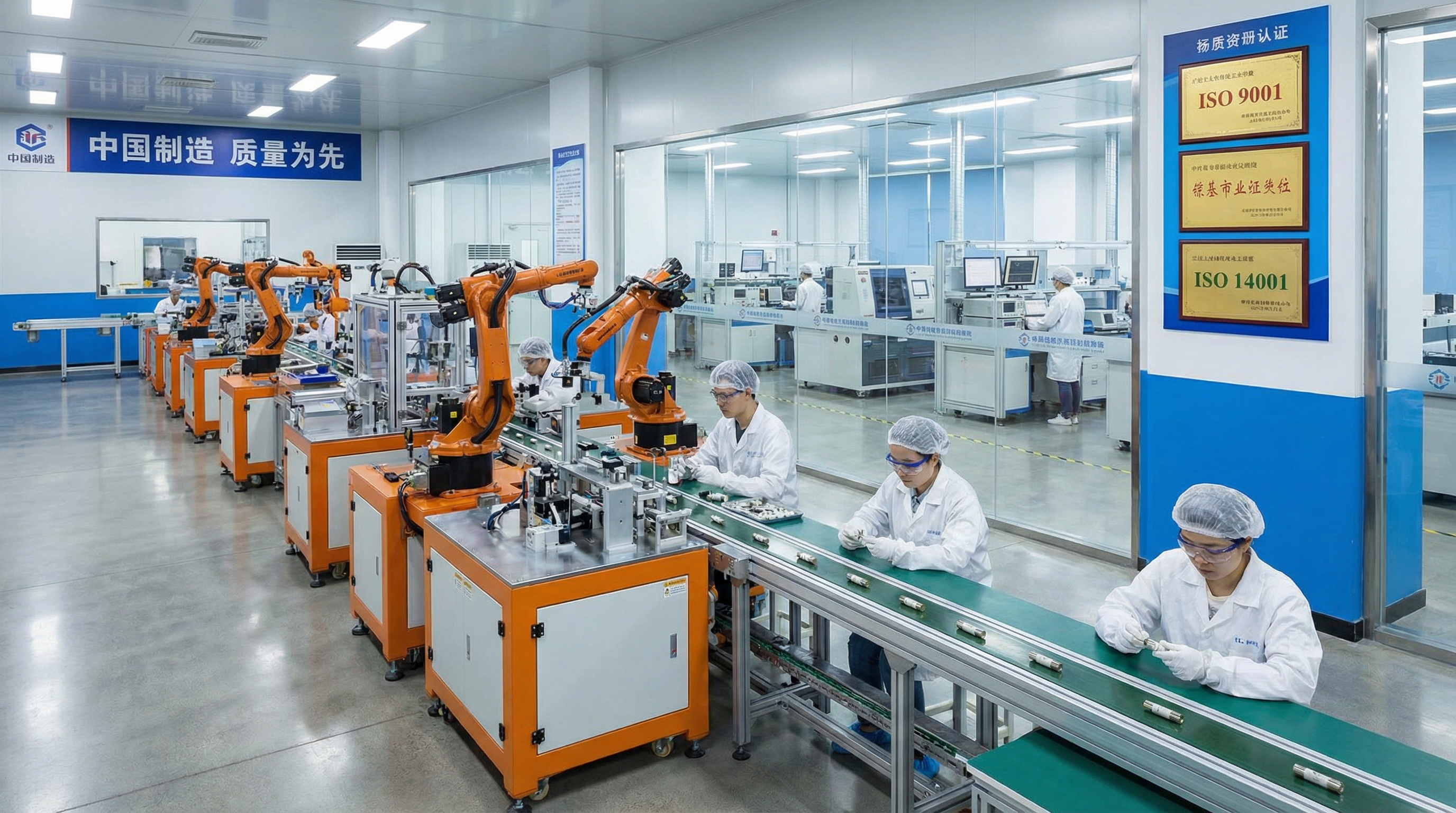
\
A modern, ISO-certified fuse manufacturing facility in China — clean rooms, automated assembly, and dedicated QC labs are non-negotiable markers of a serious supplier.
Before we talk about factories, let’s talk about physics — because understanding this will completely change how you evaluate suppliers.
In an AC circuit, the current naturally crosses zero 100–120 times per second (at 50–60 Hz). This zero-crossing is a gift: it gives the fuse element a natural “off ramp” to extinguish the arc when it melts. DC has no such luxury. In a DC circuit, the arc is continuous, persistent, and extremely difficult to extinguish.
Think of it this way: extinguishing a DC arc is like trying to blow out a candle in a wind tunnel, while extinguishing an AC arc is like blowing out a candle in a calm room. The DC fuse has to do all the heavy lifting itself — through its internal geometry, filler material, and element design.
This is why a fuse rated “32A 250V AC” cannot and must not be used in a 32A 250V DC application. The DC breaking capacity (interrupting rating) is a completely different — and far more demanding — specification.
🔑 Key Takeaway: Always specify your fuse requirements with DC voltage, DC current, and DC breaking capacity. Never substitute an AC-rated fuse in a DC circuit, regardless of the voltage and current ratings matching on paper.
A serious fuse factory is defined by its material science. When you audit a supplier, the first question isn’t “what’s your price?” — it’s “what materials are you using, and why?”
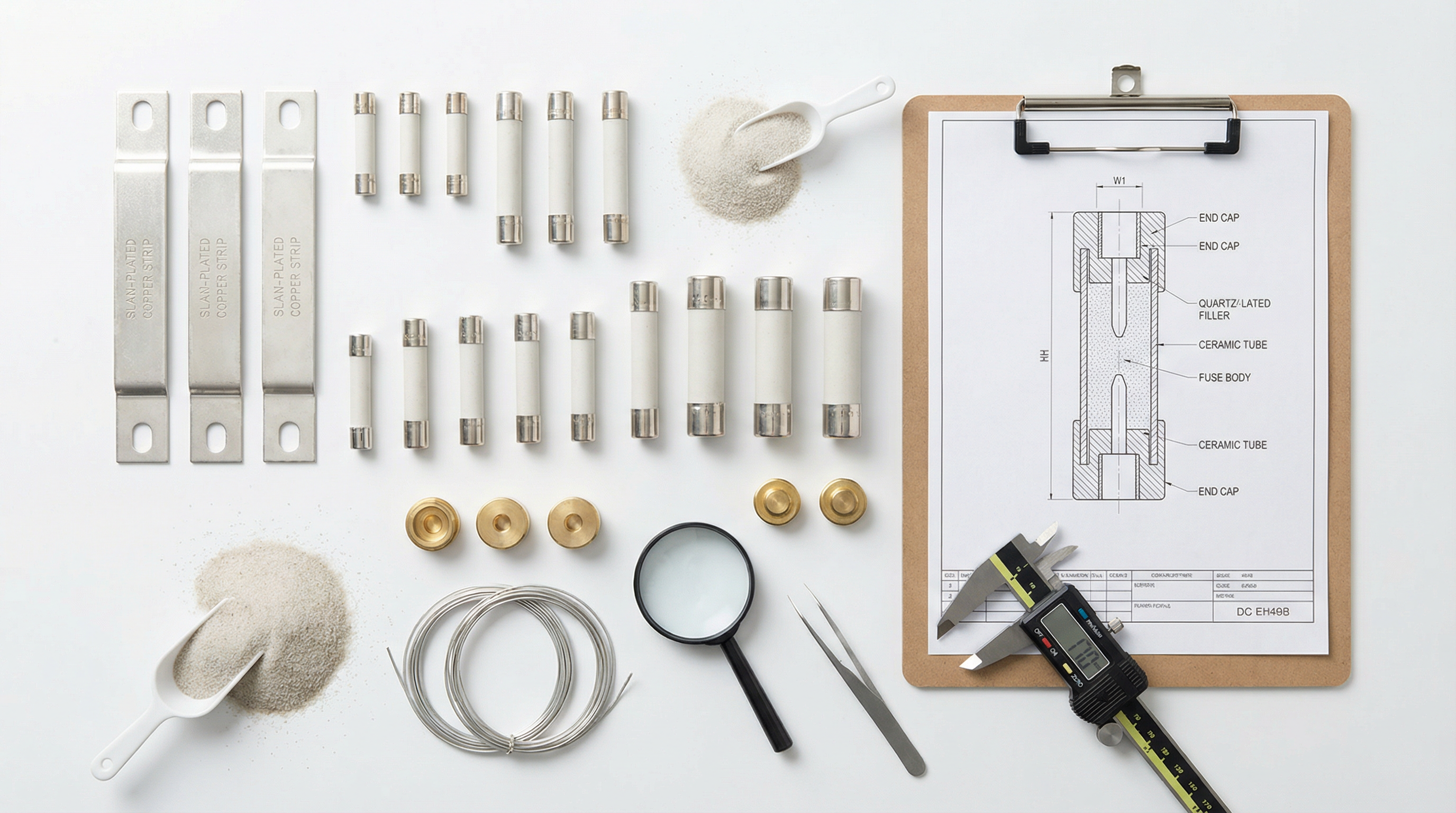
\
The core raw materials of a high-quality DC fuse: high-purity silver fuse elements, ceramic body tubes, quartz sand filler, and precision-machined end caps.
Here’s what the internal anatomy of a premium DC fuse looks like, and what each material choice signals about the factory’s commitment to quality:
| Component | Budget Factory Material | Quality Factory Material | Why It Matters |
|---|---|---|---|
| Fuse Element | Zinc-alloy or low-grade copper wire | High-purity silver (99.99%) or silver-copper alloy | Silver has the most predictable melt characteristics; critical for accurate I²t (time-current) performance |
| Body / Tube | Low-grade ceramic or fiber-reinforced plastic | High-density alumina ceramic (Al₂O₃ ≥ 95%) | Must withstand internal arc pressure and thermal shock without cracking |
| Arc Quenching Filler | Coarse or impure sand | Pharmaceutical-grade quartz sand (SiO₂ ≥ 99.5%, controlled grain size) | Grain size and purity directly control arc extinction speed — the most critical DC performance parameter |
| End Caps / Terminals | Brass with thin tin plating | Copper alloy with silver or nickel plating | Reduces contact resistance, prevents oxidation, ensures stable connection over 20+ year lifespan |
| Element Geometry | Simple straight wire | Precision-notched or M-effect element with controlled weak points | Determines the fuse’s time-current curve accuracy and pre-arcing energy |
🔑 Pro-Tip: Ask your potential supplier for a cross-section sample or a material certification (CoA) for their quartz sand. A factory that can’t provide this is almost certainly using uncontrolled filler — the single biggest cause of DC arc re-ignition failures.
After evaluating dozens of Chinese fuse manufacturers, I’ve distilled the qualification process into three stages. Skip any one of them, and you’re gambling with your project.
Most sourcing failures begin before you even contact a factory. Engineers send an inquiry that says “I need 100A DC fuses” — and that’s it. This is like calling a hospital and saying “I need medicine.” You’ll get something, but it may not be what you need.
Before reaching out to any factory, lock down these seven parameters:
| Parameter | Example Value | Common Mistake |
|---|---|---|
| Rated Current (In) | 100A | Confusing continuous current with peak/surge current |
| Rated DC Voltage (Vdc) | 1000V DC | Using AC voltage rating for DC application |
| Breaking Capacity (kA DC) | 20kA at 1000V DC | Ignoring DC breaking capacity entirely |
| Time-Current Curve (gPV / gR / aR) | gPV (IEC 60269-6) | Using general-purpose gG fuses in PV/battery systems |
| Physical Size / Form Factor | 10×38mm, 14×51mm, 22×58mm | Assuming all fuses of the same amperage share a body size |
| Mounting / Holder Compatibility | DIN rail fuse holder, specific brand | Ordering fuses without confirming holder compatibility |
| Operating Temperature Range | -40°C to +85°C | Ignoring derating requirements at elevated temperatures |
Once you have these seven parameters documented, you have a real specification — and you can hold a factory accountable to it.
Not all factories that claim to make DC fuses actually have the capability to make good DC fuses. Here is the five-point evaluation checklist I use for every new supplier:
graph TD
    A[🔍 Start Factory Evaluation] --> B{1. Certifications
UL/IEC/TÜV/CQC?}
    B -->|Yes| C{2. DC-Specific
Test Equipment?}
    B -->|No| X[❌ Disqualify]
    C -->|Yes| D{3. Raw Material
QC & Traceability?}
    C -->|No| X
    D -->|Yes| E{4. In-House
Calibrated Lab?}
    D -->|No| X
    E -->|Yes| F{5. Reference
Customers / Projects?}
    E -->|No| X
    F -->|Yes| G[✅ Proceed to Sample Order]
    F -->|No| H[⚠️ Proceed with Caution]
① Certifications — The Baseline, Not the Finish Line
Certifications are necessary but not sufficient. A factory should hold at minimum:
⚠️ Warning: Always verify certifications directly on the certifying body’s website (UL Product iQ, IECEx, TÜV SÜD database). Counterfeit or expired certificates are more common than you’d expect in the Chinese electrical components market.
② DC-Specific Test Equipment
This is the single most revealing question you can ask during a factory audit: “Can I see your DC breaking capacity test bench?”
A DC breaking capacity test requires a dedicated high-energy DC power source capable of delivering fault-level current (often 10kA–50kA) at the rated DC voltage. This equipment costs hundreds of thousands of dollars. Many factories that claim to make DC fuses simply don’t have it — they test at AC and extrapolate, which is scientifically invalid.
③ Raw Material QC and Traceability
Ask for the factory’s incoming material inspection (IQC) procedure. A qualified factory should be able to trace every batch of fuses back to the specific lot of silver wire, ceramic tube, and quartz sand used. This traceability is what makes root-cause analysis possible when (not if) a field issue arises.
④ In-House Calibrated Testing Laboratory
Third-party testing is fine for certification. But for production quality control, you want a factory with an in-house lab equipped with:
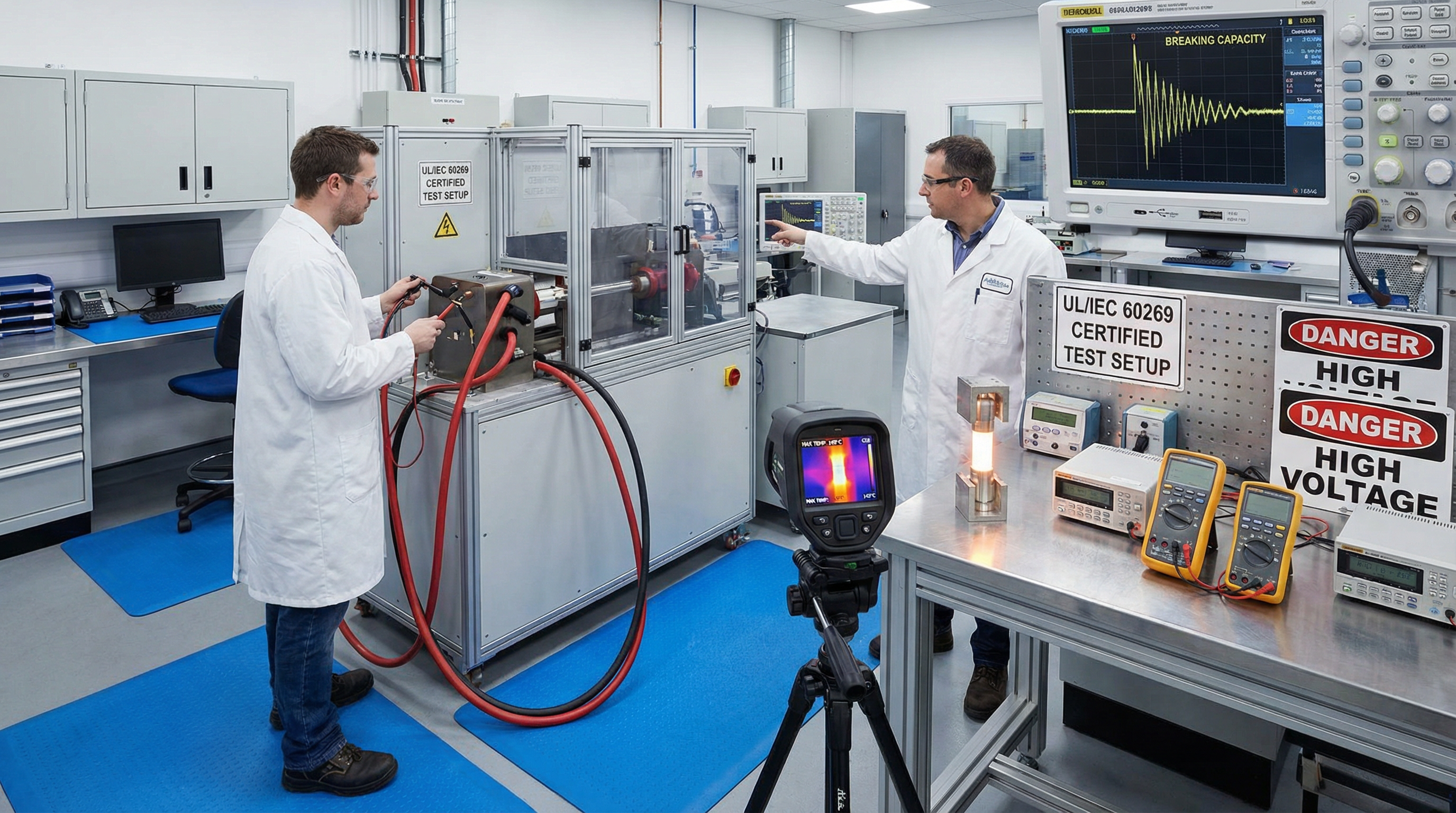
\
An in-house DC fuse testing laboratory: the breaking capacity test bench (left), thermal imaging station (center), and calibrated resistance measurement setup (right) are hallmarks of a serious quality-focused manufacturer.
⑤ Reference Customers and Deployed Projects
Ask for references in your specific application segment. A factory that has supplied DC fuses to Tier-1 solar EPC contractors, major EV charging network operators, or industrial UPS manufacturers has been battle-tested in ways that no factory audit can replicate.
Never go straight from “factory approved” to “mass production order.” The sample qualification stage is where you validate that the factory’s production capability matches their claims. Here is the minimum sample test protocol I recommend:
| Test | Standard | Acceptance Criteria | Purpose |
|---|---|---|---|
| Dimensional Inspection | Per drawing | ±0.1mm on critical dimensions | Confirm holder compatibility |
| Cold Resistance | IEC 60269-1 Cl.8.5 | ≤ specified max mΩ | Detect poor element quality |
| Conventional Fusing Current (If) | IEC 60269-1 Cl.8.6 | Fuses within 1 hour at 1.6×In | Verify time-current curve |
| Conventional Non-Fusing Current (Inf) | IEC 60269-1 Cl.8.6 | Does not fuse in 1 hour at 1.25×In | Verify overload tolerance |
| DC Breaking Capacity | IEC 60269-6 | Clears fault without re-ignition at rated Vdc and Icc | The most critical DC-specific test |
| Temperature Rise | IEC 60269-1 Cl.8.8 | ΔT ≤ 60K at terminals at In | Verify thermal design |
| Vibration & Shock | IEC 60068-2 | No physical damage or parameter shift | For mobile/EV applications |
🔑 Key Takeaway: Run the DC breaking capacity test yourself, or commission an accredited third-party lab (SGS, Intertek, TÜV) to do it. This is the one test you cannot take a factory’s word for.
China has developed a mature fuse manufacturing ecosystem, concentrated primarily in Zhejiang, Guangdong, and Jiangsu provinces. Here’s a realistic picture of the supplier tiers you’ll encounter:
| Factory Tier | Typical Profile | Strengths | Risks | Best For |
|---|---|---|---|---|
| Tier 1 — Global-Grade | 500+ employees, full IEC/UL/TÜV certs, own R&D, exports to EU/US OEMs | Consistent quality, full traceability, engineering support | Higher MOQ, longer lead time, premium pricing | Solar inverter OEMs, EV charging infrastructure, industrial UPS |
| Tier 2 — Regional Leader | 100–500 employees, IEC certified, limited DC-specific range | Good price-performance ratio, flexible MOQ | Limited DC breaking capacity range, less R&D depth | Commercial solar, telecom power, industrial panels |
| Tier 3 — Trading/Assembly | <100 employees or trading company, limited own production | Very low price, fast sample turnaround | Inconsistent raw materials, no real DC test capability, certification may be borrowed | Prototyping only — NOT for production |
🔑 Pro-Tip: Many “factories” on Alibaba and Made-in-China are actually trading companies that source from Tier-3 assemblers. The tell-tale sign: they can quote any specification within 24 hours, have no minimum order quantity, and their “factory” photos look suspiciously like stock images. Always request a video call factory tour before placing any order.
Different applications impose radically different demands on DC fuses. Use this matrix to ensure the factory you’re evaluating has genuine experience in your sector:
| Application | Voltage Range | Key DC Fuse Requirement | Critical Standard | Factory Must-Have |
|---|---|---|---|---|
| Utility-Scale Solar (PV) | 1000–1500V DC | gPV type, high DC breaking capacity, UV-resistant housing | IEC 60269-6, UL 2579 | DC test bench to 1500V, gPV curve validation |
| EV Fast Charging | 400–1000V DC | Ultra-fast response, vibration resistance, compact form | IEC 60269-4, GB/T 18487 | Thermal cycling test, vibration test rig |
| Battery Energy Storage (BESS) | 48–1500V DC | High breaking capacity at low voltage (48V, 96V), current-limiting | IEC 60269-6 | Low-voltage DC arc test capability |
| Industrial DC Drives | 110–750V DC | Semiconductor protection (aR type), ultra-fast I²t | IEC 60269-4 | High-speed oscilloscope for I²t measurement |
| Telecom / Data Center | 48V DC | High reliability, low resistance, high cycle life | NEBS GR-1089, IEC 60269 | Life cycle test equipment |
After years of factory audits, I’ve compiled the warning signs that should trigger an immediate “no”:
🚩 They quote DC fuses but only show AC test reports. DC and AC breaking capacity tests are fundamentally different. If a supplier can’t produce a DC-specific test report from an accredited lab, their DC rating is unverified.
🚩 The certificate serial number doesn’t verify on the certifying body’s website. This happens more often than the industry admits. Always check.
🚩 They can’t explain their quartz sand specification. The arc-quenching filler is the heart of a DC fuse. A factory that doesn’t know (or won’t share) the grain size distribution and purity spec of their filler is hiding something.
🚩 No engineering team or application support. A serious fuse factory employs application engineers who can review your circuit design and recommend the correct fuse. If your contact is purely a salesperson, that’s a structural weakness.
🚩 Pricing is 40%+ below market average. Premium raw materials (99.99% silver elements, high-purity quartz) have a floor cost. Pricing that defies this floor means corners are being cut somewhere in the bill of materials.
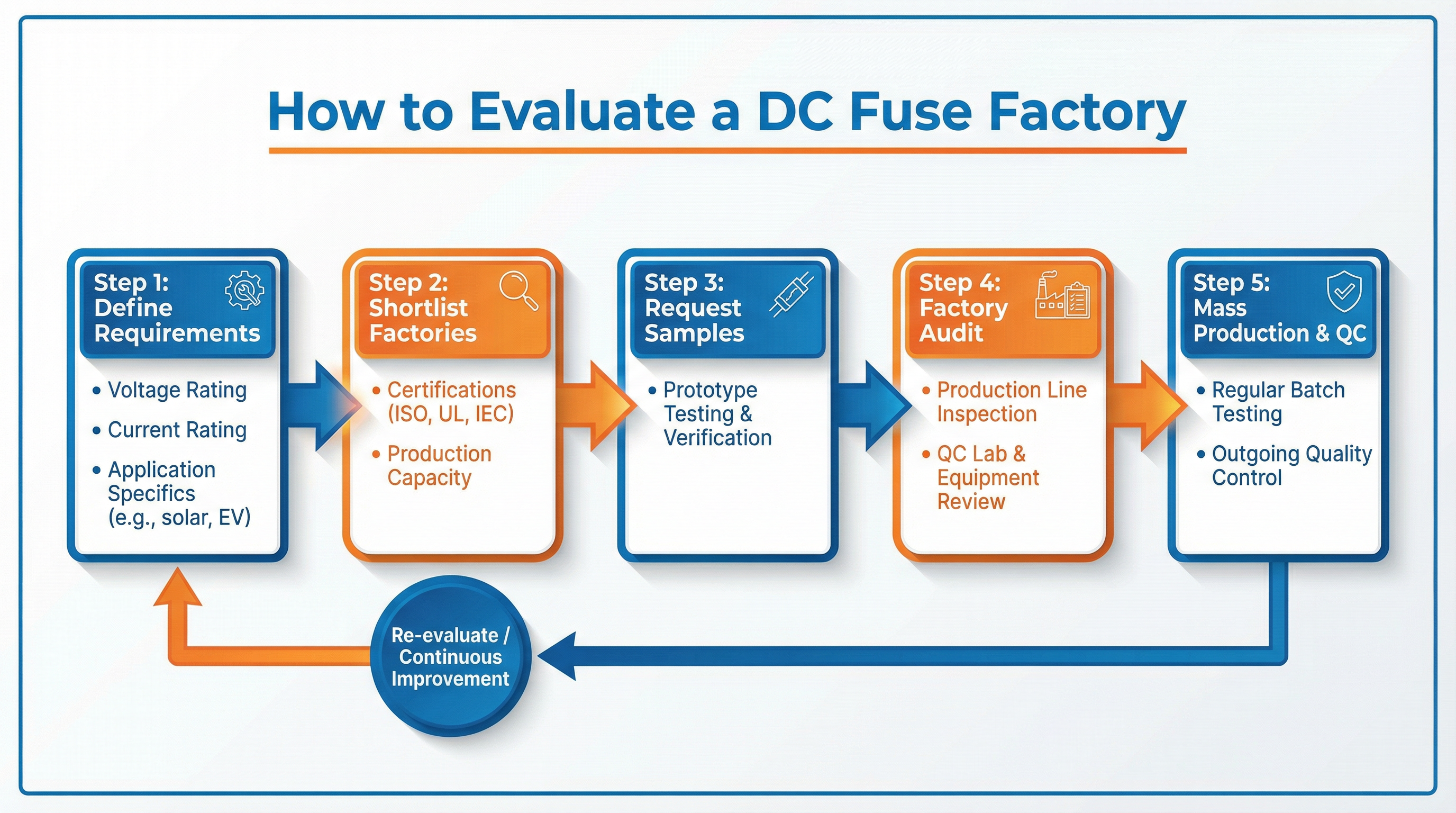
\
The five-stage factory qualification process — from defining requirements to mass production approval.
Use this checklist during your factory visit or video audit:
Production Facility
Quality Control
DC-Specific Capability
Documentation & Traceability
Q1: Can I use a Chinese-made DC fuse in a UL-listed panel in the United States?
Yes — but only if the fuse itself carries a valid UL 248 listing. The country of manufacture is irrelevant to UL compliance; what matters is whether the specific model number appears in UL’s Product iQ database. Many leading Chinese fuse factories hold full UL 248 listings for their DC fuse product lines. Always verify the listing directly on UL’s website before specifying.
Q2: What is the difference between gPV and gR fuse types for DC applications?
The gPV (general purpose PV) type is designed for photovoltaic string and combiner box protection — it has a relatively slow response to overloads (protecting cables and wiring) but a high DC breaking capacity. The gR (general purpose semiconductor) type is designed for protecting power semiconductor devices (IGBTs, MOSFETs, diodes) — it responds extremely fast to limit the I²t energy that reaches the semiconductor. Using a gPV fuse where a gR is required will result in semiconductor damage even when the fuse “operates correctly.”
Q3: How do I verify a Chinese factory’s IEC certification without visiting in person?
The most reliable method is to request the certificate number and verify it directly on the issuing body’s online database:
Additionally, request a copy of the test report (not just the certificate) — the test report contains the actual measured values, which tell you far more about the product’s performance margins.
Q4: What is a reasonable MOQ (Minimum Order Quantity) for a custom DC fuse from a Chinese factory?
For standard catalog DC fuses (common sizes like 10×38, 14×51, 22×58mm), MOQ is typically 500–2,000 pieces per model. For custom specifications (non-standard voltage ratings, special form factors, custom markings), expect MOQ of 5,000–10,000 pieces and a tooling/NRE fee ranging from $500–$3,000 USD. Tier-1 factories tend to have higher MOQs but offer better engineering support and consistency.
Q5: How long does a typical DC fuse qualification process take?
From first contact to approved mass production, allow 8–16 weeks for a rigorous qualification:
Rushing this timeline is the most common cause of quality escapes reaching the field.
Q6: Should I source DC fuses from a dedicated fuse factory or a general electrical components manufacturer?
Always prefer a dedicated fuse factory for DC applications. Fuse manufacturing — especially DC fuse manufacturing — requires highly specialized process knowledge, materials science expertise, and test infrastructure. A company whose primary business is fuses will have invested in DC-specific test benches, application engineering teams, and raw material relationships that a general components manufacturer simply cannot match. Think of it this way: you wouldn’t buy a precision surgical instrument from a company that also makes garden tools.
Q7: What documentation should I receive with a production batch of DC fuses?
At minimum, insist on:
After everything we’ve covered, here’s the core insight I want to leave you with: you cannot inspect quality into a DC fuse. By the time a fuse reaches your incoming inspection, 95% of the quality decisions have already been made — in the raw material selection, in the element geometry design, in the arc-quenching filler specification, and in the process controls on the production floor.
This is why finding the right China fuse factory is not a procurement exercise — it’s an engineering exercise. The factories that consistently deliver high-quality DC fuses are the ones that understand the physics of DC arc interruption, invest in proper test infrastructure, and treat raw material quality as a non-negotiable foundation.
Use the three-step framework in this guide: define your requirements precisely, evaluate factories against the five non-negotiable criteria, and run a structured sample qualification before committing to production. Do this, and you’ll have a DC fuse supplier that protects your systems — and your reputation — for years to come.
Have questions about DC fuse selection for your specific application? Leave a comment below or contact our engineering team at cnkuangya.com. We respond to every technical inquiry within 24 hours.
Tags: dc fuse, china fuse factory, dc fuse manufacturer, fuse factory quality, IEC 60269-6, gPV fuse, solar fuse, EV fuse, fuse sourcing guide, electrical components China
Related Posts:

