Address
304 North Cardinal
St. Dorchester Center, MA 02124
Work Hours
Monday to Friday: 7AM - 7PM
Weekend: 10AM - 5PM
Address
304 North Cardinal
St. Dorchester Center, MA 02124
Work Hours
Monday to Friday: 7AM - 7PM
Weekend: 10AM - 5PM


How Proper Protection Coordination Saved a 500kW Installation from Catastrophic Failure

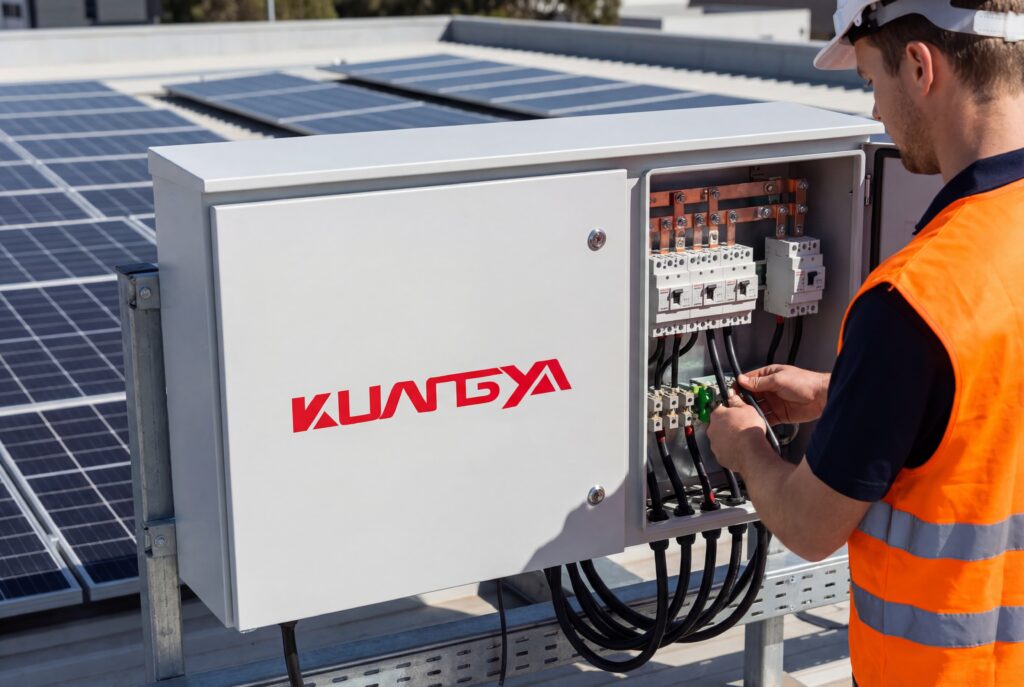
Last month, we received a frantic call from a solar installer in Arizona. His 500kW commercial rooftop system had just experienced a grid disturbance—nothing unusual in the volatile southwestern climate. But here’s what went wrong: when a minor fault occurred on the AC side, the entire DC array remained energized while the protection devices failed to coordinate properly.
The result? A cascading failure that damaged three string inverters, melted two combiner box busbars, and created a fire hazard that required emergency shutdown of the entire facility. The repair bill exceeded $50,000, not including two weeks of lost energy production.
This case study examines how proper breaker and surge protective device (SPD) design could have prevented this disaster—and provides a blueprint for protection coordination in commercial solar installations.
Commercial solar systems face unique electrical protection challenges that residential installations simply don’t encounter:
Higher DC Voltages: Modern commercial installations routinely operate at 1000VDC or 1500VDC, compared to 400-600VDC in residential systems. At these voltages, arc suppression becomes critical—DC arcs don’t self-extinguish like AC arcs do because there’s no natural current zero-crossing.
Complex Grounding Configurations: Large rooftop arrays may span multiple building sections with different grounding systems, creating potential differences that can drive surge currents into unexpected paths.
Exposure to Severe Weather: Commercial installations often occupy flat rooftops or ground-mounted arrays in open areas, making them lightning magnets with long cable runs that act as surge antennas.
Coordination Complexity: With dozens of strings, multiple combiner boxes, and centralized inverters, protection devices must coordinate precisely to isolate faults without unnecessary system-wide shutdowns.
Based on the Arizona case and hundreds of similar installations we’ve supported, here’s the protection architecture that prevents such failures:
At each string level, we implement coordinated overcurrent and surge protection:
DC Miniature Circuit Breakers (MCBs): Kuangya KYDB-63 series breakers provide 600-1000VDC rated protection with 6kA breaking capacity. These compact devices offer resettable protection against overloads and short circuits at the string level, allowing maintenance of individual strings without affecting the entire array.
gPV-Rated Fuses: For higher fault current applications, we specify gPV fuses (14×85mm or 10×38mm) with interrupting ratings up to 50kA. These UL 2579-certified fuses provide current-limiting protection that can stop faults faster than breakers in high-energy scenarios.
String-Level SPDs: Kuangya Type 2 DC SPDs with 20-40kA surge capacity protect each string from induced lightning and switching surges. The MOV-based design clamps transients within nanoseconds, diverting energy safely to ground.
As strings combine, protection requirements intensify:
High-Capacity DC Breakers: KYDB-125 series breakers rated up to 125A and 1000VDC protect the combined output. These devices coordinate with upstream and downstream protection to isolate combiner-level faults.
Main Combiner SPDs: Type 1+2 SPDs with 12.5kA (10/350μs) impulse current capacity protect against direct lightning strikes. These devices feature thermal disconnectors and remote status monitoring contacts for integration with SCADA systems.
Switch Disconnectors: Load-break disconnect switches provide visible isolation points for maintenance, rated for the full system voltage and prospective short-circuit current.
The inverter interface requires special attention:
DC Input Protection: Before the inverter, we specify coordinated breaker-fuse-SPD combinations that protect the inverter’s DC input stage while allowing selective fault clearing.
AC Output Protection: Type 2 AC SPDs protect the inverter’s AC output against grid-side surges. These coordinate with the inverter’s internal protection and utility-side devices.
AC Breakers: Properly rated AC breakers provide overcurrent protection on the output side, coordinating with the main service entrance breaker.
| Parameter | String Level | Combiner Level | Inverter Interface | AC Side |
|---|---|---|---|---|
| Voltage Rating | 1000VDC | 1000-1500VDC | 1000-1500VDC | 480VAC |
| Current Rating | 10-20A | 100-250A | 200-400A | 100-800A |
| Protection Type | MCB + Fuse + SPD | Breaker + SPD + Disconnector | Breaker + Fuse + SPD | Breaker + SPD |
| SPD Type | Type 2, 20-40kA | Type 1+2, 12.5kA impulse | Type 2, 40kA | Type 2, 40kA |
| Breaking Capacity | 6kA DC | 10kA DC | 10kA DC | 25-65kA AC |
| Key Standard | IEC 60947-2 | IEC 61643-31 | UL 1741-SA | IEEE C62.41 |
The maximum continuous operating voltage (MCOV or Uc) of SPDs must exceed the system’s maximum open-circuit voltage by at least 25%. For a solar array with 1000V nominal voltage and temperature coefficient of -0.3%/°C, at -10°C the Voc could reach:
$V_{oc_max} = 1000V \times 1.15 = 1150V$
Therefore, SPDs must have MCOV ≥ 1150V × 1.25 = 1437V minimum rating.
Before finalizing protection selections, we perform coordination studies that analyze:
Commercial installations demand rugged equipment:
SPD effectiveness depends on installation quality:
Design for the long term:
After analyzing the failed installation, we identified three critical design errors:
After implementing our recommended protection architecture—including upgraded KYDB-125 breakers with 10kA breaking capacity, properly coordinated fuses, and correctly installed Type 1+2 SPDs—the system has operated for 18 months without a single protection-related incident despite several severe weather events.
| Protection Component | Investment | Risk Mitigation Value |
|---|---|---|
| Upgraded DC Breakers | +$2,500 | Prevents $15,000+ inverter damage |
| Type 1+2 SPDs | +$1,800 | Prevents $50,000+ lightning damage |
| Coordination Study | +$3,000 | Prevents $10,000+ downtime costs |
| Proper Installation | +$2,000 | Extends equipment life 10+ years |
| Total Investment | $9,300 | Potential Savings: $75,000+ |
The ROI is compelling: spending less than $10,000 on proper protection design prevents losses exceeding $75,000—a 8:1 return on investment that doesn’t even account for avoided safety incidents and insurance complications.
A: Standard AC breakers rely on the natural zero-crossing of alternating current to extinguish arcs. DC current maintains constant polarity, creating arcs that won’t self-extinguish. DC-rated breakers use specialized arc chutes, magnetic blowout coils, and wider contact gaps to safely interrupt DC faults. Using AC breakers in DC applications creates severe fire hazards—this is a leading cause of solar installation fires.
A:
For commercial solar, we typically recommend Type 2 SPDs at the string level and Type 1+2 SPDs at main combiner boxes and inverter interfaces.
A: Follow the “fuse as backup” principle: size the fuse with a higher continuous current rating but faster clearing time for high-magnitude faults, while the breaker handles overloads and lower-level faults. For example, a 20A breaker might be backed up by a 25A gPV fuse. The fuse should have current-limiting characteristics that clear high-energy faults before the breaker’s breaking capacity is exceeded.
A: SPD installation should always be performed by qualified electricians familiar with DC solar systems. Incorrect installation—including excessive lead lengths, improper grounding, or reverse polarity connections—can reduce SPD effectiveness by 50% or more, or even create safety hazards. The installation must comply with NEC Article 690 (Solar Photovoltaic Systems) and local electrical codes.
A:
A: Quality DC breakers like Kuangya’s KYDB series have mechanical endurance rated for 10,000+ operations and electrical endurance for 3,000+ operations. In typical solar applications with minimal switching, they should last 15-20 years. However, breakers that trip frequently due to system faults or overloads may require replacement after 5-10 years. Annual exercising (switching on/off) helps maintain contact reliability.
A: Yes. While direct lightning strikes are the most dramatic surge source, indirect lightning (within 1-2 miles), switching transients from grid operations, and even static buildup can damage sensitive inverter electronics. The cost of SPDs is minimal compared to inverter replacement. Additionally, many inverter warranties now require documented surge protection for claims validity.
With 25+ years in electrical protection and 2000+ new energy projects delivered, Kuangya understands the unique challenges of commercial solar installations. Our product range includes:
✓ Complete Protection Portfolio: DC MCBs, fuses, SPDs, disconnectors, and combiner boxes—all designed to work together\
✓ Certified Quality: IEC, CE, RoHS compliance with rigorous factory testing\
✓ Application Engineering Support: Our engineers provide coordination studies and product selection assistance\
✓ Global Logistics: Factory-direct supply with fast lead times and multilingual support
Contact our application engineering team today for a free protection coordination review of your commercial solar project. Whether you’re designing a new 500kW rooftop installation or upgrading protection on an existing system, we’ll ensure your investment is protected for decades to come.
Kuangya Electrical Equipment—Reliable Protection for the Clean Energy Future
Website: https://cnkuangya.com\
Email: info@cnkuangya.com\
Products: DC MCBs, DC Fuses, DC SPDs, Switch Disconnectors, PV Combiner Boxes
This case study is based on actual project experience. Specific system designs should always be verified by licensed electrical engineers familiar with local codes and standards including NEC Article 690, IEC 60364-7-712, and IEEE 1547.