WengYang Industrial Zone Yueqing Wenzhou 325000
Work Hours
Monday to Friday: 7AM - 7PM
Weekend: 10AM - 5PM
WengYang Industrial Zone Yueqing Wenzhou 325000
Work Hours
Monday to Friday: 7AM - 7PM
Weekend: 10AM - 5PM

Choose a solar inverter AC breaker using the exact model’s documented supply terminal restrictions. The direction of normal power flow does not tell you which terminals are permitted to receive a supply. A grid-connected inverter can export through the breaker, and the grid can supply fault current toward the inverter circuit.
Backfeeding commonly describes supplying a breaker from the terminals normally regarded as its load side. Draw the grid, inverter and any alternate source on the one-line diagram, label the actual breaker terminals, and identify which side can remain energized when the breaker opens. In a hybrid system, review both grid-connected and backup operation using the equipment manual.
Schneider Electric’s QO photovoltaic application FAQ excludes specific GFI, EPD, AFI and CAFI variants from reverse feed because of their LINE and LOAD markings. Its separate PowerPact B-frame FAQ explicitly permits reverse feed for that family. These are published product examples. Use the instructions and listing for the exact device and destination market.
Suppose a contractor proposes a breaker that fits the board and matches the inverter circuit amperage. The review still needs two pieces of evidence: the breaker manufacturer permits the proposed terminal orientation, and the board instructions permit that breaker and connection arrangement. If either is missing, request the documentation before approving the substitution.
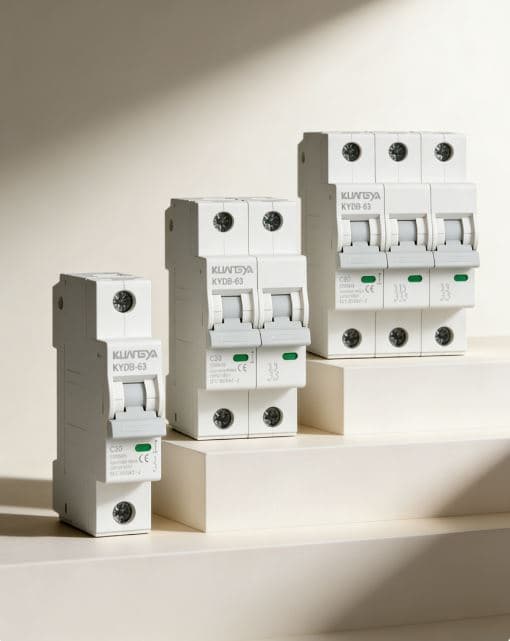
Check the terminal diagram and device instructions. C describes an overcurrent trip characteristic.
Check the RCBO separately. Its instructions can specify supply terminals and requirements for its residual-current and test functions. Review the KUANGYA RCBO range by exact model.
Send the one-line diagram, inverter and panel model, breaker part number, rated voltage, poles, fault current, proposed supply terminals and destination market when comparing KUANGYA AC MCB options.

