WengYang Industrial Zone Yueqing Wenzhou 325000
Work Hours
Monday to Friday: 7AM - 7PM
Weekend: 10AM - 5PM
WengYang Industrial Zone Yueqing Wenzhou 325000
Work Hours
Monday to Friday: 7AM - 7PM
Weekend: 10AM - 5PM

Why can an upstream RCD trip when a branch MCB is off? Learn how connected neutrals, unintended neutral–earth paths, and shared neutrals affect fault finding, with safe checks for a qualified electrician.
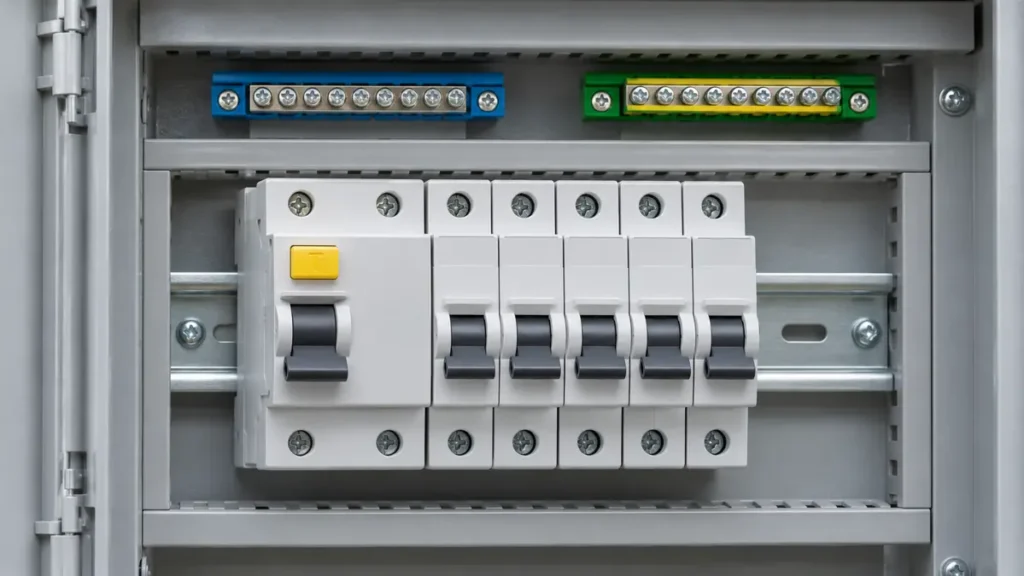
Quick answer: An upstream residual current device (RCD) can trip even while one branch miniature circuit breaker (MCB) is off. A single-pole MCB may disconnect only the line conductor; the branch neutral can remain connected. An unintended neutral-to-earth path or a shared neutral can then create an imbalance when another circuit carries current. This is a possible explanation, not a diagnosis. Have a qualified electrician identify the actual fault before restoring service.
An MCB responds to overcurrent on the conductors it protects. An RCD compares the current flowing through all conductors passing through its sensing core, including the neutral where present. If some current returns by another route, the RCD may open the circuit. Schneider Electric explains this current-balance principle in its RCD operation guide.
Turning off a branch MCB does not necessarily disconnect that branch’s neutral. Whether a particular breaker switches one or more poles depends on its design and the installation. Never treat an MCB handle in the off position as proof that wiring is safe to touch.
Consider several circuits protected by one upstream RCD. A single-pole MCB on one branch is off, but that branch neutral remains connected to the RCD’s neutral system. If neutral is unintentionally connected to protective earth downstream, current from another operating load may divide between the intended neutral return and the unintended earth path. The RCD can detect the difference and trip. The trip may happen only when another appliance starts, making the switched-off branch easy to overlook.
This explanation follows from the RCD’s current-balance principle. It does not mean every trip with an MCB off is caused by a neutral–earth fault. Schneider Electric also cautions against an improper downstream neutral–earth connection in its neutral and earth guidance. The correct bonding arrangement depends on the installation’s earthing system and local rules.
For a separate explanation of circuit connections, see our RCBO wiring guide. If the test button itself is the concern, use our RCCB test-button troubleshooting guide.
Do not disconnect protective earth, bypass the RCD, or move neutral conductors to make the trip disappear. Those actions can remove essential protection. For device selection context, compare RCCB and RCD terminology and review our RCCB range. If you need help specifying an RCCB or RCBO after the wiring fault is diagnosed, contact Kuangya with the supply arrangement, circuit diagram, load type, and applicable local standard.
Yes. An upstream RCD can still see an imbalance on its protected group. A single-pole branch MCB may leave neutral connected, and another circuit can supply the current involved.
Not necessarily. Check the actual device and wiring diagram. Isolation and verification of dead must follow the site’s electrical safety procedure.
No. Protective earth is a safety conductor. A recurring trip needs fault finding by a qualified electrician.

