WengYang Industrial Zone Yueqing Wenzhou 325000
Work Hours
Monday to Friday: 7AM - 7PM
Weekend: 10AM - 5PM
WengYang Industrial Zone Yueqing Wenzhou 325000
Work Hours
Monday to Friday: 7AM - 7PM
Weekend: 10AM - 5PM

DC surge protective devices (SPDs) are used on the DC side of photovoltaic systems to limit transient overvoltages and divert surge current before it damages inverters, monitoring equipment, combiner boxes and other sensitive components. However, markings such as Class I, Class II, In, Imax, Up and Iscpv are often misunderstood.
This guide explains DC SPD classes—Class I, Class II and Class III—and shows how to interpret a typical 1000 V DC photovoltaic SPD nameplate.
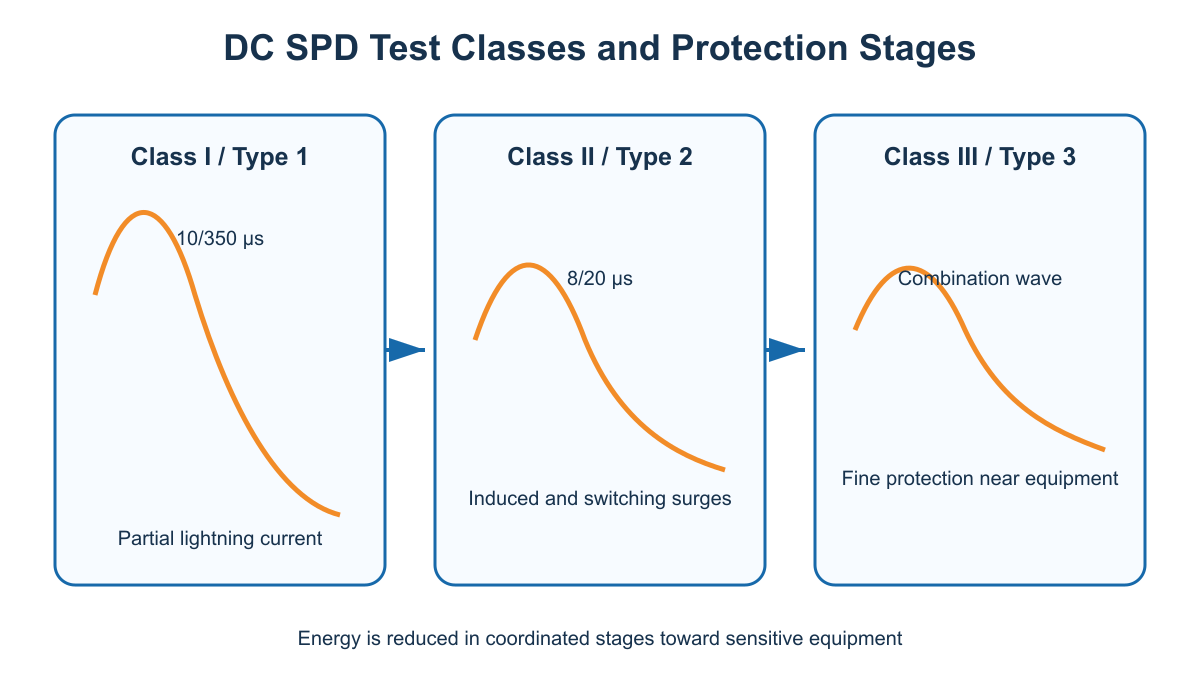
The word Class on an SPD normally refers to a test classification. It does not mean that Class I is a premium-quality product and Class II is a lower-quality product. It also does not describe an insulation class or an IP enclosure rating.
| Test class | Common product designation | Main test waveform | Typical role |
|---|---|---|---|
| Class I | Type 1 | 10/350 μs current impulse | Partial lightning-current discharge |
| Class II | Type 2 | 8/20 μs current impulse | Induced lightning and switching surges |
| Class III | Type 3 | Combination wave | Fine protection near sensitive equipment |
| Class I+II | Type 1+2 | 10/350 μs and 8/20 μs | Combined lightning-current and surge protection |
These SPD classes must not be confused with lightning protection system classes LPS I, II, III and IV. The two systems use similar Roman numerals but describe different subjects.
A Class I or Type 1 SPD is designed to handle high-energy lightning-current components. Its key test waveform is typically 10/350 μs: the current rises rapidly and then decays over a comparatively long period, giving the impulse much higher energy than a conventional 8/20 μs surge of the same peak current.
Type 1 or Type 1+2 protection should be assessed when a PV installation has an external lightning protection system, when the required separation distance cannot be maintained, or when lightning current may enter the electrical installation across a lightning protection zone boundary.
The key Type 1 parameter is normally Iimp. A large Imax value alone does not prove that an SPD is suitable for Type 1 duty because Imax is normally associated with the 8/20 μs waveform.
Class II generally corresponds to a Type 2 SPD tested with an 8/20 μs current waveform. It is the most common class used for protection against induced lightning surges and switching transients in PV combiner boxes, DC distribution equipment and inverter DC inputs.
A Type 2 SPD may also be installed downstream of a Type 1 SPD as part of a coordinated protection system. It should not be marketed as a direct-lightning-current arrester unless the product is also tested and declared as Type 1 or Type 1+2.
Class III or Type 3 SPDs provide fine protection close to sensitive equipment. They are commonly evaluated using a combination-wave generator with a 1.2/50 μs open-circuit voltage waveform and an 8/20 μs short-circuit current waveform.
Type 3 devices normally work with upstream Type 1 or Type 2 protection. They are not intended to absorb the full incoming surge energy on their own.
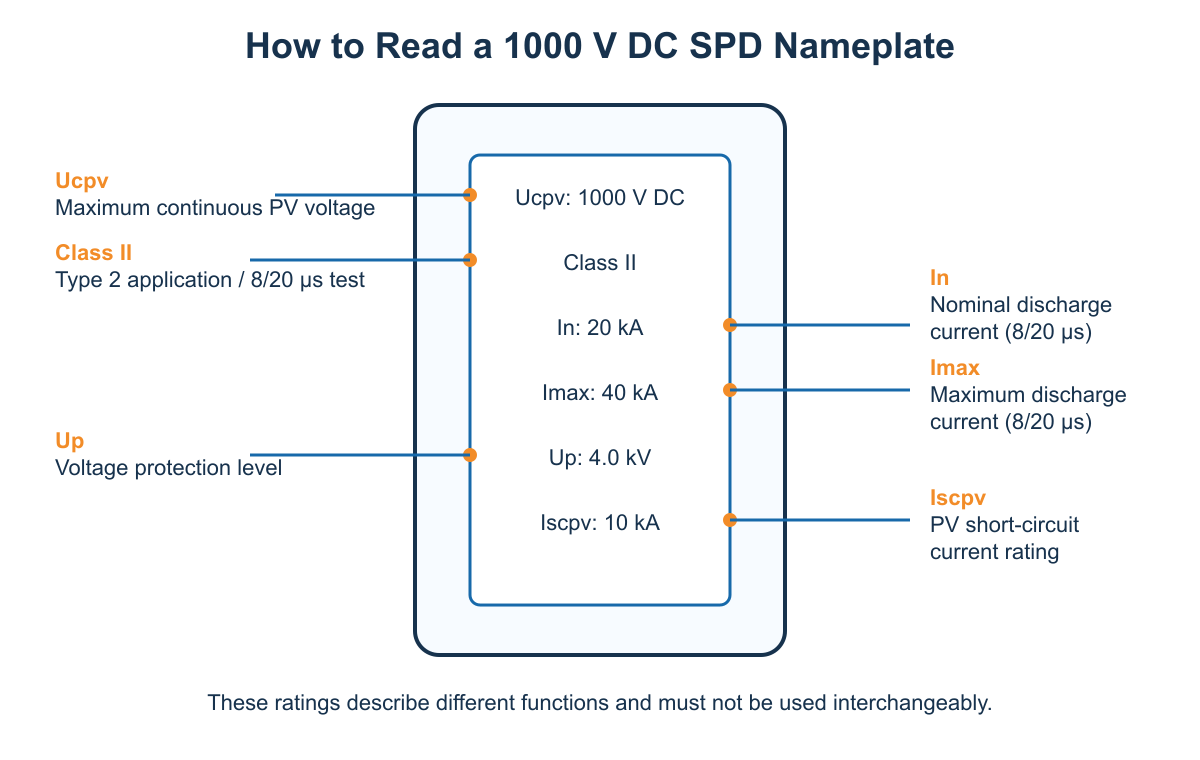
Ucpv is the maximum continuous operating voltage for a photovoltaic SPD. It is the highest DC voltage that may be continuously applied to the SPD under the conditions declared by the manufacturer.
The selected Ucpv must not be lower than the maximum PV array open-circuit voltage after correction for the lowest expected temperature. Module Voc rises as temperature falls, so a system described as “1000 V DC” cannot automatically use a 1000 V Ucpv SPD without checking the cold-weather maximum voltage.
This marking indicates Class II testing and normally a Type 2 application. It primarily addresses induced and switching surges represented by the 8/20 μs waveform. It does not describe product quality or short-circuit capacity.
In is the nominal discharge current, normally specified with an 8/20 μs waveform for a Type 2 SPD. It is used in the standard test sequence and is an important indicator of repeatable surge-current capability under the stated test conditions.
Imax is the maximum discharge current, also normally associated with the 8/20 μs waveform. It is a higher, limiting discharge value and must not be interpreted as a current that the SPD can repeatedly carry.
In and Imax must also not be directly compared with Iimp unless the associated waveforms are considered. A 10/350 μs lightning-current impulse contains substantially more energy than an 8/20 μs impulse with the same peak value.
Up is the voltage protection level. It indicates the level to which the SPD limits voltage under the specified test conditions. Up should be coordinated with the impulse withstand voltage of the protected equipment.
A lower Up can improve the protection margin, but Up cannot be evaluated alone. Ucpv must remain high enough for the PV system, and installation conductor length must be minimised because conductor inductance adds voltage during a surge.
Iscpv is the PV short-circuit current rating of the SPD. It is not a surge-discharge rating. It describes the prospective PV short-circuit current for which the SPD and its disconnection arrangement are suitable under the manufacturer’s declared conditions.
This value is particularly important in DC PV systems because a failed SPD must disconnect safely without sustaining a dangerous DC arc.
This normally describes the permitted relative humidity range. The full data sheet should be checked for conditions such as non-condensing operation, corrosion, icing and altitude.
This is the declared temperature range. For equipment installed inside outdoor combiner boxes or enclosures, the internal cabinet temperature may be significantly higher than the ambient weather temperature.
IP20 provides basic protection against finger access and certain solid objects, but the second digit “0” means that no water-ingress protection is declared. An IP20 SPD must not be exposed directly to rain. Outdoor PV applications require a suitable enclosure selected for the environmental conditions.
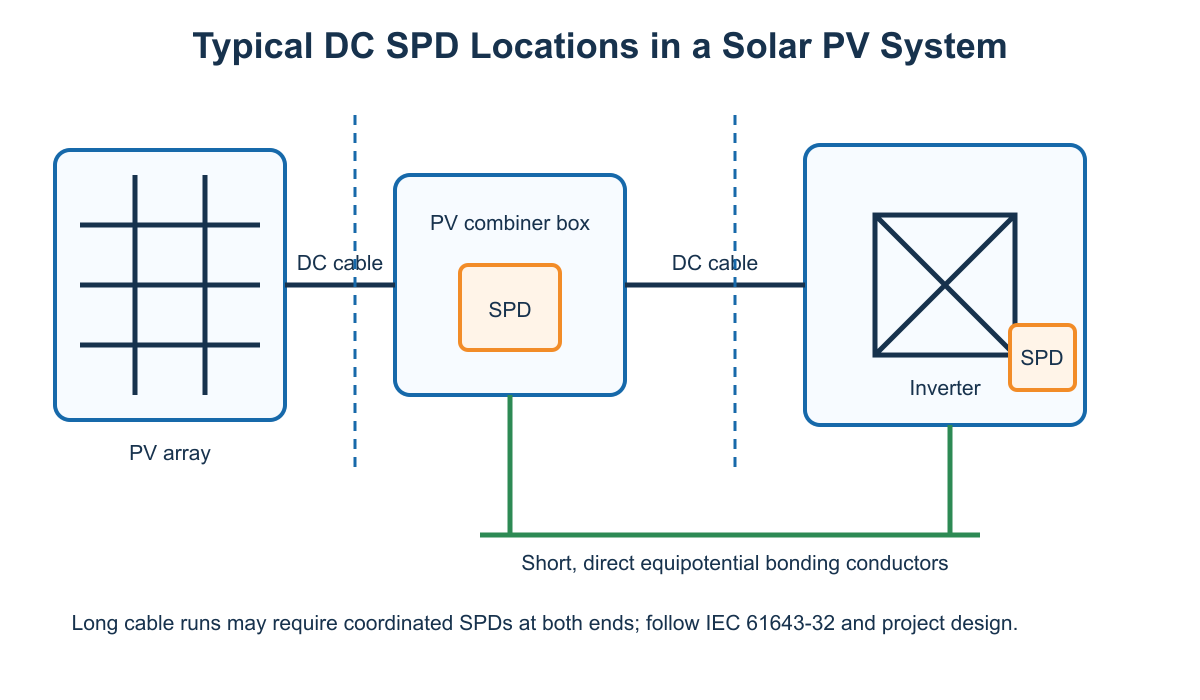
DC SPDs are commonly installed in PV combiner boxes and near inverter DC inputs. The appropriate number and location depend on the system layout, cable routing, lightning protection concept, earthing arrangement and equipment withstand levels.
Where DC cables are long, coordinated SPDs may be needed at both ends. Final placement and coordination should follow the applicable installation design and IEC 61643-32 rather than a universal one-device rule.
The final selection must always consider Ucpv, Iimp where applicable, In, Imax, Up, Iscpv, protection mode, earthing system, backup protection and certification—not only the largest kA number on the label.
A correct DC SPD selection is a coordinated engineering decision. The SPD must have a suitable continuous operating voltage, the correct test class, sufficient discharge capability, an appropriate voltage protection level and adequate PV short-circuit safety.
For the example nameplate, Class II indicates a Type 2 application; In 20 kA and Imax 40 kA describe 8/20 μs surge-current performance; Up 4.0 kV is the voltage protection level; and Iscpv 10 kA is the PV short-circuit current rating. None of these values can replace another.
Need help selecting a DC SPD for your PV system? Send KUANGYA your maximum system voltage, module string configuration, minimum site temperature, installation position, earthing arrangement and lightning-protection conditions. We can recommend a suitable Type 1, Type 2 or Type 1+2 model for the application.
Class I (Type 1) DC SPDs are tested with a 10/350 μs lightning-current impulse and are intended for installations where partial lightning current may enter the PV system. Class II (Type 2) DC SPDs are tested with an 8/20 μs waveform and mainly protect against induced lightning and switching surges.
A Type 2 SPD is not automatically suitable for direct-lightning-current duty. Where lightning current can enter the installation, use a properly tested Type 1 or Type 1+2 SPD as required by the lightning protection and risk assessment.
Choose a Ucpv rating that is not lower than the PV array maximum open-circuit voltage after correcting module Voc for the lowest expected site temperature. Also verify the inverter voltage limit and the manufacturer’s installation requirements.
Typical locations include PV combiner boxes and inverter DC inputs. Long cable routes or lightning protection zone boundaries may require coordinated SPDs at more than one location.

