WengYang Industrial Zone Yueqing Wenzhou 325000
Work Hours
Monday to Friday: 7AM - 7PM
Weekend: 10AM - 5PM
WengYang Industrial Zone Yueqing Wenzhou 325000
Work Hours
Monday to Friday: 7AM - 7PM
Weekend: 10AM - 5PM

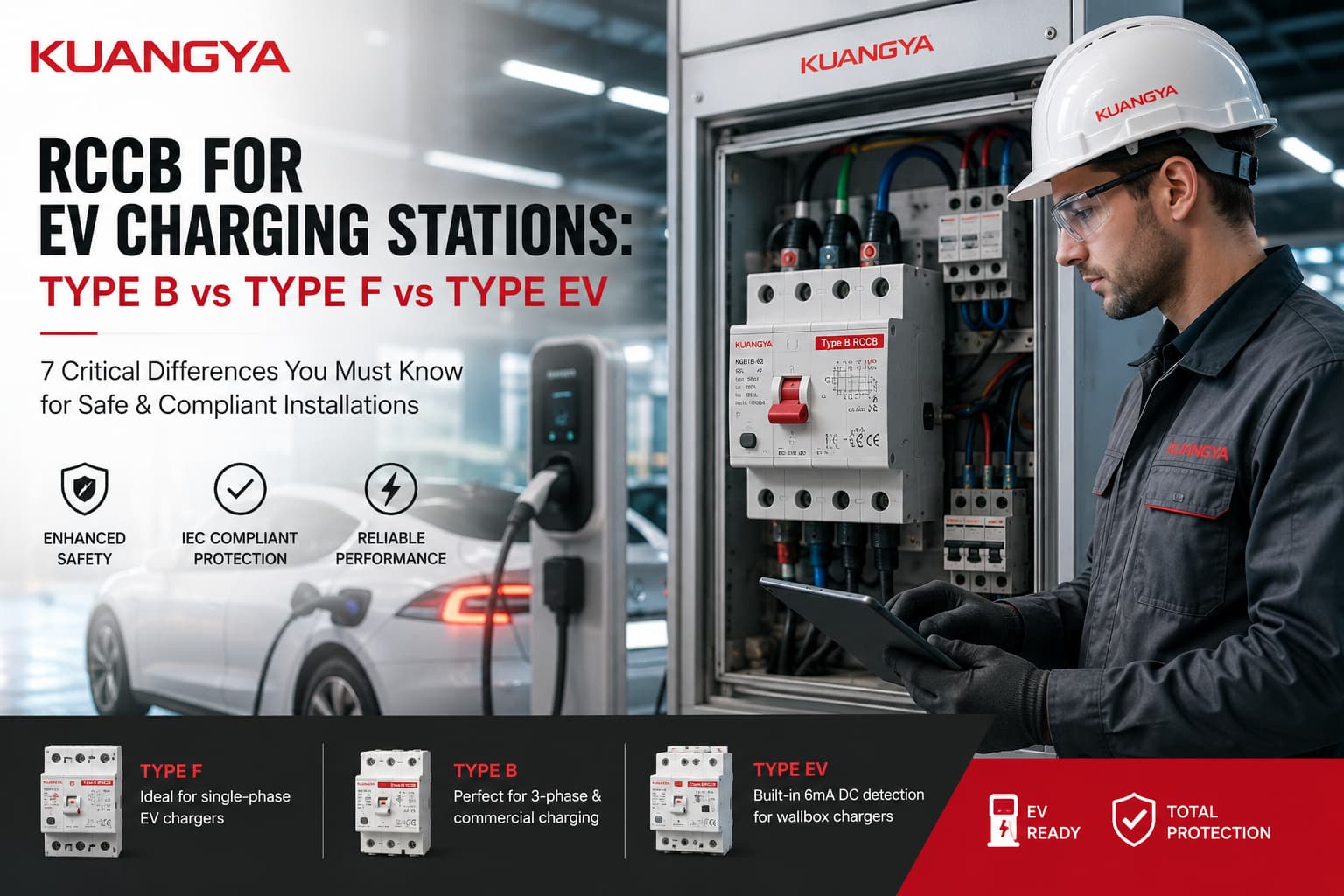
RCCB for EV Charging Stations: Type B vs Type F vs Type EV is becoming one of the most critical topics in modern EV charging safety. Choosing the correct RCCB ensures reliable protection, prevents DC leakage risks, and complies with IEC standards.
As electric vehicles continue to dominate the global transportation market, EV charging infrastructure is expanding rapidly across residential, commercial, and public sectors. However, one critical safety challenge is often overlooked during charger installation: proper residual current protection.
Choosing the wrong RCCB for an EV charging station can lead to nuisance tripping, undetected DC leakage currents, equipment damage, fire hazards, or even electric shock risks.
This is why understanding the differences between Type B RCCB, Type F RCCB, and Type EV RCCB has become essential for electrical engineers, installers, EV charger manufacturers, and project contractors.
In this guide, we will explain:
Whether you are designing a home EV charging system or a large commercial charging station, this article will help you choose the correct RCCB protection solution.
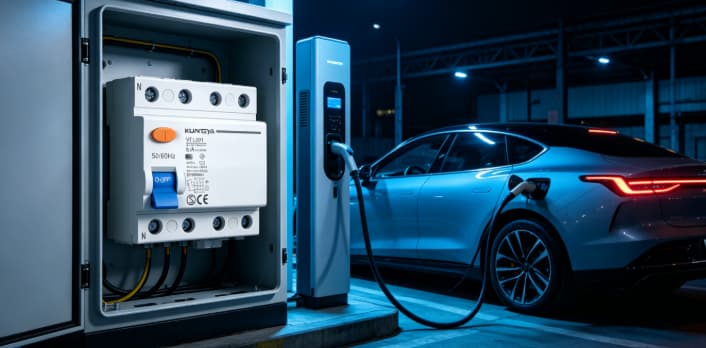
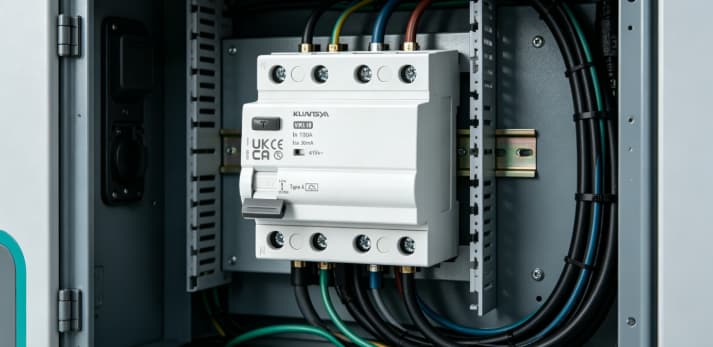
RCCB for EV Charging Stations: Type B vs Type F vs Type EV has become essential because modern EV chargers generate complex DC leakage currents that ordinary RCCBs may fail to detect.
Modern RCCB for EV Charging Stations solutions must handle AC leakage, pulsating DC currents, and complex inverter-generated fault currents.
An RCCB (Residual Current Circuit Breaker) is a protective device designed to disconnect electrical circuits when leakage current is detected.
In EV charging applications, RCCBs are essential because charging systems involve:
Unlike traditional household appliances, EV chargers generate complex residual currents that standard RCCBs may not properly detect.
The primary purpose of an RCCB in EV charging stations is to:
Without proper RCCB protection, EV charging systems may become dangerous under insulation failure or DC leakage conditions.
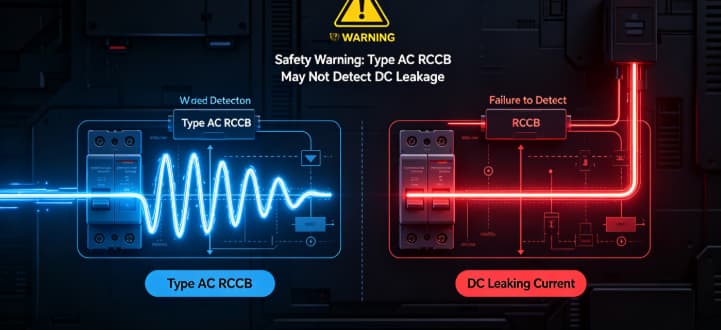
Traditional Type AC RCCBs are designed only for pure sinusoidal AC leakage currents.
However, modern EV chargers contain:
These electronic systems may generate:
When DC leakage exceeds 6mA, ordinary Type AC or even some Type A RCCBs may become “blinded,” meaning they can no longer detect dangerous leakage currents.
This creates serious safety risks.
Because of this, international standards increasingly prohibit using Type AC RCCBs alone for EV charging stations.
The most common RCCB types used for EV charging systems include:
| RCCB Type | Detects AC Leakage | Detects Pulsating DC | Detects Smooth DC | Suitable for EV Charging |
|---|---|---|---|---|
| Type AC | Yes | No | No | No |
| Type A | Yes | Yes | Limited | Partial |
| Type F | Yes | Yes | Limited | Some Single-Phase EV Chargers |
| Type B | Yes | Yes | Yes | Best Universal Solution |
| Type EV | Yes | Yes | 6mA DC Monitoring | Optimized EV Charging Solution |
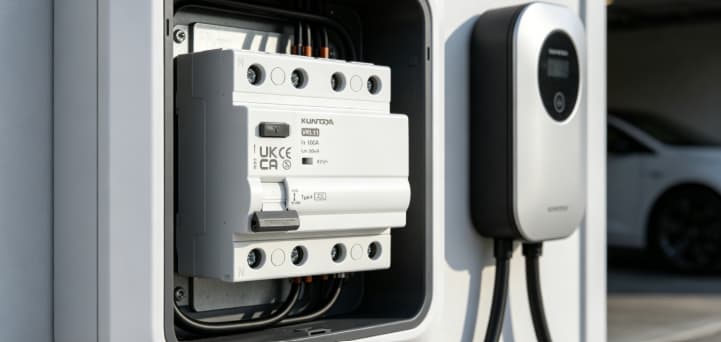
RCCB for EV Charging Stations: Type B vs Type F vs Type EV is an important comparison when selecting protection devices for residential and commercial EV charging systems.
Type F RCCBs are specially designed for circuits containing:
They can detect:
Compared with Type A RCCBs, Type F provides improved immunity against nuisance tripping.
Type F RCCBs are commonly used in:
They are particularly suitable when:
Type F RCCBs can handle higher frequency leakage currents generated by modern EV chargers.
They provide improved resistance against transient currents and electrical noise.
Type F RCCBs are usually less expensive than Type B solutions.
Despite their advantages, Type F RCCBs cannot detect smooth DC leakage currents above certain levels.
This means they are not suitable for:
Many installers now compare RCCB for EV Charging Stations: Type B vs Type F vs Type EV to balance safety, compliance, and installation cost.
Many engineers consider Type B the safest RCCB for EV Charging Stations because it can detect smooth DC leakage currents reliably.
Type B RCCBs are the highest-level residual current protection devices for modern power electronics.
They can detect:
Type B RCCBs are specifically designed for:
Many EV charging systems may generate smooth DC leakage currents exceeding 6mA.
Only Type B RCCBs can reliably detect these dangerous leakage currents.
Because of this, Type B RCCBs are widely recommended by:
Type B RCCBs can detect smooth DC residual currents that other RCCB types may miss.
They provide the highest level of protection for:
Type B RCCBs are compatible with:
As EV charger technology evolves, Type B RCCBs remain compatible with advanced charging architectures.
Type B RCCBs are significantly more expensive than Type A or Type F devices.
They often require larger distribution panel space.
Correct wiring and coordination with SPD and MCB systems are essential.
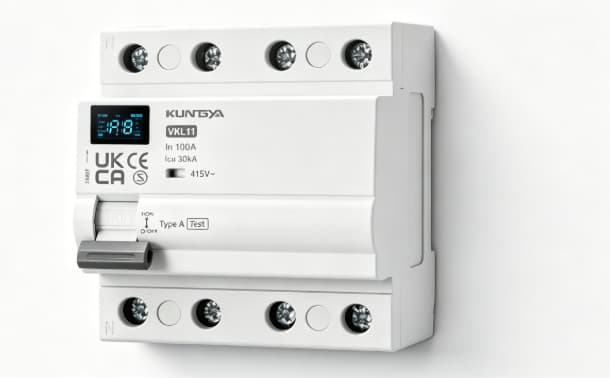
Type EV RCCBs are specially designed for EV charging applications.
They usually combine:
This design allows the device to disconnect the circuit before dangerous DC leakage can blind upstream RCCBs.
Instead of using a full Type B RCCB, many modern EV chargers use:
This combined solution is commonly referred to as “Type EV.”
The system continuously monitors DC leakage currents.
If DC leakage exceeds 6mA:
Type EV solutions are usually more economical.
Ideal for home EV wallboxes.
Smaller than traditional Type B RCCBs.
Widely accepted for modern EV charger protection.
Type EV solutions are not always suitable for:
In many commercial installations, Type B RCCBs are still mandatory.
When comparing RCCB for EV Charging Stations: Type B vs Type F vs Type EV, engineers should consider the type of charger, single-phase or three-phase supply, DC leakage detection, and commercial vs residential application.
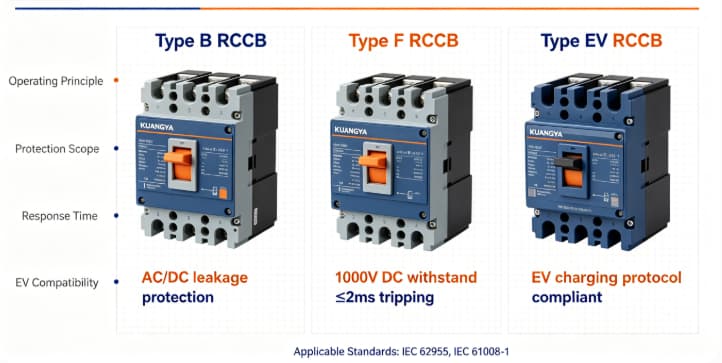
Understanding RCCB for EV Charging Stations: Type B vs Type F vs Type EV helps installers and engineers select the safest protection solution for different charging systems.
| Feature | Type F RCCB | Type B RCCB | Type EV RCCB |
|---|---|---|---|
| AC Leakage Detection | Yes | Yes | Yes |
| Pulsating DC Detection | Yes | Yes | Yes |
| Smooth DC Detection | Limited | Full | 6mA Monitoring |
| High Frequency Detection | Partial | Excellent | Good |
| EV Charging Compatibility | Medium | Excellent | Excellent |
| Residential EV Chargers | Good | Excellent | Excellent |
| Commercial Charging Stations | Limited | Best | Medium |
| DC Fast Charging | No | Yes | Limited |
| Cost | Medium | High | Medium |
| IEC Compliance | Conditional | Full | Full |
| Recommended For | Home Chargers | Universal EV Systems | Smart Wallboxes |
International regulations increasingly reference RCCB for EV Charging Stations: Type B vs Type F vs Type EV when defining safe EV charger protection requirements.
Several international standards regulate RCCB usage in EV charging systems.
This standard defines EV conductive charging system safety requirements.
Specifically addresses RDC-DD protection devices for EV charging.
Covers RCCB technical requirements and Type B classifications.
Different countries may impose additional requirements:
Always verify local regulations before installation.
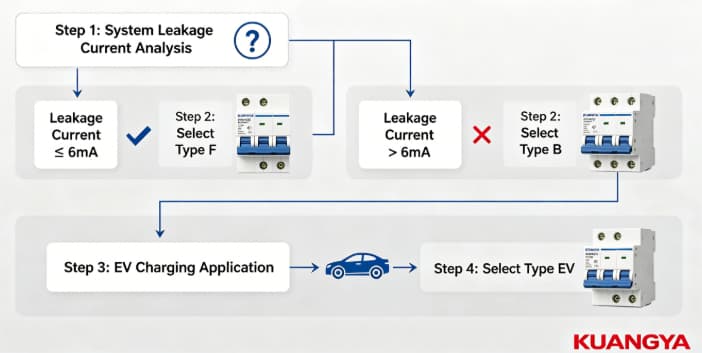
Choosing the right RCCB depends on several factors.
Usually compatible with:
Recommended:
Mandatory:
Higher power chargers produce more complex leakage currents.
Large charging stations generally require Type B protection.
Single-phase systems may use Type F or Type EV.
Three-phase commercial systems typically require Type B.
Some EV chargers already contain 6mA RDC-DD modules.
In this case:
Always check manufacturer specifications.
Incorrect understanding of RCCB for EV Charging Stations: Type B vs Type F vs Type EV may lead to improper protection device selection and serious electrical hazards.
This is one of the most dangerous installation mistakes.
Many installers overlook 6mA DC detection rules.
Improper neutral connections may cause nuisance tripping.
EV charging stations should coordinate:
for full protection.
A typical EV charging protection system includes:
| Protection Device | Function |
|---|---|
| MCB | Overcurrent Protection |
| RCCB | Leakage Protection |
| SPD | Surge Protection |
| Isolator | Maintenance Safety |
| RDC-DD | DC Leakage Monitoring |
For modern EV infrastructure, combining all these protection layers is essential.
As EV infrastructure expands globally, RCCB for EV Charging Stations: Type B vs Type F vs Type EV will remain a major focus for electrical safety and IEC compliance.
As EV technology advances, RCCB technology is also evolving.
Future developments include:
The rapid growth of ultra-fast charging systems will further increase demand for advanced Type B protection solutions.
Only if the charger includes integrated 6mA DC leakage detection.
Otherwise, Type B protection is recommended.
Not always.
Many residential chargers use Type EV or Type A + RDC-DD solutions.
However, commercial and DC charging stations often require Type B.
Type B detects full smooth DC leakage currents directly.
Type EV combines Type A RCCB with integrated 6mA DC monitoring.
They contain advanced sensing electronics capable of detecting multiple residual current waveforms.
Only in limited residential applications where integrated DC detection already exists.
It is not suitable for universal EV charging protection.
RCCB for EV Charging Stations: Type B vs Type F vs Type EV remains one of the most searched topics in modern EV electrical protection and charging safety design.
Selecting the correct RCCB for EV charging stations is critical for electrical safety, regulatory compliance, and long-term system reliability.
While Type F RCCBs may work for some residential single-phase chargers, they cannot provide universal protection.
Type EV RCCBs offer a cost-effective solution for modern wallbox chargers with integrated DC monitoring.
However, Type B RCCBs remain the safest and most comprehensive protection solution for commercial EV charging infrastructure, DC fast chargers, and advanced power electronic systems.
As EV charging networks continue to expand globally, proper residual current protection will become even more important.
Choosing between RCCB for EV Charging Stations: Type B vs Type F vs Type EV depends on charger technology, leakage current characteristics, and installation requirements.
Investing in the correct RCCB today ensures safer charging systems, lower maintenance risks, and compliance with future electrical standards.
Kuangya provides professional circuit protection solutions for:
Our products include:
Contact our technical team today to find the best protection solution for your EV charging projects.
Learn more about our RCCB for EV Charging Stations: Type B vs Type F vs Type EV solutions at KUANGYA for safer and more reliable EV charger protection.

