WengYang Industrial Zone Yueqing Wenzhou 325000
Work Hours
Monday to Friday: 7AM - 7PM
Weekend: 10AM - 5PM
WengYang Industrial Zone Yueqing Wenzhou 325000
Work Hours
Monday to Friday: 7AM - 7PM
Weekend: 10AM - 5PM

NPN vs PNP refers to two types of bipolar junction transistors used in electronics and industrial automation. The main difference is that NPN transistors turn ON with a positive base signal, while PNP transistors turn ON when the base voltage is lower than the emitter voltage.
NPN vs PNP is one of the most searched topics in electronics and industrial automation. Whether you are working with PLC systems, sensors, Arduino projects, or switching circuits, understanding the difference between NPN and PNP transistors is essential.
Both transistor types are widely used in modern electronics, but their operation is based on bipolar junction transistor theory , especially in how charge carriers move inside semiconductor materials.
In this guide, we will explain:
A transistor is a semiconductor device used to amplify or switch electronic signals. It usually has three terminals: emitter, base, and collector.
Transistors are one of the most important components in modern electronics and industrial automation systems. Their working principle is explained in semiconductor device theory.
The two most common bipolar junction transistors (BJTs) are:
Understanding NPN vs PNP is fundamental for electronics and industrial automation.
An NPN transistor turns ON when a small positive current is applied to the base relative to the emitter.
In the NPN vs PNP comparison, NPN transistors are more commonly used in electronic switching circuits and microcontroller systems.
NPN transistors are widely used in modern control systems because they are faster and easier to integrate with digital electronics.
A PNP transistor turns ON when the base voltage becomes lower than the emitter voltage.
PNP behavior is commonly used in high-side switching systems found in industrial automation.
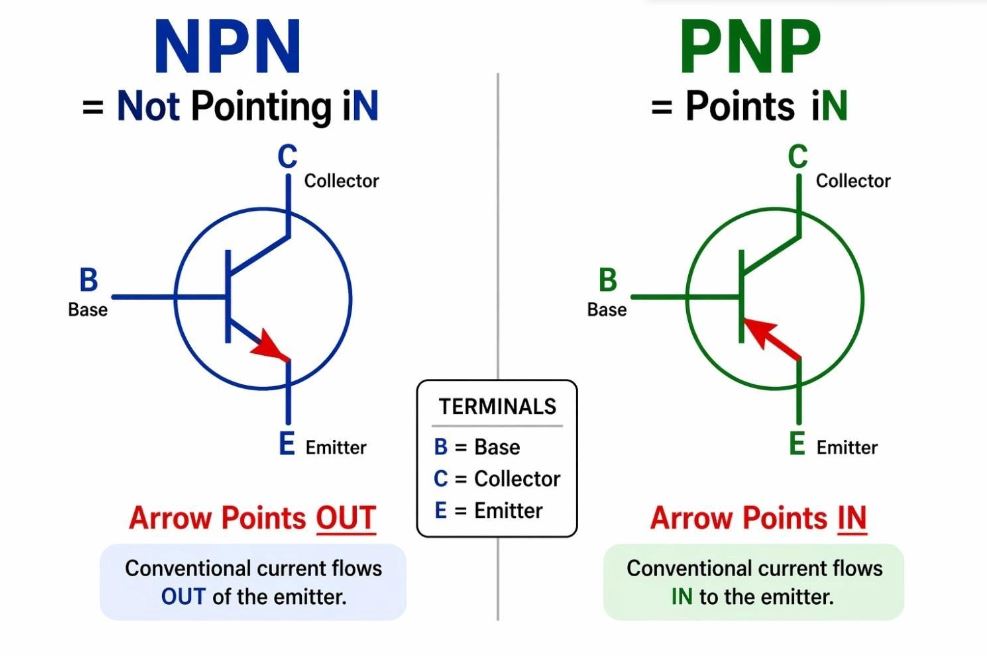
| Feature | NPN | PNP |
|---|---|---|
| Current Flow | Collector → Emitter | Emitter → Collector |
| Trigger Signal | Positive base voltage | Lower base voltage |
| Switching Type | Low-side switching | High-side switching |
| Speed | Faster | Slightly slower |
| Usage | Digital & microcontroller circuits | Industrial control systems |
Understanding NPN vs PNP is essential in industrial circuit design and automation systems.
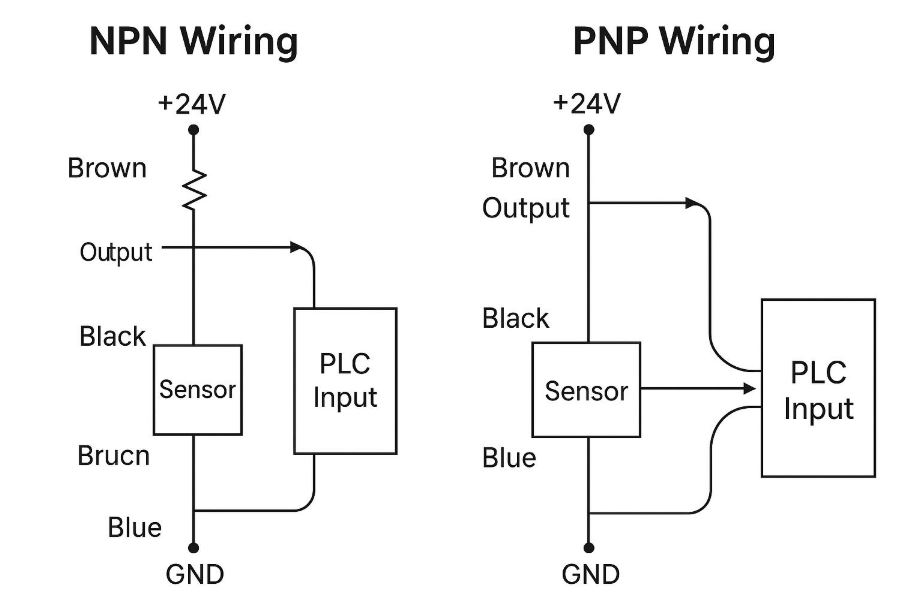
The wiring difference is critical in industrial automation systems.
In PLC systems, NPN vs PNP determines how input signals are processed.
This is a key concept in industrial automation systems and PLC architecture design.
PNP systems are often preferred because troubleshooting with multimeters is easier and safer in industrial environments.
In the NPN vs PNP comparison, NPN is more widely used because:
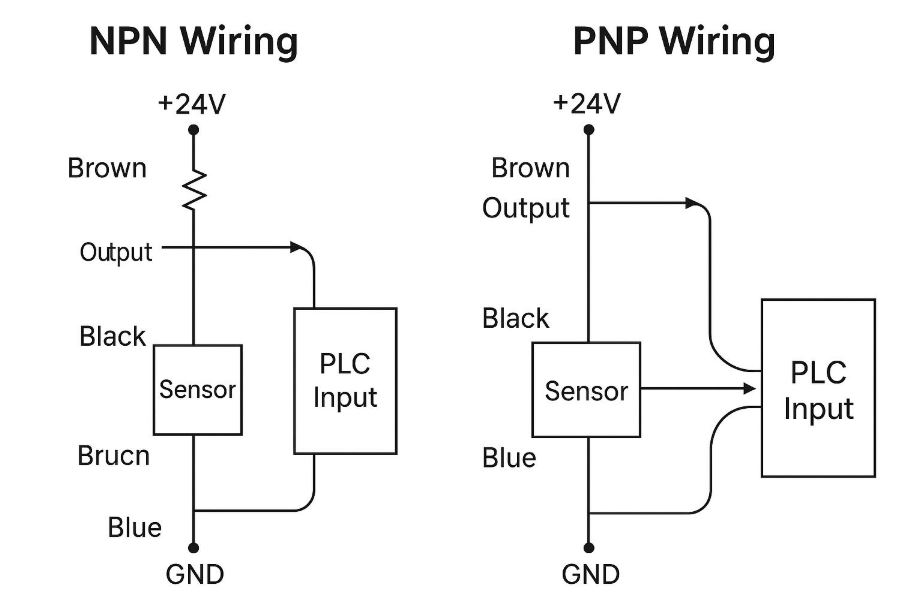
Industrial sensors also follow NPN vs PNP logic:
Incorrect selection may cause PLC signal failure or system malfunction.
Although MOSFETs are widely used today, NPN and PNP transistors are still important because they are:
They are still widely used in education, industrial electronics, analog circuits, and automation systems.
NPN vs PNP is a fundamental concept in electronics and industrial automation. Both transistor types are essential depending on circuit design and application.
To summarize:
Choosing between NPN vs PNP depends on your system design and application requirements.
The difference is current direction and triggering polarity.
NPN is generally faster due to electron mobility.
Because it determines whether sensors use sinking or sourcing logic.
No, they require different polarity and circuit design.
PNP is more common in modern industrial automation systems.
Yes, they are still widely used in electronics, automation, and control systems.
For more information, please contact KUANGYA.

We are a professional manufacturer of electrical products for solar and industrial applications, including MCB, SPD, RCD, and related accessories. With rich export experience, we provide reliable solutions and OEM/ODM services for global clients.
+86-577-61885000
+86 13676769183
info@cnkuangya.com
export@cnkuangya.com
WengYang Industrial Zone, Yueqing, Wenzhou 325000, China

