WengYang Industrial Zone Yueqing Wenzhou 325000
Work Hours
Monday to Friday: 7AM - 7PM
Weekend: 10AM - 5PM
WengYang Industrial Zone Yueqing Wenzhou 325000
Work Hours
Monday to Friday: 7AM - 7PM
Weekend: 10AM - 5PM

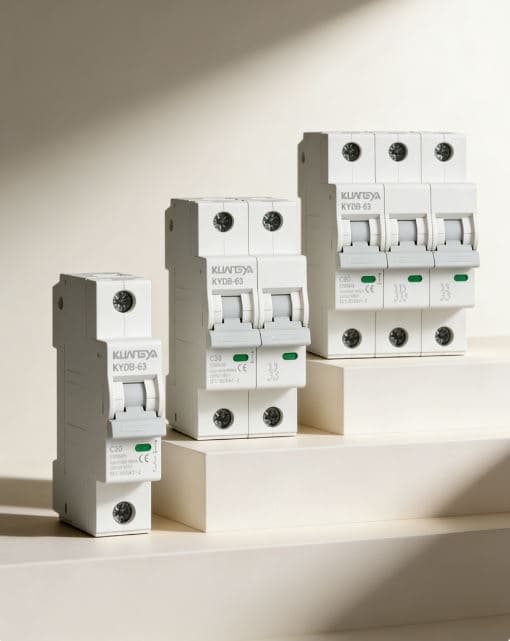
The electrical landscape is undergoing a radical transformation. The proliferation of non-linear loads such as Electric Vehicle (EV) charging stations, solar photovoltaic (PV) arrays, and Variable Frequency Drives (VFDs) in industrial settings has introduced new and complex challenges for electrical safety. These modern technologies, essential for energy efficiency and sustainability, can generate fault currents that legacy protective devices were never designed to handle.
This creates a critical protection gap. Standard Type AC and Type A Residual Current Devices (RCDs), which have been the bedrock of electrical safety for decades, are fundamentally blind to smooth DC residual currents. In the presence of such faults, these devices can become desensitized or “blinded,” failing to trip not only for the DC fault but also for the very AC faults they are meant to detect. This failure leaves personnel, equipment, and entire installations dangerously exposed.
The definitive solution to this modern problem is the Type B RCBO (Residual Current Circuit Breaker with Overcurrent Protection). As the highest standard in residual current protection, it is specifically engineered to detect the full spectrum of fault currents, from simple sinusoidal AC to pulsating DC and, most importantly, smooth DC. This article serves as a definitive technical guide for engineers, contractors, and procurement managers. It will cover the core technology, critical applications, and essential criteria needed to intelligently buy Type B RCBO units for your demanding applications.
To fully appreciate the superiority of Type B protection, it’s essential to understand its place in the hierarchy of residual current devices and the unique technology that sets it apart.
First, a brief recap: an RCBO is a single, compact device that combines the functions of two separate components:
By integrating both functions, an RCBO provides comprehensive protection for a single circuit, simplifying panel design and improving fault isolation. The “Type” designation (AC, A, F, B) refers specifically to the RCD portion’s ability to detect different types of leakage current waveforms.
The evolution of RCD types reflects the growing complexity of electrical loads over time.
However, none of these types are equipped to handle the smooth DC leakage currents that are a distinct possibility in three-phase power conversion systems and DC-generating applications. This is the exclusive domain of Type B.
A Type B RCBO provides all the protective capabilities of a Type F device and adds one critical feature: the guaranteed detection of smooth DC residual currents.
The limitation of Type AC, A, and F devices lies in their reliance on a core-balance current transformer. This passive magnetic component works by detecting an imbalance in the magnetic fields generated by the live and neutral conductors. It is highly effective for AC and pulsating DC currents but is physically incapable of detecting pure, smooth DC, which creates a static magnetic field. Worse, a significant DC fault current can saturate the magnetic core, rendering the device unable to detect a subsequent AC fault.
Type B RCBOs overcome this with a sophisticated dual-sensing mechanism. They retain the traditional core-balance transformer to detect AC and pulsating DC faults but add a second, active detection circuit specifically for smooth DC. This is typically achieved using a highly sensitive flux-gate sensor or a dedicated electronic circuit that continuously monitors for the presence of DC.
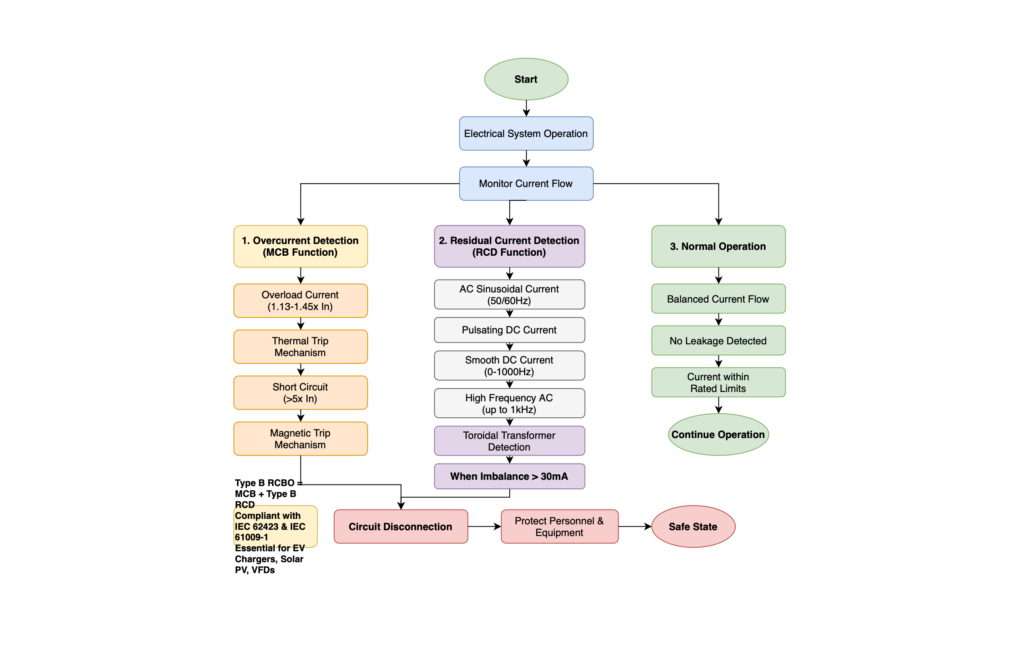
This diagram illustrates the comprehensive detection capability of a Type B device across different waveforms—sinusoidal AC, pulsating DC, and smooth DC—ensuring it will trip reliably regardless of the fault type.
The performance and tripping characteristics of Type B devices are rigorously defined by international standards to ensure safety and interoperability. The two most important standards are:
Choosing a device certified to these standards is your guarantee of performance, safety, and regulatory compliance.
While Type A RCBOs are sufficient for many general-purpose circuits, a growing number of applications legally and technically mandate the use of Type B protection. In these scenarios, using a lower-grade device is not a cost-saving measure but a serious safety and compliance violation.
EV chargers are one of the primary drivers for the adoption of Type B protection. A Mode 3 EV charging station contains a sophisticated AC/DC converter that can, under certain fault conditions within the vehicle’s electronics, produce a smooth DC leakage current back onto the AC supply cable. The international standard for EV charging installations, IEC 61851-1, explicitly requires that each charging point is protected against DC fault currents. This can be achieved either by using a Type B RCBO 30mA or by using a Type A RCBO in conjunction with a separate 6mA DC detection device (RDC-DD). Using an all-in-one Type B RCBO provides a more robust, integrated, and reliable solution.
Solar power systems, particularly those using transformerless (or non-isolated) inverters, are another critical application. These inverters are directly coupled to the AC grid. In the event of an insulation failure on the DC side (the solar panels), it’s possible for DC fault current to “leak” through the inverter and onto the AC installation. This DC component can blind any upstream Type A or AC RCDs, creating a hidden danger across the entire property. Therefore, regulations and inverter manufacturer instructions almost universally require Type B protection on the AC output of the inverter to ensure safety and prevent the entire system’s protection from being compromised.
In industrial environments, three-phase Variable Frequency Drives are ubiquitous for controlling the speed and torque of AC motors in applications like conveyors, pumps, fans, and machine tools. VFDs work by rectifying the incoming three-phase AC to a DC link and then inverting it back to a variable frequency AC output. This internal architecture makes them a primary source of potential smooth DC residual currents, especially in regenerative braking scenarios or during an earth fault on the motor circuit. Protecting VFD circuits with Type B RCBOs is essential to guarantee disconnection under fault conditions and prevent the blinding of other RCDs in the industrial plant.
Beyond the “big three,” Type B protection is also crucial for a range of other specialized equipment, including:
Transitioning from theory to practice, selecting the correct Type B RCBO requires a methodical approach based on circuit parameters and application needs. Making the right choice is critical for ensuring both safety and operational reliability.
When specifying a Type B RCBO, you must consider the following four parameters:
It is important to address the cost factor directly. A Type B RCBO is a premium safety component, and its price is higher than that of a standard Type A device. This price difference reflects the advanced electronics, dual-sensing technology, and rigorous testing required to meet the IEC 62423 standard. An illustrative price for a 2-Pole, 32A/30mA Type B RCBO might be in the $150-$250 range, while a 4-Pole industrial equivalent could be $400-$600 or more.
However, framing this cost as a simple expense is shortsighted. The correct way to view the Type B RCBO price is as an investment in risk mitigation and a non-negotiable cost of compliance. The potential cost of not using a Type B RCBO in a mandated application includes catastrophic equipment damage, extended operational downtime, legal liability for non-compliance, and, most critically, the severe risk of fire or fatal electric shock. The return on investment is the guaranteed safety and resilience of your electrical installation.
For electrical contractors, installation companies, systems integrators, and distributors, securing a reliable supply of certified components is paramount. We understand the unique needs of our B2B partners and offer a dedicated program for RCBO Type B wholesale inquiries.
Partnering with cnkuangya.com for your wholesale needs provides several key advantages:
Contact our wholesale team today for a personalized quote and to discuss partnership opportunities.
This table provides a quick reference guide to some of our common Type B RCBO models and their typical applications. Use it to help identify the right product for your project.
| Model Number (Illustrative) | Poles | Rated Current (A) | Rated Sensitivity (mA) | Breaking Capacity (kA) | Applicable Standards | Common Applications | Illustrative Price Range |
|---|---|---|---|---|---|---|---|
| KYB-R-2P32-30 | 2P (1P+N) | 32A | 30mA | 10kA | IEC 61009-1, IEC 62423 | EV Charging Stations, Single-Phase Inverters | $150 – $250 |
| KYB-R-2P40-30 | 2P (1P+N) | 40A | 30mA | 10kA | IEC 61009-1, IEC 62423 | High-Power EV Chargers, Data Center PDU | $180 – $280 |
| KYB-R-4P40-30 | 4P (3P+N) | 40A | 30mA | 10kA | IEC 61009-1, IEC 62423 | Small VFDs, Three-Phase Machinery, Lifts | $380 – $580 |
| KYB-R-4P63-30 | 4P (3P+N) | 63A | 30mA | 10kA | IEC 61009-1, IEC 62423 | Large VFDs, Industrial Motor Control Centers | $450 – $650 |
| KYB-R-4P63-300 | 4P (3P+N) | 63A | 300mA | 10kA | IEC 61009-1, IEC 62423 | Upstream Distribution, Fire Protection | $400 – $600 |
The electrical world has evolved, and our approach to safety must evolve with it. The rise of DC-generating and power-converting technologies means that the protective devices of the past are no longer adequate for the challenges of today. The Type B RCBO is not merely an optional upgrade; it is an essential component for a growing list of critical applications where the risk of smooth DC residual current is real.
By providing comprehensive protection against all foreseeable fault current waveforms, the Type B RCBO stands as the gold standard in electrical safety. It ensures regulatory compliance, mitigates the risk of catastrophic equipment failure, and provides unparalleled protection for personnel. Investing in certified Type B protection is an investment in safety, reliability, and peace of mind.
Protect your investments and ensure personnel safety. Explore our full range of certified Type B RCBOs or contact our engineering team for a consultation on your specific application.
The fundamental difference lies in their detection capabilities. A Type A RCBO can detect sinusoidal AC residual currents and pulsating DC residual currents, making it suitable for most standard residential and commercial applications with single-phase electronic loads like computers, televisions, and household appliances.
A Type B RCBO, however, provides significantly broader protection. It detects everything a Type A device can, plus smooth DC residual currents up to the rated residual current (IΔn). This smooth DC detection is achieved through advanced dual-sensing technology—typically combining a traditional core-balance transformer with an active electronic circuit such as a flux-gate sensor. This makes Type B essential for applications involving three-phase power converters, VFDs, transformerless PV inverters, and EV charging stations, where smooth DC leakage can occur. Critically, Type B protection prevents the “blinding” effect where DC components can desensitize Type A devices, potentially causing them to fail to trip even for AC faults.
Type B protection is mandated by international standards and local electrical codes in several critical applications:
Electric Vehicle Charging: IEC 61851-1, the international standard for EV charging equipment, requires protection against DC fault currents for Mode 3 charging points. This can be achieved with a Type B RCBO or a Type A RCBO combined with a separate 6mA DC fault detection device (RDC-DD). Most installations opt for Type B as the more reliable, integrated solution.
Solar PV Systems: Installations using transformerless (non-isolated) inverters typically require Type B protection on the AC output circuit. This is often stipulated by the inverter manufacturer’s installation instructions and local electrical codes, as DC leakage from the DC side can compromise the entire installation’s protection.
Industrial Motor Control: Circuits supplying Variable Frequency Drives (VFDs) controlling three-phase motors generally require Type B protection, particularly in industrial and commercial settings where regulations mandate comprehensive fault protection.
Medical Facilities: Equipment such as MRI scanners, CT scanners, and X-ray machines often require Type B protection due to their complex power conversion systems.
Always consult the latest version of your local electrical code (such as NEC, IEC 60364, BS 7671, or equivalent) and the specific equipment manufacturer’s installation requirements to ensure full compliance.
The higher price of Type B RCBOs—typically 2-4 times that of comparable Type A devices—reflects the advanced technology required for smooth DC detection. This includes sophisticated electronic circuits, dual-sensing mechanisms, rigorous testing to IEC 62423 standards, and the use of precision components like flux-gate sensors or active DC monitoring circuits.
However, the cost must be viewed in context. In applications where Type B protection is mandated or technically necessary, the question is not whether it’s “worth it” but rather the cost of not using it. The potential consequences of inadequate protection include:
When viewed as an insurance policy against these risks, the Type B RCBO represents excellent value. For a typical commercial EV charging installation, a $200-250 Type B RCBO protects a $5,000-15,000 charging unit and eliminates liability exposure worth potentially millions. The return on investment is unquestionable.

